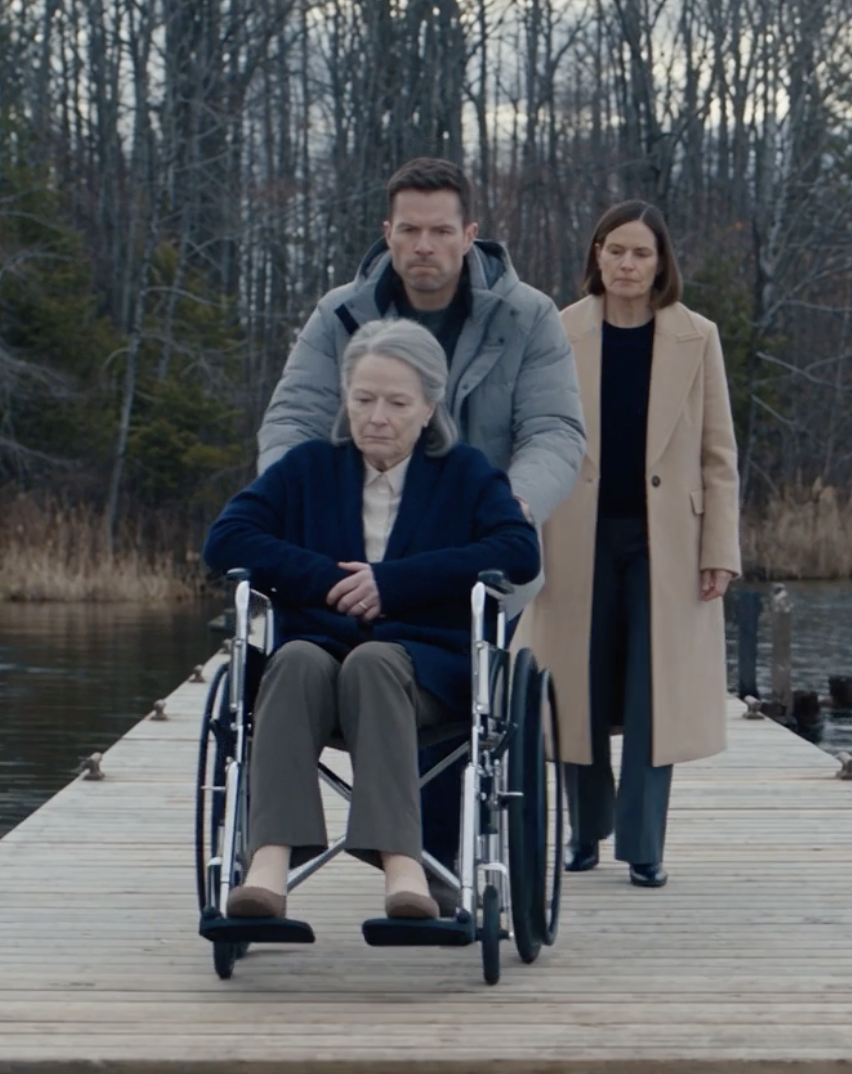
The first thing I did after my son pushed me into the lake was open my eyes.
Not scream.
Not pray.
Not panic.
I opened my eyes.
Above me, the winter sky trembled through six feet of dark water, pale and distorted like something remembered from another life. Bubbles streamed past my cheeks. My cardigan billowed around me. The wheelchair beneath my body pulled downward with relentless, mechanical certainty.
For eight months, Derek and Amanda had watched me sit almost motionless in that chair.
For eight months, they had spoken around me as if my mind were already gone.
For eight months, they had believed I was helpless.
And now, as freezing water crushed the air from my chest, I discovered exactly how much that lie had cost me.
My son’s last words still seemed to vibrate inside my skull.
“I’m sorry, Mom.”
Then Amanda’s voice from somewhere beyond the surface.
“She’s d.r.o.w.n.e.d.”
And finally—
“Now we have eleven million dollars.”
The lake dragged me deeper.
I curled my fingers around the wheelchair armrest.
One movement.
Small.
Controlled.
But it was the first movement Derek and Amanda had not expected.
My legs tightened.
The old instinct returned.
Twenty-five years before Derek was born, before marriage, mortgages, school lunches, widowhood, strokes, attorneys, and inheritance papers, I had belonged to water.
At nineteen, I had been the fastest 400-meter freestyle swimmer in my state.
At twenty-one, I had won a national masters title.
At twenty-six, I could stay underwater long enough to terrify lifeguards who didn’t know me.
Swimming had taught me something no one understood unless they had once pushed their body beyond the point where every nerve begged them to stop.
Panic was a thief.
It stole oxygen.
It stole judgment.
It stole seconds.
And underwater, seconds were everything.
So I counted.
One.
Two.
Three.
I forced myself not to fight the chair.
That would waste strength.
Instead, I reached down.
Months earlier, Amanda had insisted on buying me a padded wheelchair belt.
“For safety,” she had said.
I had smiled vaguely while she fastened it.
Later, when everyone was asleep, I had practiced opening the buckle one-handed.
Then with numb fingers.
Then without looking.
That practice saved my life.
My right thumb found the release.
The buckle clicked.
My coat caught beneath one armrest.
I twisted.
Fabric tore.
The wheelchair fell away from me.
For one instant, I floated in black water with nothing beneath my feet.
My chest screamed.
Every muscle had weakened during the months after my illness, and eight months of pretending weakness had not magically preserved the body I once possessed.
But my body remembered enough.
I kicked.
Once.
Twice.
Three times.
I did not swim toward the dock.
Derek and Amanda would be watching the surface there.
Instead, I angled beneath it.
Twenty yards east of the dock stood an old line of pilings from a boathouse demolished years ago. Beyond them grew reeds thick enough to hide a person from anyone standing at the end of the dock.
I knew because I had brought Derek there when he was nine.
He had spent an entire summer catching minnows between those pilings.
The memory nearly stopped me.
I saw him again—skinny knees, sunburned nose, plastic bucket in both hands.
“Mom! Look!”
Another kick.
The image disappeared.
The cold was getting into my bones.
I surfaced among the reeds without making a sound.
Air tore into my lungs.
I almost coughed.
Almost.
Instead, I pressed a fist to my mouth and listened.
The dock stood perhaps thirty yards away.
Amanda’s beige coat was easy to see through the reeds.
Derek stood beside her.
He was staring at the water.
Not moving.
Amanda grabbed his arm.
“We need to go.”
He didn’t answer.
“Derek.”
Still nothing.
Then he said something so quietly I almost missed it.
“We should wait.”
“For what?”
He stared toward the place where the wheelchair had disappeared.
“I don’t know.”
Amanda pulled harder.
“There’s nothing to wait for.”
That sentence gave me strength.
I sank lower behind the reeds.
Amanda turned toward the path.
Derek remained another second.
Then another.
For one impossible moment, I wondered if he knew.
If perhaps he had seen the bubbles moving sideways.
If perhaps, somehow, he understood that his mother had not gone where the chair had gone.
Then he turned away.
They disappeared into the trees.
I waited until the sound of their footsteps faded.
Only then did I begin to shake.
Not delicate trembling.
My entire body convulsed.
Cold.
Shock.
Grief.
I wrapped both arms around myself and pressed my forehead against a wet wooden piling.
My son had pushed me into a lake.
There are sentences the human heart rejects even when the mind knows they are true.
That was mine.
