Chapter 1 – The Kitchen Door
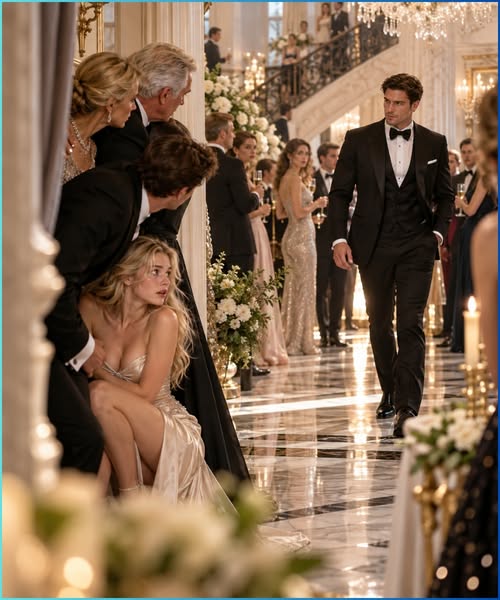
“And I’m what?” Madeline’s voice was barely louder than the hum of the central air conditioning, yet it seemed to vibrate against the gilded moldings of her childhood bedroom.
Evelyn Hartwell paused, her manicured fingers still resting on the diamond clasp of her bracelet. For a split second, an unfamiliar flicker crossed her face—guilt, perhaps, or merely the irritation of an architect whose carefully drawn floor plan had met an unexpected load-bearing wall.
“You are practical, Madeline,” her mother said smoothly, recovering her practiced social cadence. “You have always been the sensible one. Claire thrives under the lights. Mason is his father’s heir; the business community expects him at Grant’s right hand. You simply get overwhelmed by these functions. We are trying to spare you.”
“You’re trying to hide me,” Madeline said evenly. There were no tears in her eyes. She had cried her last tears over family photographs six years ago, on the rainy afternoon they buried Ruth. “You have always hidden me.”
“Don’t be melodramatic. It isn’t becoming.” Evelyn smoothed the front of her shimmering silver St. John gown, turning back toward the full-length mirror. “Just keep an eye on the back corridors until the receiving line disperses. Ensure the sommelier isn’t over-pouring the reserve Pinot Noir, and please make sure Mrs. Abernathy’s walker doesn’t end up blocking the terrace entrance again. It looks untidy.”
Without waiting for an answer, Evelyn turned and swept out of the room, leaving behind a faint trail of Chanel No. 5 and the heavy, suffocating silence of an old, familiar verdict: *You are useful, but you are not meant to be seen.*
Madeline stood alone before the mirror. The cream-colored dress hung straight down, elegant in its restraint, but undeniably modest. It was the dress of someone who wished to blend into wallpaper, someone who apologized for taking up oxygen.
She thought of the emerald-green dress hanging in the back of the closet—the silk slip dress Naomi had made her buy, the one with the sharp cowl neck and the open back that made her brown eyes burn like amber. *Not tonight,* she whispered to her reflection. *Tonight, just get through the evening. Two hundred families need rent checks on Monday. That is what matters.*
She smoothed her skirts, checked her watch—five forty-five—and descended the back staircase, completely unaware that forty feet away, the tectonic plates of her entire life were about to shift.
***
In the grand foyer of the Hartwell mansion, the air was thick with the scent of five thousand imported white gardenias and the low, self-satisfied rumble of Asheville’s elite.
Grant Hartwell stood beneath the Austrian crystal chandelier, the very picture of Appalachian aristocracy. At sixty-two, his silver hair was immaculate, his bespoke tuxedo tailored to conceal the slight thickening of his waistline. Beside him stood Mason, thirty-four, sharp-jawed and radiating the brash, unearned confidence of an only son who had never had a bank loan denied in his life. Claire stood to his left, resplendent in ruby satin, laughing with precisely the right amount of throat exposure at a joke made by State Senator Thomas.
“He’s thirty minutes late,” Mason muttered under his breath, barely moving his lips as he maintained his photogenic smile. “If Cole thinks his Silicon Valley logistics money lets him treat North Carolina heritage like a roadside diner, he’s mistaken.”
“Quiet, Mason,” Grant murmured, his tone firm. “Adrian Cole doesn’t just have software money. His private infrastructure fund holds seventy percent of the land access rights for the western rail corridor expansion. If we partner with him on the riverfront development, Hartwell Properties doubles its valuation overnight. You will smile, you will call him ‘Mr. Cole’ until he asks you not to, and you will let your sister do the charming.”
Claire gave a tiny, confident tilt of her head. “The director of the Whitmore Foundation told me yesterday that Adrian sits on their national selection board. I’ve memorized his entire corporate philanthropic portfolio. By dessert, he’ll be offering me the regional chair.”
The heavy mahogany front doors swung open.
The sound of the string quartet seemed to dip an octave. The room’s ambient hum died, like water receding before a tidal surge.
Adrian Cole entered unaccompanied.
He wore no tuxedo. He had arrived in a tailored charcoal suit of Italian wool, crisp white shirt unbuttoned at the throat, no tie. He was six-foot-two, broad-shouldered, with dark hair cut ruthlessly short and eyes the color of a winter sky over the Blue Ridge Mountains—cold, observant, and completely unimpressed. At forty-three, he carried none of the nervous energy typical of self-made billionaires. He walked like a man who owned the ground beneath his feet, not because he had bought it, but because he knew exactly what it was worth down to the bedrock.
