PART 1- THE SOUND BENEATH THE CHANDELIERS
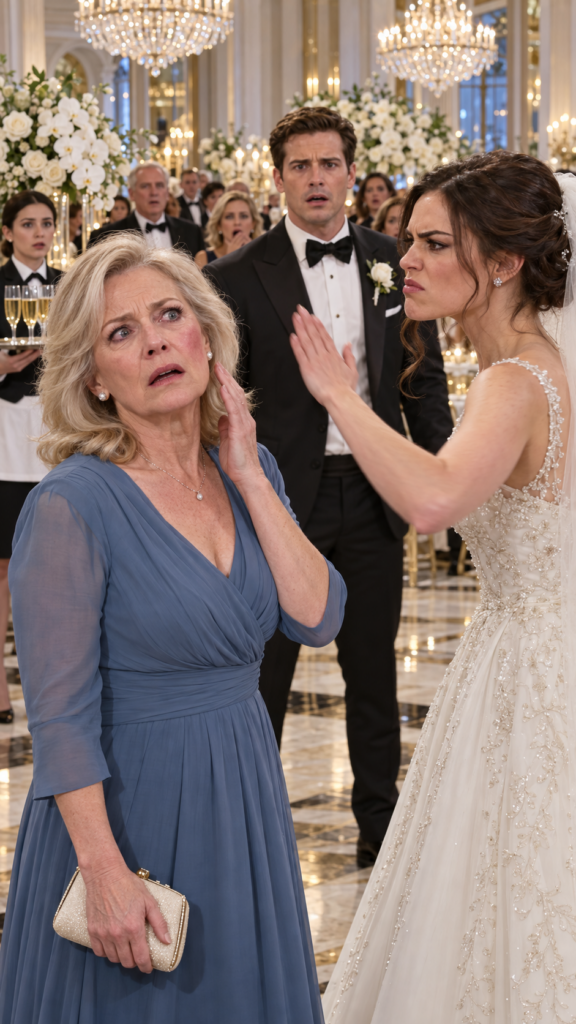
The slap cracked beneath the crystal chandeliers before I had time to understand that my new daughter-in-law had actually hit me in front of nearly two hundred and fifty wedding guests.
For one strange second, I didn’t feel pain.
I felt heat.
A bright, spreading heat across the left side of my face, followed by the sharp sting of humiliation.
The ballroom seemed to inhale all at once.
Music had stopped sometime before Tiffany’s hand struck me, but I hadn’t noticed until afterward. The silence was so complete that somewhere behind me, a champagne glass touched a table with a tiny crystal click.
That sound was almost worse.
It reminded me how many people were watching.
Tiffany stood directly in front of me in the wedding dress I had helped pay for.
Ivory silk. Hand-beaded bodice. Cathedral veil.
When she first tried it on six months earlier, she had stepped onto the little platform in the bridal boutique and turned toward me with tears in her eyes.
“It’s perfect,” she had whispered.
The price had been more than she and Daniel originally planned to spend on the entire wedding dinner.
I had paid the difference.
Now she was wearing that dress while staring at me as if I were something she wished someone would remove from the ballroom.
Her chest rose and fell quickly.
Her cheeks were flushed.
Her eyes were hard.
I was sixty-two years old.
Widowed.
Standing beneath imported flowers, professional lighting, and three enormous chandeliers in a private estate where more than forty-five thousand dollars of my money had helped create what everyone around us kept calling a dream wedding.
And my new daughter-in-law had just slapped me.
But that wasn’t the moment that hurt most.
The moment that hurt most came when I looked at my son.
Daniel stood only a few feet away in his tuxedo.
He stared at Tiffany.
Then at me.
Then back at Tiffany.
I waited.
There are moments when a mother does not need a speech from her son.
She needs one sentence.
One instinct.
One step in her direction.
I thought he would say, “What the hell are you doing?”
I thought he would move between us.
I thought he would ask if I was all right.
Instead, he whispered, “Mom.”
His voice sounded exhausted.
Not shocked.
Not angry.
Exhausted.
“Please,” he said. “Let’s not make this worse.”
That sentence hurt more than the slap.
Because Daniel had been saying some version of it for months.
Mom, please.
Can you let this go?
Don’t make this difficult.
She’s stressed.
It’s the wedding.
She only gets married once.
Please don’t argue tonight.
Please just do this for me.
I looked at him for several seconds.
I saw my little boy at eight years old, standing in the kitchen with a bloody knee after falling off his bicycle.
I saw him at fifteen, pretending not to cry after his first girlfriend broke up with him.
I saw him at twenty-three, hugging his father after college graduation.
I saw him at thirty-two, sitting across from me at my kitchen table and telling me he had met someone serious.
And then I saw the man in front of me.
A husband now.
A son still, at least in my heart.
A man who had just watched his wife strike his mother and whose first concern was keeping the wedding comfortable.
“Tiffany hit me,” I said.
My voice was quieter than I expected.
Daniel glanced toward the guests.
“I know.”
“You know?”
“Mom, please.”
There it was again.
That word.
Please.
A word that had become a lever.
Tiffany lifted her chin.
“She shouldn’t have interfered.”
A few people shifted behind us.
Someone whispered.
I could feel hundreds of eyes moving between the three of us.
I turned back to Tiffany.
“What exactly did I interfere with?”
“You embarrassed me.”
“I asked you not to speak to one of the servers that way.”
“You corrected me at my own wedding.”
“You were yelling at a nineteen-year-old girl because the champagne arrived five minutes late.”
“It was not your place.”
“She was crying.”
Tiffany gave a short, disbelieving laugh.
“So you decided to humiliate me?”
“No. I asked you to stop humiliating her.”
Her eyes sharpened.
“That is exactly what I mean. You always do this. You act like you’re better than everyone.”
The irony of that accusation was so clean and perfect that I almost laughed.
But there was nothing funny about the way Daniel remained frozen.
The argument had begun less than two minutes earlier.
The young server had nearly dropped a tray after Tiffany snapped her fingers at her and said, “Do I have to explain everything twice tonight?”
I had seen the girl’s face.
I had seen her fight tears.
So I stepped forward and quietly said, “Tiffany, that’s enough.”
I did not shout.
I did not insult her.
I did not make an announcement.
I simply told her to stop.
She turned toward me.
“What did you say?”
I should have recognized the warning.
Instead, I repeated myself.
“That’s enough.”
Then came the words.
Her telling me I needed to remember whose wedding it was.
Me reminding her that being a bride did not give her permission to treat people cruelly.
Her accusing me of trying to control everything.
Me saying I had spent months doing the opposite.
Then her hand moved.
Fast.
Open palm.
One sharp motion.
And now we stood beneath the chandeliers surrounded by the wedding I had spent nearly a year helping create.
The wedding hadn’t started as a forty-five-thousand-dollar spectacle.
When Daniel and Tiffany first announced their engagement, they talked about eighty guests.
A good restaurant.
Simple flowers.
Family.
Friends.
A warm celebration.
Daniel sat at my dining room table with Tiffany beside him, both of them smiling.
“We don’t want anything ridiculous,” he had said.
Tiffany nodded.
“Something intimate.”
I remember smiling at that word.
Intimate.
It sounded sensible.