I offered to help financially because I wanted to.
Not because Daniel asked.
Not because Tiffany demanded it.
After my husband Thomas died, Daniel was my only child, and I wanted to give him something beautiful at the beginning of his marriage.
Thomas would have wanted that too.
At least, that was what I told myself.
So I gave them a number.
A generous number.
Then eighty guests became one hundred and twenty.
One hundred and twenty became one hundred and eighty.
Eventually, the guest list climbed toward two hundred and fifty.
The restaurant disappeared.
Tiffany found the estate.
“She fell in love with it,” Daniel told me.
The simple flowers became imported roses and orchids.
Then came premium wine.
Professional lighting.
A twelve-piece band instead of a small group.
Luxury transportation.
Custom favors.
Upgraded tableware.
A designer cake.
A second late-night food service.
Then the farewell brunch the following morning.
Every increase came separately.
That was how it happened.
No one ever sat me down and said, “Would you like to spend forty-five thousand dollars?”
Instead, it came in pieces.
Two thousand here.
Three thousand there.
Five hundred for this.
Nine hundred for that.
A deposit.
An upgrade.
A final balance.
A last-minute emergency.
And every time I hesitated, Daniel gave me that look.
The same one he was giving me now.
Tired.
Cornered.
As if my refusal would create a problem he desperately needed me to prevent.
“Mom, she only gets married once.”
Or:
“Can you let this one go too?”
And I usually did.
I told myself I was being generous.
Then I told myself I was keeping peace.
Eventually, I stopped asking myself what I was doing at all.
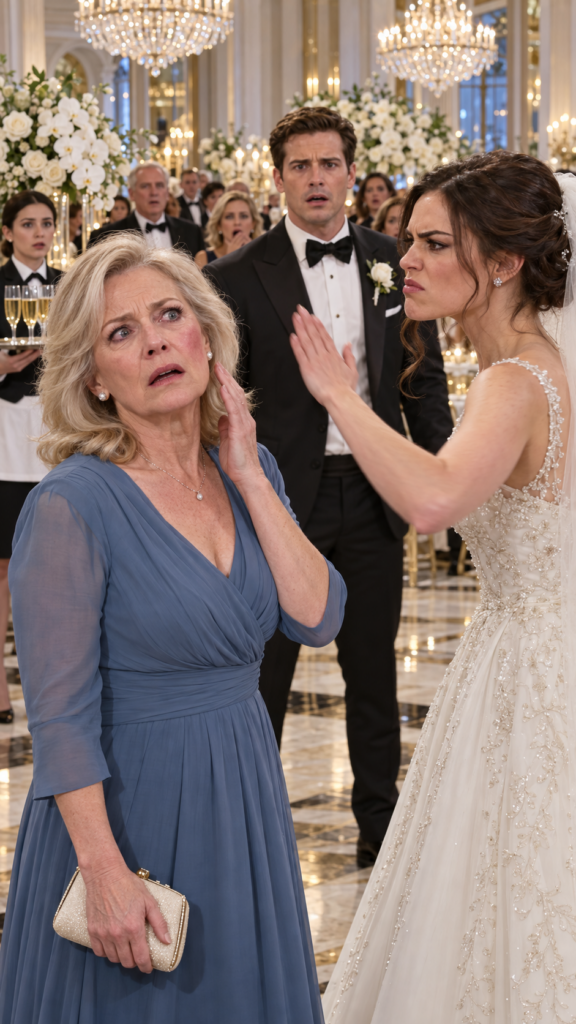
Standing in that ballroom with my cheek burning, I suddenly understood the cost of every yes.
It had not simply cost money.
It had taught them something.
It had taught Tiffany that pressure worked.
It had taught Daniel that I would absorb discomfort so he wouldn’t have to.
And worst of all, it had taught me that loving my son meant making myself smaller whenever his life became inconvenient.
Daniel stepped closer.
“Mom, maybe you should sit down.”
I looked at him.
Not because I hadn’t heard him.
Because I had.
“You think I should sit down?”
“That’s not what I meant.”
“What did you mean?”
He rubbed one hand over his face.
“I mean everyone’s staring.”
I almost smiled.
“So that’s the emergency?”
His expression changed.
“Mom.”
“Not that your wife hit me.”
“Of course that matters.”
“But everyone staring matters more.”
“I didn’t say that.”
“You didn’t have to.”
Tiffany crossed her arms.
“This is unbelievable.”
I turned to her.
For the first time since she slapped me, I noticed something I had missed.
She wasn’t ashamed.
She was angry that the room had gone quiet.
Angry that people had seen her lose control.
Angry that the wedding atmosphere had been damaged.
But not ashamed of hitting me.
That realization settled something inside me.
Something cold and final.
“I’m leaving,” I said.
Daniel looked startled.
“Mom, no.”
“Yes.”
“You can’t leave.”
The absurdity of those words nearly stopped me.
“Why not?”
He glanced around again.
“Because this is my wedding.”
“I know.”
“People will notice.”
I held his gaze.
“They already noticed.”
“Please.”
I shook my head.
“No.”
The word felt unfamiliar.
Then powerful.
Tiffany laughed under her breath.
“Oh, now she wants to be dramatic.”
I looked at her carefully.
“No, Tiffany. Dramatic was striking a sixty-two-year-old woman in front of two hundred and fifty people.”
Her face hardened.
“I told you not to interfere.”
“And I’m telling you now that you will never put your hands on me again.”
Daniel lowered his voice.
“Mom, please don’t threaten her.”
I stared at him.
“I didn’t threaten her.”
I paused.
“I set a boundary.”
The difference seemed to confuse him.
Maybe because I had not set many before.
I picked up my handbag from the chair beside the nearest table.
My fingers were trembling now.
Not from fear.
From adrenaline.
From grief.
From the realization that I could not remember the last time I had said no to Daniel without immediately explaining, apologizing, or softening it.
He reached for my arm.
“Mom.”
I stepped away before he touched me.
His hand remained suspended between us.
“You can stay,” I told him. “You should stay. This is your wedding.”
His face tightened.
“What are you saying?”
“I’m saying I love you.”
The words nearly broke my voice.
“But I am not going to stand here and pretend this is acceptable so your evening feels easier.”
His eyes dropped.
Behind us, someone quietly began speaking to another guest.
The silence was breaking.
The room was moving again.
But nothing felt normal.
I walked toward the ballroom doors.
No one stopped me.
A woman I barely knew touched my elbow as I passed and whispered, “I’m so sorry.”
A cousin stared at the floor.
One of Daniel’s college friends looked furious.
The young server Tiffany had been yelling at stood near the service entrance.
Our eyes met.
She looked terrified.
I gave her the smallest smile I could manage.
Then I walked outside.
The evening air hit my face.
Cool.
Clean.
Quiet.
For the first time all night, there were no chandeliers above me.
No flowers.
No music.
No expensive decorations.
Just darkness, trees, and the distant sound of traffic beyond the estate gates.
I sat on a stone bench near the entrance.
My hands finally began to shake.
That was when I thought of Thomas.
Not because he would have known what to say.
Thomas had not always known what to say.
But he would have stood beside me.
I knew that with absolute certainty.
And sitting alone outside my son’s wedding, I realized something I had been refusing to understand for months.
I had spent nearly a year protecting Daniel from conflict.
But no one had been protecting me.
And for the first time, I wondered what would happen if I stopped