Chapter 1 – The Restricted Elevator That Changed My Life
Panic had a taste.
I never knew that before that night.
People always described fear with words like shaking hands, racing hearts, or blurred vision. They talked about the obvious things. The things anyone could see.
But they never talked about the taste.
Fear tasted like metal.
Like a copper coin pressed against the back of your tongue.
Like your body knew something terrible was coming before your mind was ready to admit it.
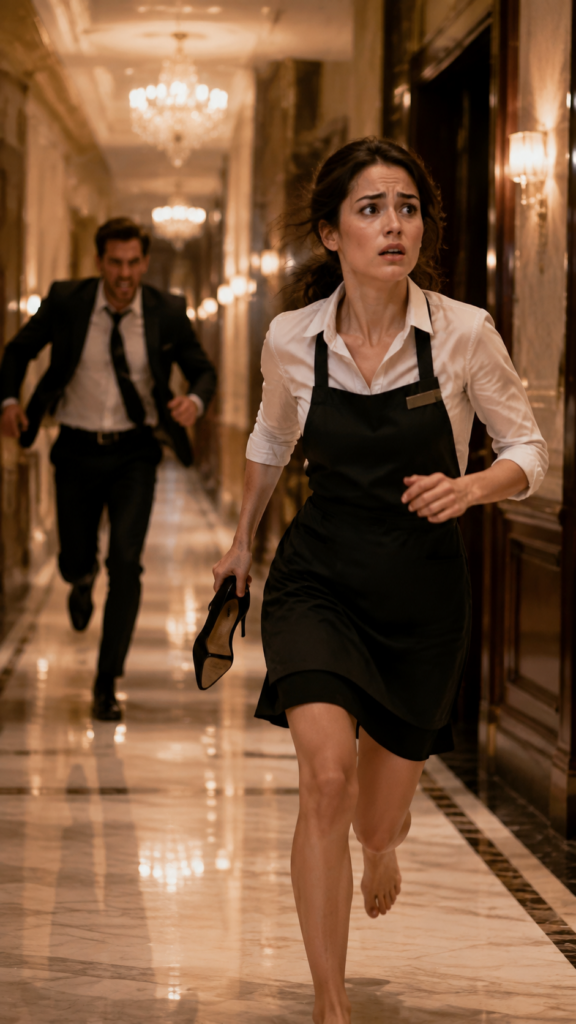
That was the taste filling my mouth as I ran through the private corridor of the Azure Hotel with one broken shoe in my hand and my entire life falling apart behind me.
The strangest part was that everything around me looked beautiful.
That was what made it worse.
The Azure Hotel was famous for perfection.
The marble floors were polished until they reflected the golden glow of the chandeliers above. The walls were decorated with expensive artwork that most guests walked past without understanding. The air smelled like roses, expensive perfume, and freshly prepared food from a kitchen that never seemed to sleep.
That night, the hotel was hosting one of the biggest charity galas of the year.
The ballroom was filled with wealthy donors, celebrities, politicians, and businessmen wearing flawless suits and expensive jewelry.
Everyone inside those walls looked like they belonged.
Except me.
I was just a waitress.
A woman carrying trays.
A woman who knew when to smile, when to disappear, and when to pretend she did not hear the cruel comments wealthy guests whispered when they thought employees were invisible.
For three years, I had mastered the art of becoming invisible.
Until Trent Miller decided I was no longer allowed to disappear.
“Norah!”
His voice echoed behind me.
I froze for half a second.
Not because I wanted to stop.
Because my body remembered.
My body remembered the sound of that voice when the doors were closed.
When nobody was watching.
When there were no witnesses.
I tightened my grip around the broken heel in my hand and forced myself to keep running.
The hallway stretched ahead.
The private elevator was at the end.
The only way out.
My lungs burned.
My black waitress skirt moved against my legs as I ran. My white shirt sleeve was torn near my shoulder. My hair, normally tied neatly during work, had fallen loose around my face.
I hated that I was afraid.
I hated that after everything he had done, some part of me still expected him to catch me.
Because Trent had always been good at making me believe I had nowhere else to go.
Three weeks.
That was how long I had hidden the bruises on my wrist.
Three weeks of long sleeves.
Three weeks of smiling at coworkers.
Three weeks of telling everyone I was fine.
People always believed the word “fine.”
It was the easiest lie in the world.
I reached the elevator.
My fingers shook as I pressed the button.
Nothing happened.
“No, no, no…”
I pressed it again.
The small red light appeared.
The display above the doors changed.
The elevator was coming down.
Behind me, Trent’s footsteps grew louder.
Slow.
Heavy.
Certain.
Like he already knew I had nowhere left to run.
“Norah.”
His voice changed.
That was the part that terrified me most.
When he was angry, he shouted.
When he wanted other people to see him, he smiled.
But when he lowered his voice like that…
It meant he was no longer pretending.
“You’re embarrassing yourself.”
I looked over my shoulder.
He stood at the end of the corridor.
The man everyone loved.
The man who shook hands with executives.
The man who donated money to charity events.
The man who had told everyone I was lucky to have him.
His expensive black suit was slightly wrinkled now. His tie hung loose. His hair was messy from running.
For once, the perfect image was cracking.
But his eyes were the same.
Cold.
Possessive.
“You know how this ends,” he said.
I stepped backward.
“No.”
A small word.
But it was the first honest word I had spoken to him in months.
His expression changed.
Almost surprised.
Maybe he had never heard me refuse before.
“You’re upset.”
“No.”
“You’re confused.”
“No.”
He walked closer.
“You’ll regret making a scene.”
That sentence hurt more than it should have.
Because that was always his favorite weapon.
Not threats.
Not yelling.
Making me believe I was the problem.
Making me believe my pain was an inconvenience.
The elevator chimed.
The doors opened.
I didn’t think.
I didn’t plan.
I simply moved.
I threw myself inside.
And then I stopped.
Because I wasn’t alone.
Two men stood inside the elevator.
The first thing I noticed was silence.
Not ordinary silence.
