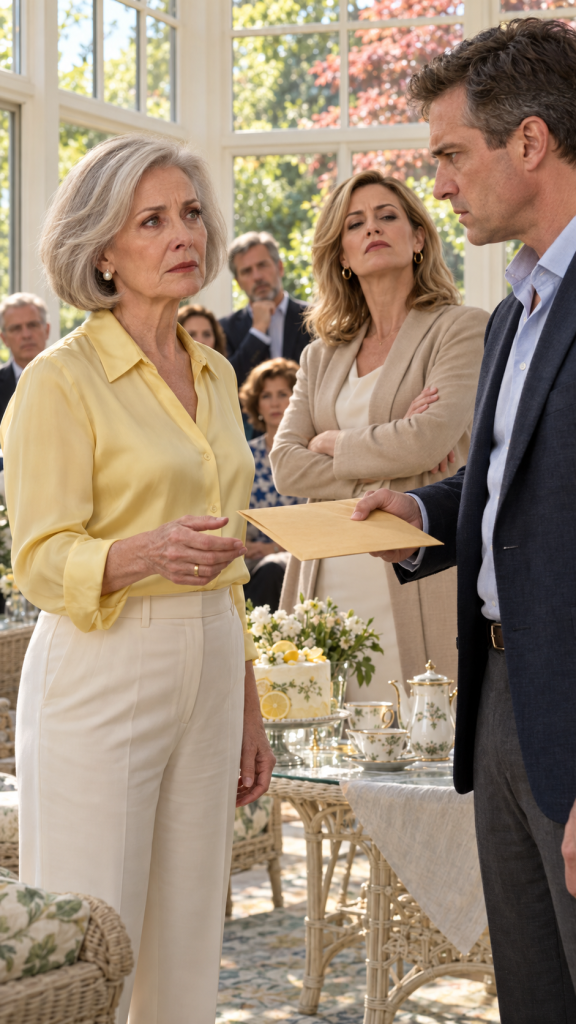
It was my eight-year-old grandson who finally revealed what my children had done to me for five Christmases.
He didn’t mean to hurt me.
On December 1st, he stood in front of his parents’ refrigerator, holding his mother’s cell phone, and pointed the camera at a colorful advent calendar with names on it.
Everyone was listed.
My son, too.
My daughter.
Your spouses.
Cousins, neighbors, colleagues, and friends I barely knew.
Everyone except me.
“Grandma, why aren’t you coming again this year?”
Before I could answer, my daughter-in-law appeared behind him.
“Nathan, give me the phone.”
“But Mom, I just wanted to…”
The screen went black.
I sat at the kitchen table, staring at my reflection in the dead display.
For five years, I had accepted every excuse my children gave me.
The house was too full.
The roads were dangerous.
The children needed their routines.
Someone had already reserved the spare room.
Next year would be better.
But that morning, when I saw the advent calendar, which featured practically everyone in my circle of friends, I finally understood something.
They weren’t short on space.
They had simply stopped making room for me.
And what happened over the next 23 days would show them that there’s a world of difference between being excluded from someone’s Christmas and having the right to just walk into their house.
My name is Evelyn Hartley.
I am 68 years old, a widow, and the mother of two grown children.
Until my husband Robert’s death, I hosted every Christmas for our family for over 30 years.
Our house wasn’t huge.
It had four bedrooms, a dining room that was a bit too narrow for our table, and a kitchen where people were constantly bumping into each other.
But somehow we managed every Christmas.
Robert would then bring the folding table up from the cellar.
I would get extra chairs from the bedrooms.
Our children complained that we cooked too much and then spent the afternoon eating the leftovers straight from the serving dishes.
When the grandchildren came, we moved the furniture aside to make room for their toys.
If a relative wanted to bring a friend who had nowhere else to go, we added another chair.
That’s how Christmas was at our house.
You didn’t earn your place through comfort.
You simply belonged.
Robert taught finance at a community college for 32 years.
He was a careful man with money and a generous man with people, a combination I sometimes thought was difficult to find.
He could spend twenty minutes comparing the price of two nearly identical refrigerators, then quietly pay a struggling student’s textbook bill without mentioning it to anyone.
“There’s a difference between being careful and being small,” he used to tell me.
He also had a saying about family.
“Love them as much as you can, Evie.
Just don’t teach them that loving you is optional.”
I used to laugh when he said things like that.
Robert could turn almost anything into a lesson.
But after he died, I discovered how much of our family’s peace had depended on him.
The first Christmas without him, my son Daniel invited everyone to his house.
Daniel was forty-three now.
He worked in insurance, had a comfortable home with his wife Natalie, and was raising our grandson Nathan.
That first year, I understood why he wanted to host.
The old family house was full of memories, and I had spent the months after Robert’s funeral feeling as though every ordinary object was waiting to remind me of something.
Daniel called in early December.
“Mom, Natalie’s got everything planned.
You can take it easy this year.”
“That sounds lovely,” I told him.
Then he cleared his throat.
“Actually, we’re probably going to keep it small.
Just Natalie’s parents and the kids.