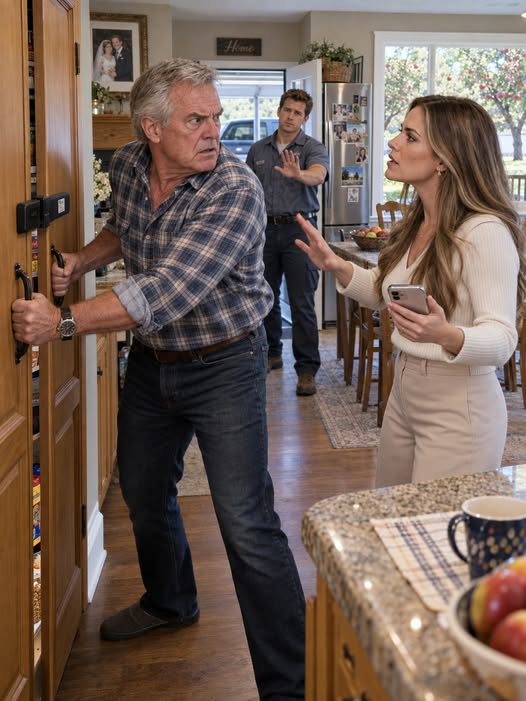
The quiet that settled over the kitchen after Brooke walked upstairs was not peace. It was the heavy, pressurized silence that settles over a factory floor right before a boiler gives out.
I took a slow sip of my black coffee, feeling the heat settle in my chest, and listened to the floorboards creaking overhead. Two rapid paces, a pause, then the muffled, sharp cadence of footsteps moving toward the guest bedroom where Miles was still sleeping off a sixty-hour work week.
I sat at the head of the oak table I had built with my own two hands during our twelfth year of marriage. In the center of the table rested the evidence: the black plastic electronic keypad with its crooked warranty sticker, four shiny drywall screws, the canceled platinum bank card, and the single sheet of lined paper I had torn from my legal pad.
Ten minutes later, the first tremor hit.
It didn’t start with words. It started with the chime of a cell phone down in the foyer, followed by the angry chime of another notification. Miles had tried to use his digital wallet.
Every Saturday morning around seven-thirty, Brooke liked him to order artisanal pastries and cold brew from the organic bakery three miles down the road—a twenty-eight-dollar breakfast ritual she had instituted the second week they lived here.
I heard the door upstairs wrench open.
“Miles, wake up! Look at this!” Brooke’s voice carried down the stairwell, stripped of the sweet, melodic lilt she usually reserved for public consumption. “The card is declined. Both of them. It says unauthorized account closure!”
A groggy mumble answered her, followed by the dull thud of bare feet hitting the carpet.
I didn’t move. I reached for the ceramic mug, cupping it in my work-roughened palms. Thirty years on the assembly line at the Midwest Tool & Die plant had taught me that when a machine jams, rushing in with your bare fingers only gets you crushed. You cut the power, let the gears stop spinning, and inspect the damage with a cold eye.
The footsteps hurried down the stairs. Miles appeared first. He was wearing his gray sweatpants and a rumpled T-shirt, his hair sticking up on one side, rubbing the sleep from his eyes with his knuckles. He still looked so much like the eight-year-old boy who used to wake up early on Saturday mornings to help me rake leaves by the apple trees.
Behind him came Brooke. She had thrown on a silk dressing gown—blush pink, sweeping the floorboards—and her face was flushed red, her lips pressed into a bloodless line.
“Dad?” Miles rasped, leaning against the doorframe of the kitchen. “Did something happen to the checking account? I just tried to pay for the order, and the app threw a fraud flag. It locked me out.”
Then his gaze drifted from my face down to the table.
He saw the electronic lock first. It looked tiny, pathetic almost, sitting on the polished golden oak. Then he saw the silver-and-blue authorized-user card I had snipped cleanly down the middle with kitchen shears. Finally, his eyes found the note.
“What is this?” Miles asked, his voice cracking slightly.
“That,” Brooke cut in, stepping past him into the kitchen, her slippers slapping against the linoleum, “is your father throwing a temper tantrum. Because I dared to set a boundary.”
She crossed her arms, standing on the other side of the table, glaring down at the lock. She didn’t look at me; she looked at Miles, waiting for him to play his assigned part.
Miles rubbed his forehead. “Dad… come on. Did you cut my card? Over the pantry? Are you serious right now?”
“Sit down, Miles,” I said quietly.
“I’m not sitting down,” he snapped, frustration flaring in his eyes. “We have a venue coordinator calling us at nine. The florist needs the final deposit before noon. Why the hell would you cancel my card without telling me? What if I was on the highway and needed gas?”
“If you were on the highway and needed gas,” I answered, keeping my voice steady at an even, conversational decibel, “you would use your own debit card. Connected to your own bank account. Funded by your own paycheck.”
Miles blinked, taken aback by the ice in my tone.
Brooke stepped in immediately, shifting her weight, her chin tilting up. “Miles works eighty hours a week so we can build a life, Arthur! You told him you’d help us while we stayed here! That was the deal. You told us to save our money for the wedding and our down payment!”
“No, Brooke,” I said. “That wasn’t the deal.”
I reached beside my chair and lifted my old brown leather briefcase onto the table. The brass latches popped open with two sharp clicks that sounded like gunshots in the quiet room.
