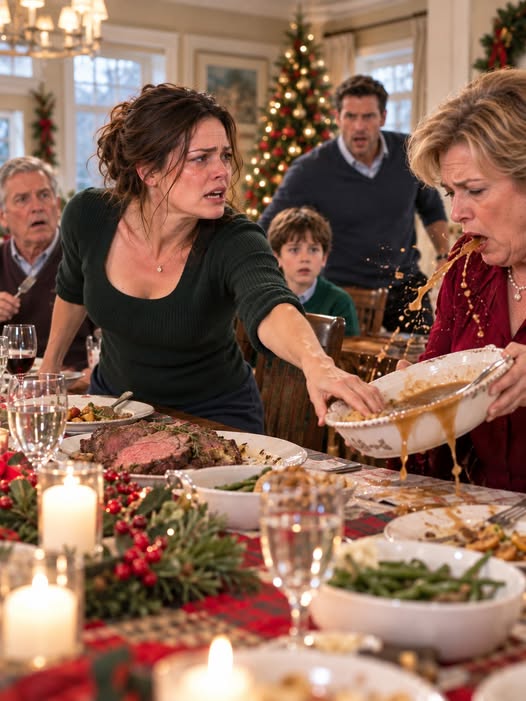
The café was warm, smelling of dark roast coffee and toasted cinnamon, a stark sanctuary against the brutal Ohio sleet tapping rhythmically against the glass. Micah had sugar clinging to the corner of his lower lip. His small, deliberate fingers held the miniature coupling of his 1940s die-cast locomotive, gently testing the hinge. He was calm now, lulled by the pastry and the steady hum of background conversation, but I could still see the pale red mark near his collarbone where the boiling gravy had scalded his skin before sinking into the knit of his favorite holiday sweater.
My phone vibrated violently against the faux-wood laminate of the small table.
It wasn’t a text. It was a direct call from my mother, Evelyn.
I looked down at the glowing screen. For four years, that specific ringtone had triggered an instantaneous Pavlovian panic in my chest—an involuntary tightening of my lungs, a mental inventory of what bill might be late, what errand had slipped my mind, or what minor grievance my brother Ross had suffered that required my immediate financial cushion.
I took a deep, steadying breath, felt the air fill my ribs, and slid my thumb across the screen to accept the call. I tapped the speaker button and set the phone gently between my coffee cup and a paper napkin.
“Nora?” Her voice didn’t carry an ounce of apology, nor the softened timbre of a grandmother whose conscience had caught up with her. It was sharp, thin, and brittle, vibrating with indignation. “What did you do to the thermostat portal?”
I looked at Micah. He had paused his inspection of the train’s wheels, his large hazel eyes looking up at me through long eyelashes, waiting to see if the world was going to tilt on its axis again. I smiled gently at him, reached across the table, and smoothed down a dry cowlick on his crown.
“Hello, Mom,” I said, my voice deadpan, devoid of the customary soothing lilt I had weaponized for decades to keep her calm.
“Don’t give me that tone,” she snapped, the familiar cadence of kitchen pots clattering in the background. “Ross tried to turn the hallway heat up because the foyer is freezing, and the digital pad gave him an authorization error. Then I went to check the app on my tablet, and it says the primary administrative card on the utility billing has been revoked. The furnace is running on basic default, Nora. It’s thirty-two degrees outside. Did your payment bounce?”
She hadn’t asked if Micah was still crying. She hadn’t asked if the scalding meat juice had blistered his cheek. She hadn’t even bothered to ask where we were or if we were safe on the icy roads.
“My payment didn’t bounce,” I said evenly. “I removed my credit card from the account. I also unlinked my checking account from the auto-draft for the electric grid.”
There was a heavy, suffocating silence on the other end of the line. In the background, I could hear the muffled drone of the television in the den—my father, Arthur, watching a rerun of a bowl game, oblivious or deliberately indifferent.
“What do you mean you unlinked it?” Her pitch rose an octave. “The bill is due on the twenty-seventh! That’s four hundred and sixty dollars because of the drafty bay window in the living room! Why would you touch the billing portal right before Christmas?”
“Because you dumped dinner on my son’s head,” I replied. I didn’t yell. I didn’t let my vocal cords fray with grief. I spoke with the clinical, chilling precision of an auditor presenting an irrecoverable ledger. “You tipped a serving dish of hot beef and gravy over a nine-year-old child because he had the audacity to talk about a model train.”
“Oh, for heaven’s sake, Nora! Don’t be so dramatic!” Evelyn scoffed, though there was a slight, frantic flutter beneath her irritation. “The dish slipped. My arthritis flared up in my wrist. I was under enormous stress trying to cook a holiday dinner for everyone while your brother is trying to find his footing, and Micah was rambling on and on. It was an accident, and you know it. If you hadn’t run off like a petulant child, we could have had dessert by now.”
Across from me, Micah shrank slightly into his padded vinyl booth. He recognized the tone. For his entire young life, he had watched his mother absorb those slights, minimize them, and laugh awkwardly to keep the peace.
“It wasn’t an accident,” I said. “You looked directly into his eyes, tilted the ceramic bowl, and poured it. Dad watched you do it. Ross laughed. And then you told us to get out.”
