At 3:07 a.m., my brother Jonas dragged me out of bed by my hair while my father stood in the hallway laughing. Even before I fully grasped what was happening, I knew only one thing: if I silently endured another night, they would claim again tomorrow that I had made it all up.
The bedroom door wouldn’t open. It slammed so hard against the wall of our old apartment in Leipzig-Gohlis that the framed photo on my dresser cracked. For a moment, I just lay there, staring into the strip of light from the hallway.
Then Jonas came to visit me.
He didn’t look confused. Not even particularly drunk. He looked resolute, as if he had already made up his mind and just needed to carry it out on me.
His hand grabbed my hair before I could sit up. My scalp burned. My shoulder slammed against the bedside table, the lamp fell to the floor, and with a sharp crack, the bulb shattered.
“Get up,” hissed Jonas.
I grabbed his wrist with both hands. “Jonas, stop. Please.”
He just pulled harder.
My knees got caught in the duvet as he dragged me across the floor. The hallway smelled of stale coffee and the laundry detergent my mother always bought. A perfectly ordinary smell, and that’s precisely what made everything worse.
Then I saw my father.
Rolf Hartmann stood in the doorway, his gray hair flattened from sleep, wearing old sweatpants and a faded T-shirt. One hand rested loosely on the frame. He didn’t take a step toward me.
He smiled.
“There we have her again,” he said quietly, laughing. “Lena, always the victim.”
That sentence hit me harder than the wall against which Jonas pushed me the next moment.
I knew him in a hundred different ways. When Jonas locked me out on the balcony in winter when I was seventeen, they said I must have provoked him. Years later, when my mother noticed bruises on my arm, my father explained that I’d just always been clumsy. In every argument, I was blamed, even before I knew what I was actually being accused of.
Jonas pushed me against the wallpaper.
“Apologize.”
“For what?”
That was the question that never needed an answer in our family.
He pulled me further into the living room. My hip slammed against the glass table. Something slid across it, fell onto the carpet, and landed right next to my hand.
My mobile phone.
Jonas saw it too.
He grinned for a second.
“Why don’t you call someone?” he said. “Let’s see who believes you this time.”
A door creaked in the stairwell. Someone had been woken by the noise. My father glanced briefly at the apartment door, but not with concern. More annoyed, in fact, that there might be a witness.
At that exact moment, my hand closed around the phone.
My fingers were shaking so badly that I had to tap the first number twice.
1.
1.
0.
The connection was established.
“Police, where exactly is the emergency?”
Die Stimme am anderen Ende war ruhig. Beinahe sachlich. Diese Ruhe brachte etwas in mir zum Einsturz.
„Mein Bruder greift mich an“, keuchte ich. „Bitte schicken Sie jemanden. Leipzig-Gohlis. Bitte.“
Jonas’ Gesicht veränderte sich.
Mein Vater hörte auf zu lachen.
Nur für einen Augenblick.
Dann stürzte Jonas nach vorn, packte mein Handgelenk und schlug mir das Telefon aus der Hand. Es rutschte unter den Couchtisch. Die Verbindung blieb offen.
„Du verdammte Lügnerin“, sagte Jonas.
Unter dem Tisch hörte ich die Stimme der Leitstelle nach mir rufen.
Und dann hörte ich meinen Vater, plötzlich mit diesem geduldigen Ton, den er nur für Fremde benutzte.
„Sie macht so etwas ständig, um Aufmerksamkeit zu bekommen.“
Da verstand ich, was sie bereits taten.
Sie bauten die Geschichte, die sie der Polizei erzählen würden.
Sie waren darin geübt.
Nur wussten sie nichts von dem Rauchmelder über meinem Bücherregal.
Drei Wochen zuvor hatte Jonas mein Zimmer durchsucht, weil er überzeugt war, ich hätte ihm Geld weggenommen. Danach kaufte ich eine winzige Kamera und versteckte sie im Gehäuse des Rauchmelders. Ich erzählte niemandem davon. Nicht Freunden. Nicht meiner Mutter. Nicht einmal mir selbst sagte ich laut, warum ich sie brauchte.
Ich wusste nur, dass ich es nicht mehr ertrug, von Menschen für verrückt erklärt zu werden, die darauf angewiesen waren, dass niemand sah, was hinter unserer Wohnungstür geschah.
Als mein Blick dunkel wurde, versuchte ich noch, zwei Wörter in Richtung des offenen Telefons zu sagen.
„Die Kamera.“
Aber ich weiß bis heute nicht, ob überhaupt ein Ton herauskam.
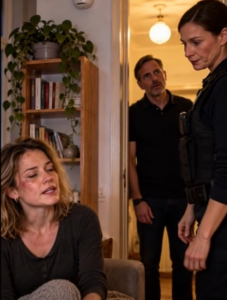
Als ich wieder zu mir kam, brannte weißes Licht über dem Wohnzimmer. Zwei Polizeibeamte standen zwischen mir und Jonas. Einer stellte mir langsam Fragen, während Jonas plötzlich ganz leise sprach und mein Vater die Stirn in sorgenvolle Falten legte.
