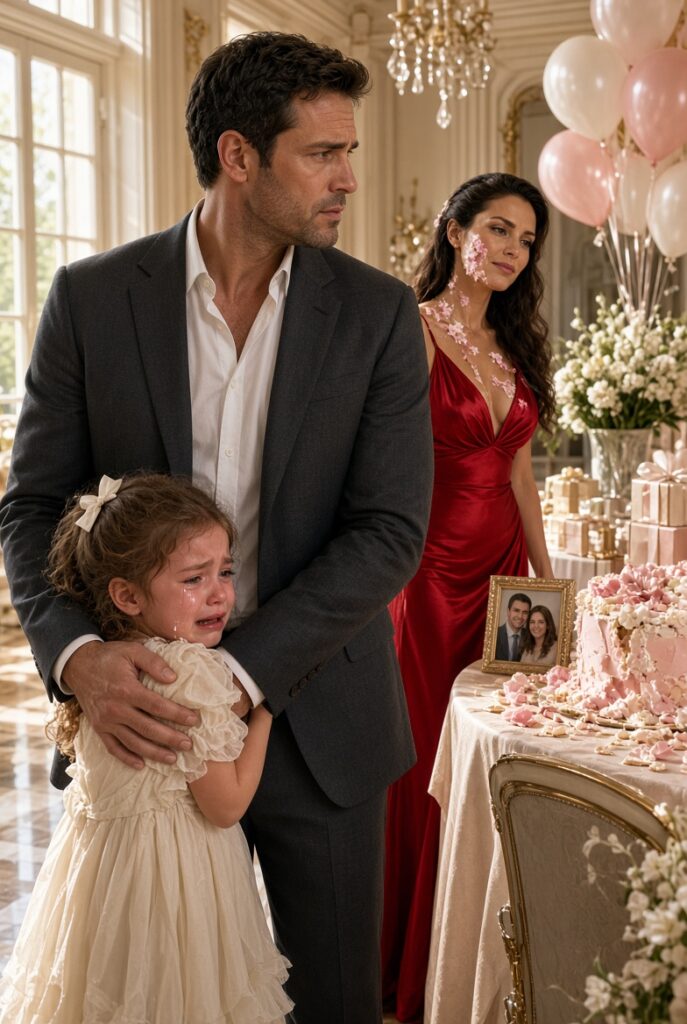
When the call ended, he stayed outside. Across the street, someone was bringing in a bicycle. A dog barked at a delivery van. Bellford went on being a town in which people needed groceries and neighbors borrowed ladders. Caleb had once wanted to escape its smallness. Tonight its refusal to become a ballroom felt like a kindness.
Juliet left a voice message. He listened with the phone against his ear.
“I know what it looked like. I was under so much pressure, and your mother knew exactly how to push me. We were supposed to be starting our own family today. I need you to talk to me before you throw everything away.”
He played it once. Then he sent a written answer.
I will arrange a conversation about practical matters. Do not contact my mother. Do not come to her house. The marriage will not take place.
He did not add a sentence explaining how much he had loved her. That belonged to a different conversation, perhaps to none at all.
When he went back inside, Martha was in the living room wearing a blue cardigan and wool socks. The shawl lay across her lap. She had found the torn place near its edge and was examining it under the lamp.
“Leave that for tonight,” he said, then caught himself. “Would you like me to put it away?”
“No. I want to see whether the stitches ran.”
He sat on the other end of the sofa.
The wool had stretched where Juliet’s hand caught it. Two loops had escaped, leaving a narrow opening like a small mouth. Martha slipped a safety pin through them to keep the damage from traveling farther.
“That will hold,” she said.
“I can buy you another.”
She looked at him without anger. “I know you can.”
He remembered the shawl around his own shoulders when he was a boy. He remembered its weight while he waited for the Rowans to decide, as he had believed then, whether he was worth keeping. He had been so afraid of needing anything that Martha used to put a glass of water outside his room in case he was too shy to ask.
“You want this one.”
“Yes.”
He nodded.
Annie came in with tea and said she would go home if Martha felt settled. They agreed she would return in the morning. At the door she squeezed Caleb’s shoulder hard enough to hurt a little, an old gesture from the years when he had been taller than her but not yet grown.
After she left, the house seemed to draw a long breath.
“Will you stay?” Martha asked.
“Of course.”
“You don’t have to cancel your life.”
“I’ve canceled a wedding. I think there’s room.”
She smiled faintly. “Your room has clean sheets.”
He wondered when she had put them on. Before the wedding, perhaps, on the chance that he and Juliet might stop there on the way to the airport. Or simply because keeping a place ready had become a habit.
“Mom, can I ask you something?”
She nodded.
“What happened before today? Not just the last five minutes. Whatever you want me to know.”
Martha turned her cup once on its saucer.
“I don’t want to give you a list and have you think every meal, every visit, every time I smiled at her was a lie.”
“I won’t.”
“There were good afternoons. She brought me tulips in the spring. We talked about a book. I liked her then.”
He let her finish.
“Lately there have been so many small corrections. Where I should stand. What I should wear. Which stories would bore your new friends. I told myself a wedding made people foolish. I told myself you were happy.”
“I was happy.” The truth hurt to say. “I didn’t know what it was costing you.”
“You didn’t ask very many questions.”
“No.”
She looked at him, measuring whether he could accept that single word without asking her to soften it.
“Get my bag,” she said.
He brought it from the hallway. Martha took out the gray folder. Inside was the wedding program, folded once, though its heavy paper had resisted.
On the page headed Our Families, he found Graham and Celeste Ashford, a paragraph about their charitable work, a photograph of Juliet as a child. His own paragraph described an exceptional young man who had built a company from almost nothing. Beneath it, in smaller type, were the words: Special thanks to Mrs. Martha Rowan, a former foster carer who helped Caleb during his early years.
He read them again.
“This wasn’t what I wrote.”
“Did you read the final version?”
He had approved the cover. The flowers. The typeface, because Juliet had asked him which of two almost identical fonts he preferred. He had told her the rest looked fine without opening the attached file.
“No.”
Martha took the program back. “I wasn’t going to bring it up today.”
“You should never have had to bring it up.”
She smoothed the crease with the side of her hand. That gesture, familiar from a lifetime of flattening fabric, nearly undid him.
“I can correct this,” he said.
“In time. There’s something else you need to see.”
From behind the program, she drew a second packet. This paper was ordinary, printed in black and stapled at the corner. He recognized his company’s name before he understood anything else.
ROWAN HOME. RIVER STREET PROJECT. OCCUPANT TRANSITION SUMMARY.
“Where did you get this?”
« Il a été livré au magasin jeudi. »
Son regard parcourut la page. L’atelier de réparation était indiqué comme fermé. Ses occupants étaient décrits comme retraités, et un accord de principe avait été trouvé concernant leur relogement. Une date cible de passation de pouvoir était inscrite en marge, à côté d’un petit carré à cocher.
Le magasin où son premier commerce avait été emballé dans des cartons. Le magasin que sa mère ouvrait encore tous les mardis et jeudis. Fermé.