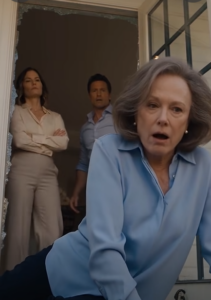
My own son threw me through a glass door.
For several seconds after I hit the patio, I could not understand what had happened.
There had been Daniel’s hand against my shoulder.
A burst of pressure.
Then a sound like a gunshot as the glass gave way behind me.
And suddenly I was on the ground.
Tiny diamonds glittered around my shoes and beneath my palms.
My left shoulder burned where I had struck the stone.
Something warm crawled from my temple toward my jaw, and when I touched it, my fingers came away red.
Daniel stood in the broken doorway.
His hand was still half raised.
His face had gone white.
For one ridiculous instant, I thought he was going to run toward me.
I thought he would say, Mom, I’m sorry.
I thought somewhere beneath the expensive suit, the panic, and the bitterness of the past few months, my forty-year-old son still remembered that I was the woman who had sat beside his hospital bed when he broke his leg at twelve.
That I had driven three hours in the rain when his first marriage collapsed.
That I had given him the money for the down payment on his first house without ever asking for it back.
He did none of those things.
He simply stared.
Then Vanessa stepped around him.
She looked down at me through the shattered doorway.
There wasn’t shock on her face.
There wasn’t concern.
There wasn’t even fear.
There was irritation.
She crossed her arms.
“We’re done supporting you,” she said.
“Get out.”
I stared up at her.
Supporting me.
The words were almost enough to make me laugh.
Almost.
But I had glass embedded in the sleeve of my blouse, blood on my cheek, and an ache spreading through my ribs.
So I didn’t laugh.
I slowly pushed myself to one knee.
Daniel finally moved.
“Mom—”
“Don’t.”
My voice came out quieter than I intended.
He stopped.
There are moments when something inside you changes so completely that you can almost feel the old version of yourself disappear.
That was one of them.
For eight months, I had been telling myself Daniel was under pressure.
For eight months, I had excused his impatience.
His sharpness.
The way he had stopped correcting Vanessa when she made jokes about me.
The way he had started speaking to me as if I were an obligation instead of his mother.
I had told myself grief made me sensitive.
I had told myself his business troubles were temporary.
I had told myself families survived difficult seasons by showing patience.
Then he put his hands on me.
And something became simple.
I stood.
A shard of glass fell from my cardigan.
Vanessa took half a step backward.
Maybe she saw something in my face.
“You’re bleeding,” Daniel said.
“Yes.”
“I didn’t mean—”
“You shoved me.”
“You were screaming.”
“I raised my voice.”
“You came at me.”
I looked at him.
“Daniel, I was holding a folder.”
His eyes flicked toward the papers scattered across the living room floor.
The folder that had started everything.
PETITION—ADULT GUARDIANSHIP.
My name was printed beneath it.
MARGARET HALBROOK.
Petitioner: Daniel Halbrook.
Proposed Guardian and Conservator: Vanessa Halbrook.
I had discovered it less than ten minutes earlier.
Ten minutes.
That was all it had taken to learn that my son and his wife had spent weeks—possibly months—turning my ordinary life into evidence against me.
I looked through the broken doorway at the paperwork.
Then back at Daniel.
“You were going to tell a judge I couldn’t manage my own affairs.”
“That’s not what this is.”
“I read it.”
“Then you read it without context.”
Vanessa gave a humorless laugh.
“She’s proving the point right now.”
I turned to her.
“What point?”
“You’re unstable.”
Daniel closed his eyes briefly.
“Vanessa.”
“No.
She needs to hear it.”
She stepped closer to the broken doorway but was careful not to step into the glass.
“We’ve been trying to help you for months, Margaret.
You sold your home.
You moved in here.
You don’t understand half the things Daniel explains to you about technology.
You forget people’s names.
You leave your glasses everywhere.
You don’t even drive much anymore.”
I stared at her.
“You think losing my reading glasses means I should lose control of my bank accounts?”
“That’s not what I said.”
“Your petition says I am financially irresponsible.”
“You gave Daniel money when he didn’t ask for it.”
That one almost impressed me.
They had managed to turn generosity into incapacity.
Daniel looked away.
And I understood something else.
He knew.
He knew exactly what the petition said.
“How long?”
I asked.
He frowned.
“What?”
“How long have you been preparing this?”
“Mom, you’re upset.”
“How long?”
Vanessa answered.
“About six weeks.”
Daniel looked at her sharply.
But it was too late.
Six weeks.
Six weeks of little comments.
Senior moments.
Technology gets harder as we age.
Are you sure you paid that bill?
Did you forget where you parked?
Maybe you shouldn’t drive at night.
You already told us that story.
For weeks I had thought Vanessa was being cruel.
Now I realized she had been collecting material.
Building a picture.
Creating a woman who didn’t exist.
I looked down at my hands.
They were trembling.
Not from confusion.
Not from age.
From fury.
“Why?”
I asked.
Daniel moved toward me.
I stepped back.
His face tightened.
“Mom, I know this looks bad.”
“Why?”
“Because you haven’t been yourself since Dad died.”
There it was.
Thomas.
My husband.
Even dead, he had become useful to them.
Thomas and I had been married thirty-eight years.
He had died fourteen months earlier from complications following a heart procedure.
He had been difficult in some ways.
Private.
Obsessive about details.
Suspicious of debt.
Suspicious of flashy people.
Suspicious, in fact, of nearly everyone who said money was easy.
But he had also been the most disciplined man I had ever known.
