Chapter 1 – The Ocean House
The Ocean House smelled of expensive wax, melted butter, and fragile ego. Dark Atlantic waves slammed against the seawall outside, throwing spray high into the cold evening air, but inside, everything was tailored to make middle-aged men feel like gods.
Arthur Mercer loved places like this. He loved the white linen tablecloths, the polished brass wall sconces, and the crisp deferential tones of the hostesses. At sixty-eight, my father didn’t view birthdays as a reminder of mortality. He viewed them as proof that time itself was afraid of him.
“The Mercer party,” the hostess said, offering a practiced smile.
Arthur tilted his chin, his shoulders squared under his bespoke jacket. “That would be us.”
He didn’t wait for her to lead. He strode ahead, expecting the crowd to part. My stepmother, Eleanor, trailed two paces behind, clutching her cream cardigan against her collarbone like an armor against his mood. My younger brother, Nathan, walked behind her, nervously chewing the inside of his cheek—a childhood habit that had survived thirty-four years of emotional landmines.
I walked last, keeping pace with Colonel Quinn Park.
To my father, Quinn was merely “Lila’s friend from work.” I hadn’t corrected him. Over my forty-two years on this earth, I had learned that some truths were far more potent when saved for the precise moment they needed to detonate.
Quinn’s gray dress jacket was tailored and simple. Her dark hair was pinned into a tight, military bun. She moved with an effortless grace that made the heavy restaurant furniture look flimsy by comparison. When Arthur gave her a passing glance at the entrance, he dismissed her immediately. To him, an unmarried woman in her late thirties with no flashy jewelry was invisible.
The hostess showed us to a prime table beside the floor-to-ceiling windows. Arthur instantly took the head seat, unfolding his napkin with a sharp, rifle-shot snap.
“Lila,” he commanded, tapping the seat to his right. “Sit.”
I sat without arguing. Quinn took the chair directly opposite me.
“So,” Arthur began, leaning back as if holding court. “What was it you said you do, Quinn?”
“Defense administration,” Quinn replied evenly.
Strictly speaking, that was accurate.
Arthur grunted, a dismissive smirk touching his lips. “In other words, paperwork.”
Quinn raised her water glass to her lips. “Paperwork can be surprisingly effective.”
I looked down at my menu to hide the slight twitch of my lip.
For the first thirty minutes, the dinner followed the script Arthur had written in his head. He delivered long, sweeping monologues about how soft the younger generation had become, how discipline was dying, and how his real estate firm was the last bastion of true American work ethic. Eleanor offered her synchronized laugh exactly half a second after each of his jokes, her eyes darting to his face to ensure her timing was approved. Nathan nodded intently, trying to prove his loyalty after dropping out of law school three years ago.
I kept my mind occupied by cataloging the room. Two kitchen doors. One main entrance. A narrow corridor leading to the restrooms. A fire extinguisher behind the decorative palm. A waiter whose hands shook slightly as he served oysters.
It was a habit I couldn’t break.
Then, Eleanor froze. Her face turned the color of dry chalk.
“Oh no,” she whispered, leaning toward the empty seat next to her.
“What’s wrong, Mom?” I asked softly.
“The dinner rolls,” she whimpered, her voice trembling. “I left them in the oven to stay warm at home. I forgot to turn the burner off.”
Her panic was immediate, disproportionate, and entirely tragic. She wasn’t worried about a house fire; she was terrified of Arthur’s reaction.
Arthur lowered his head, intertwining his thick fingers to lead us in prayer. He assumed his solemn, pious expression—the face he used when he wanted the world to see what a righteous man he was.
I leaned slightly closer to Eleanor and whispered quietly, “Phone Mrs. Lane. Ask her to use the spare key and turn it off.”
It was just a quiet suggestion. No sarcasm. No disruption.
Arthur’s eyes snapped open. The candle flame between us flickered as his posture stiffened instantly.
“What did you just say?” his voice lowered to a dangerous rumble.
“Mom left the oven on,” I said, keeping my tone level. “I told her to call the neighbor.”
Arthur’s jaw tightened, his veins bulging against his collar. “We are saying grace.”
“I know. But it’s an operational hazard—”
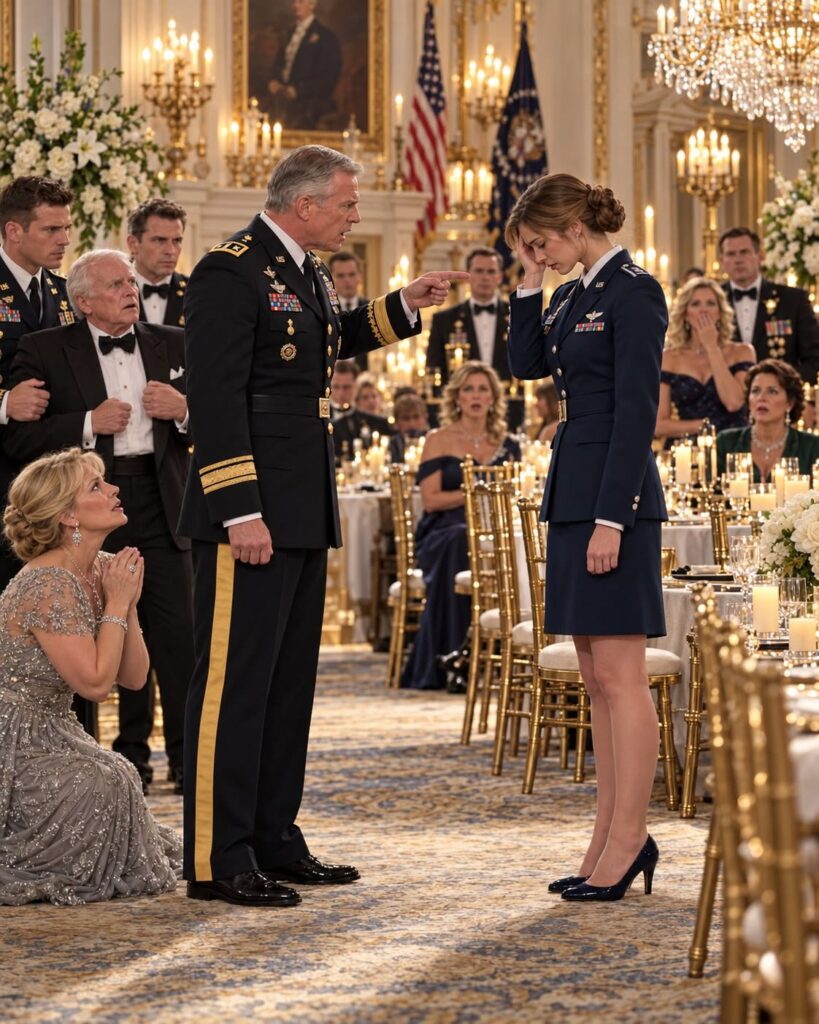
The slap cut me off.
It cracked across the restaurant like a wooden beam snapping under heavy load. The sheer force of his hand turned my head violently to the left. The room went dead silent.