At the bottom of an approval sheet was my electronic signature.
I had never signed it.
I remember looking at the screen, then at the crayon drawing Lily had taped to my monitor. She had drawn four people holding hands. None of them was smiling, because she said she hadn’t learned to draw mouths yet.
My fingers had gone cold. I knew at once why Victoria wanted me gone.
When Bianca was presented at Christmas as the mother of a future Whitmore heir, I did not yet know whether she was pregnant. I did know the family had begun moving money months before that announcement. The baby’s existence was being used as an excuse to accelerate transactions that had nothing to do with a baby.
One December afternoon, I had found a draft trust certification in a shared board packet. It represented that the family expected the birth of an additional descendant and needed immediate liquidity to protect a planned distribution. As trustee, Eleanor Whitmore would have had to approve any such acceleration. Her signature appeared on a document she later swore she had never seen.
After that, the divorce felt less like a surprise than the final step in a plan.
I had asked Naomi to negotiate what mattered: full decision-making authority for day-to-day care, a court-approved relocation provision, secure support for Lily and Noah, and disclosure rights preserved for reporting suspected fraud. The settlement had non-disparagement language, but Naomi made sure it could not be read as a promise to conceal wrongdoing or interfere with an investigation. Julian signed the relocation consent after his lawyer told him it would make the divorce go faster. Victoria had called it a bargain.
They had imagined silence was something I sold.
My phone rang again. This time the number belonged to Eleanor Whitmore.
I hesitated. Eleanor was ninety-one, sharp-eyed and arthritic, and the only Whitmore who ever asked whether I had eaten before she asked what I could do for her. She had laughed when Lily called her Great-Grandma El. Still, she had sat at the Christmas table. She had clapped for Bianca. I had never forgotten it.
I answered.
“Claire,” she said.
Her voice was small in a way I had never heard. Behind her were doors opening and closing, distant voices, the sterile echo of a place with tiled floors.
“Are the children safe?”
“Yes. We’re in Edinburgh.”
A pause. “Good. Your father would have liked that.”
I swallowed. “How do you know about my father?”
“Moira wrote to me,” Eleanor said. “Years ago. She thought I ought to know what was happening to you.”
I looked toward the window. A blackbird settled on the sill, inspected the glass, then flew away.
“Eleanor, what happened at the clinic?”
“The doctor said there is no pregnancy. Bianca insists there was once. Victoria is blaming everyone except herself.” Her breath caught. “But that isn’t why I’m calling.”
“Why, then?”
“I have a letter in front of me. It says I authorized thirty-one million dollars in distributions from my trust. The signature is remarkably good.”
The room seemed to narrow.
“Did you authorize it?”
“No.” I heard paper rustle. “And someone has attached a statement declaring that you witnessed me sign.”
I felt myself turn to stone.
“Claire,” she whispered, “they have made you the witness to a crime.”
Then, behind her, I heard Victoria shout my name.
The line went dead.
Chapter 2 – SEVEN PEOPLE IN A WAITING ROOM
I didn’t learn everything that happened at the maternity clinic until much later. The facts came in pieces: voice messages, a statement from Eleanor, a letter from the clinic’s solicitor, and eventually testimony under oath. I reconstructed that morning the way one restores a broken plate, careful not to pretend the cracks had never been there.
The appointment was at a private women’s health clinic in Back Bay. Bianca had requested it in early January, after telling the Whitmores that the pregnancy needed close monitoring. Victoria reserved a larger consultation room. She told the receptionist, in language that appeared later in a complaint, that the family expected a “highly significant heir” and required privacy.
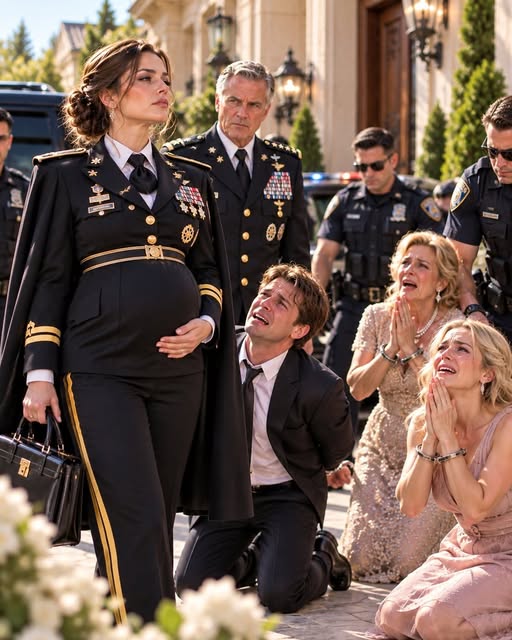
Seven Whitmore relatives arrived with Julian. Victoria wore cream wool and her largest pearls. Charles brought a leather briefcase. Grant and Miles, Julian’s younger brothers, arrived separately from their offices. Celeste wore a gray silk dress; she was the only person in the family who looked uncomfortable in the photographs taken outside. Aunt Evelyn carried white roses. Eleanor came in her wheelchair, pushed by an assistant she had known for nineteen years.
Eight adults, if you included the father of the supposed baby. The clinic staff did not seem impressed.