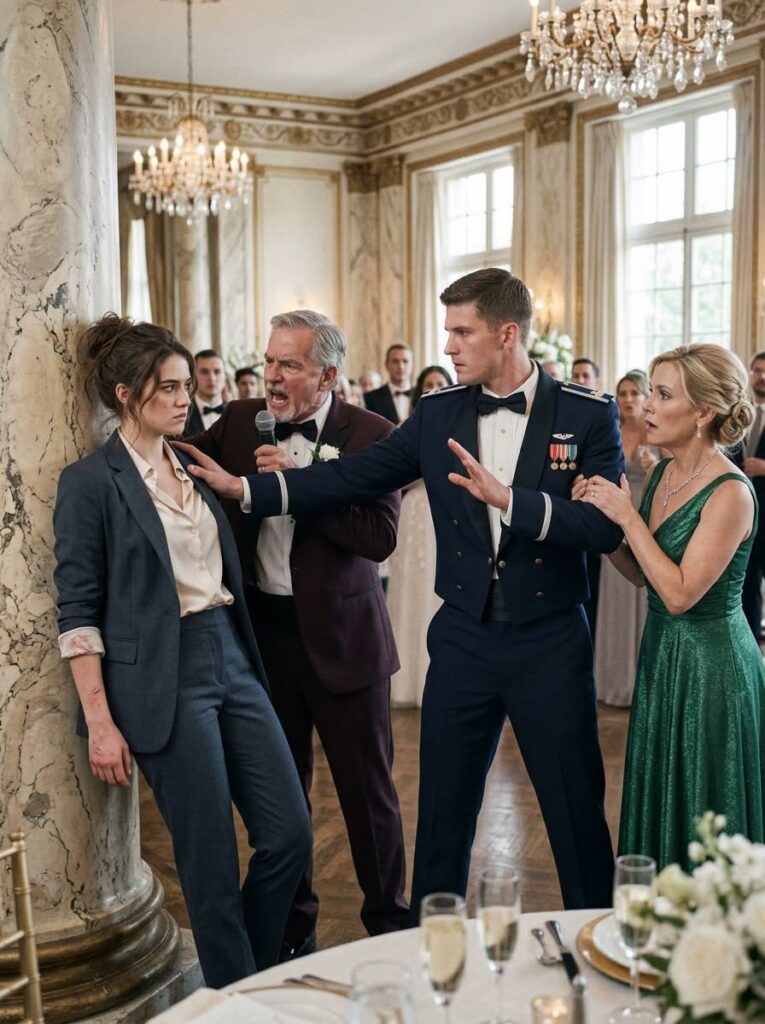
Brooke crossed the floor to me. My sister, who’d taken my room, who’d worn a diamond while believing I was a disgrace, stood in front of me with tears ruining her makeup.
“I let him move me into your room,” she said. “I let him tell me you’d deserted. I was so willing to believe you were the failure, because being the good daughter felt good, and asking questions felt dangerous.” She took my scarred hand, gently, over the burn. “This is from carrying a man out of a fire. And I’ve been using the room it cost you as a closet for shoes.” She broke down completely. “I’m so sorry, Lena. I don’t deserve for you to forgive me. But I’m done believing him. I’m done. The wedding, everything, I don’t care. I’m not going to stand next to that man and keep pretending you’re the problem.”
Ryan put his hand on Brooke’s shoulder. Then he looked at me, and he did something I didn’t expect. In the middle of the ruined ballroom, Lieutenant Commander Ryan Cole came to attention, and he saluted me.
“Major Vance,” he said. “On behalf of the teammate you carried out of that building, and every one of us who got to keep him. Thank you. It’s an honor I didn’t expect at my own engagement party.”
I returned the salute. It was the first time, in forty-eight hours of being called a coward in my childhood home, that anyone had looked at me and seen what I actually was.
PART 5
My father’s evening ended with him standing alone in the center of a emptying ballroom, the microphone dead in his hand, the audience he’d spent his life performing for filing out in silence. There’s a particular loneliness to a man who has just discovered that his power was all borrowed from people’s belief in his story, the moment the story collapses.
The financial fraud was not a thing that could be waved away, because I didn’t let it be. I’m a Marine officer; I don’t leave an objective half-taken. With the trust documents, the account records, and my father’s own public admission that he’d accessed my savings, the case was straightforward. He’d diverted my combat earnings and, it turned out, had been quietly siphoning from the family trust for years, Brooke’s inheritance as much as mine. The grandchildren’s trust my grandfather had built was supposed to pass to Brooke and me. My father had been spending it as his own.
He was removed as trustee. A court saw to that. Much of what he’d taken from the trust was recoverable; my personal savings, largely spent, were partially recovered through a civil judgment that will follow him for the rest of his life. He was not criminally prosecuted in the end, because Brooke asked me not to pursue it that far, he was still her father, and I’d done enough fighting for one lifetime. I honored her request, which is to say I stopped at taking back what he’d stolen and ending his control over the family’s money, rather than at putting a seventy-year-old man in prison. It was more mercy than he’d shown me. I decided that was the point.
My relationship with my father is over. Not dramatically. Simply. He chose, over two days and then in front of four hundred people, to call his decorated daughter a deserter to protect the money he’d stolen from her, and there is no coming back from a thing a man does that deliberately, that publicly, that cruelly. He reached out, later, with the kind of non-apology men like him produce, a letter about how I’d “humiliated the family” and “aired private matters in public.” I didn’t answer. He picked up the microphone. He made it public. I just told the truth once he had.
Brooke is a different story, and the good one. My sister did the hardest thing a favored child can do: she looked at the system that favored her, understood it was built on her sister’s erasure, and chose to dismantle it even though it had always benefited her. She moved out of the room that had been mine, not that it mattered by then, but she did it anyway, as a gesture. She stood beside me through the trust proceedings against her own father. She asked me, carefully, over many months, to tell her who I actually was, the sister she’d let our father convince her was a disgrace. We’re close now, closer than we ever were as children, when the roles were assigned and I was always the difficult one. It turns out my sister is funny and kind and fierce when she finally decides what she’s fighting for. She fought for me. I won’t forget it.
