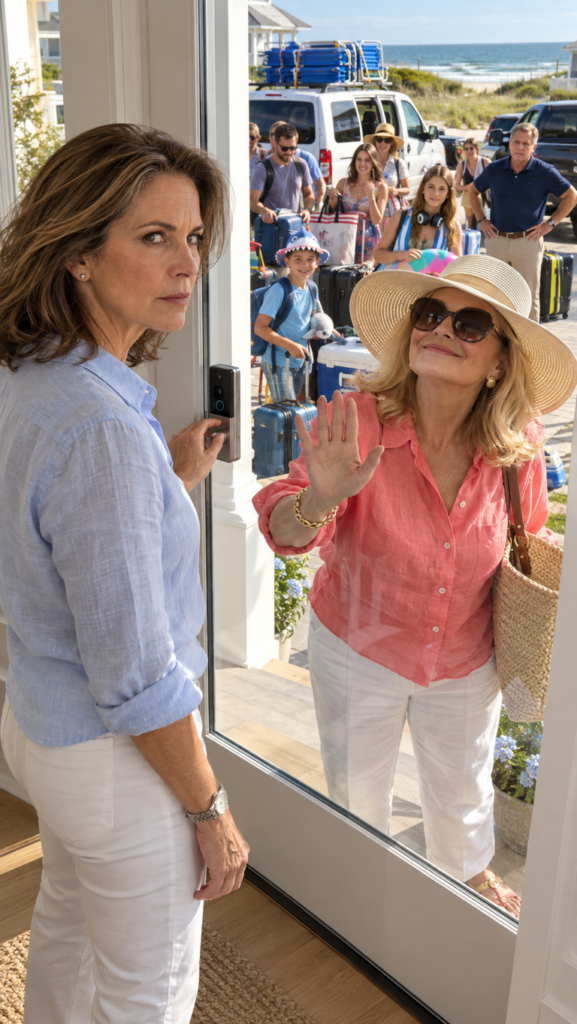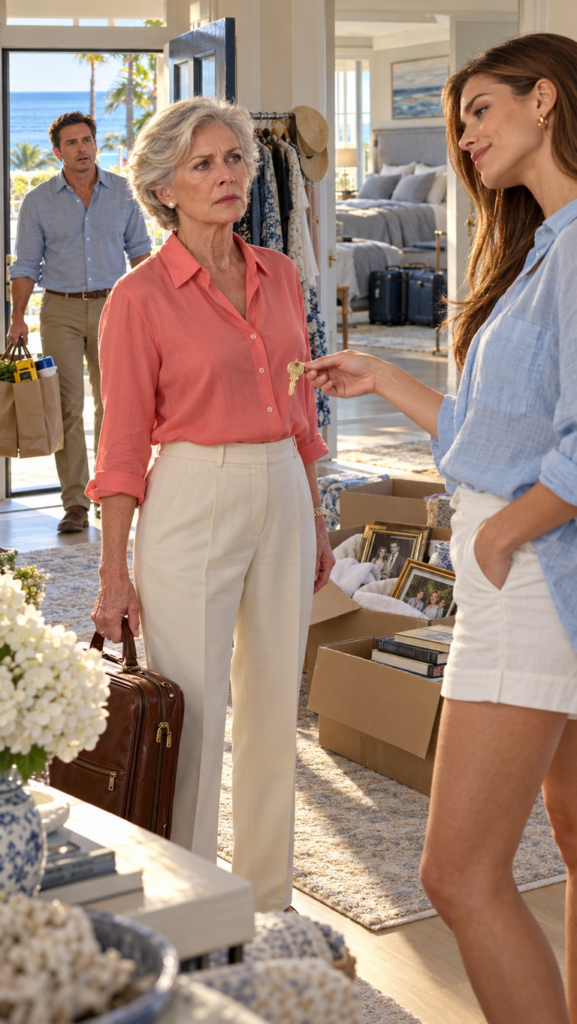
The house was gone.
The boundary was no longer theoretical.
“I accept your apology,” I said.
She looked up.
Relief appeared too quickly.
“So we’re okay?”
“No.”
The relief vanished.
“But maybe we will be.”
She swallowed.
“What does that mean?”
“It means forgiveness and trust are different things.”
Daniel stared at his coffee.
Lauren nodded slowly.
For once, she did not argue.
That mattered.
We talked for nearly two hours.
Her parents had sold their condo.
They rented a small apartment near Melissa.
Frank had picked up more contracting work.
They were not thrilled about it, but they were managing.
Nobody had become homeless.
Nobody’s life had been destroyed.
The catastrophe Lauren had used to justify taking over my house had turned out to be exactly what most adult problems are:
Unpleasant.
Complicated.
Expensive.
Solvable.
When they left, Lauren hugged me.
It was awkward.
But real.
Daniel stayed behind for a moment.
“Do you regret selling?”
I looked around my new house.
Sunlight filled the room.
My photographs were on the walls again.
Robert’s blue heron stood beside the fireplace.
The cracked photograph had been repaired.
My books were unpacked.
Nobody else’s luggage occupied the hallway.
“No.”
“Not even a little?”
I thought about the ocean.
I missed waking to it.
I missed the storms.
I missed the way Robert used to complain about sand getting into everything.
But missing something does not mean you made the wrong decision.
“Sometimes a place finishes being yours before you realize it,” I said.
Daniel nodded.
Then he smiled.
“Aunt Evelyn says I need a reservation to visit.”
“That sounds like her.”
“She wasn’t kidding.”
“That also sounds like her.”
He kissed my cheek and left.
A few weeks later, Evelyn invited me to dinner at the beach house.
I arrived just before sunset.
No strange cars filled the driveway.
No bicycles blocked the garage.
No wet towels hung over the chairs.
The cedar tree still leaned toward the ocean.
Inside, the house felt different.
Not worse.
Not better.
Different.
Evelyn had changed the curtains.
She moved the sofa.
She hated the blue kitchen tile as much as I once had, which made me irrationally defensive of it.
“You are not replacing that tile,” I told her.
She stared at me.
“You sold me the house.”
“Some things are sacred.”
She laughed.
We ate on the patio.
Halfway through dinner, headlights swept across the driveway.
I stiffened instinctively.
Evelyn noticed.
“Relax.”
A car door closed.
Daniel and Lauren appeared carrying dessert.
I looked at my sister.
“You invited them?”
“Yes.”
“Without asking me?”
“It’s my house.”
For one second, I stared at her.
Then we both burst out laughing.
Lauren heard us as she came through the gate.
“What’s funny?”
“Nothing,” I said.
“Family joke.”
She narrowed her eyes but smiled.
Daniel poured wine.
Lauren brought out plates.
Evelyn complained that everyone was using too many napkins.
The sun lowered over the dunes.
And for the first time in months, the house felt like what I had always wanted it to be.
A place family could gather.
Not because they owned it.
Not because they were entitled to it.
Because they had been invited.
There is a difference.
A very important one.
Later, when Daniel walked me to my car, he stopped beside the driver’s door.
“Mom?”
“Yes?”
“When you came home that day…”
He hesitated.
“I really thought you’d just accept it.”
“I know.”
“I’m glad you didn’t.”
That surprised me.
“Are you?”
He looked back at the house.
“Yeah.”
Then he looked at me.
“I think we all needed to learn where you ended and we began.”
I felt something loosen in my chest.
Maybe that was the real thing I had sold.
Not the house.
The old version of me.
The woman who believed peace meant keeping everyone else comfortable.
The woman who mistook generosity for obligation.
The woman who would rather swallow anger than risk disappointing her son.
I hugged him.
Then I drove home.
My smaller house was dark when I arrived.
I unlocked the front door.
Turned on the lamp.
Set my purse on the table.
Everything was exactly where I had left it.
Robert’s photograph sat on the shelf.
The repaired glass caught the light.
I smiled at him.
“Well,” I said softly, “that was dramatic.”
In my imagination, I could hear him laughing.
I walked into the kitchen, made tea, and carried it onto the porch.
The marsh was quiet beneath the moon.
No shouting.
No barbecue smoke.
No strangers.
No suitcases.
Just me.
My house.
My rules.
And for the first time in a very long while, that didn’t feel lonely.
It felt like freedom.