El auditorio de Fort Liberty estaba impregnado del aroma a abrillantador de latón, lana impecable y décadas de historia militar. Los techos altos atrapaban el murmullo de las conversaciones entre los militares en servicio activo y sus familias. Para la mayoría de los soldados que permanecían firmes a lo largo del pasillo izquierdo, la tarde era un honor formal; para mí, era una prueba que apenas había reunido el valor para soportar.
Me encontraba cerca del escenario, con mi uniforme de gala, la tela rígida contra mi piel. Recorrí con la mirada la tercera fila del público, deteniéndose en las tres personas que me habían hecho la vida imposible mucho antes de pisar una zona de combate.
Mi padre, Richard, estaba sentado con las manos fuertemente entrelazadas en su regazo, mirando fijamente al frente con una expresión vacía y pasiva. A su lado estaba mi madrastra, Linda, con los brazos cruzados sobre el pecho y los labios curvados en una leve mueca de desdén, la misma que la caracterizaba desde que yo tenía doce años. Junto a ella estaba mi hermanastro, Kyle, recostado despreocupadamente en su silla, tamborileando con los dedos sobre la rodilla como si esperara a que terminara una película aburrida.
“Sargento Natalie Porter”, resonó la voz del locutor por el sistema de megafonía.
Di un paso al frente, poniéndome firme al ver acercarse al teniente general Robert Hayes. Su pecho estaba cubierto de condecoraciones: toda una vida de servicio plasmada en plata y oro sobre su chaqueta oscura. Cojeaba levemente, un recordatorio físico del despliegue que habíamos compartido dos años antes en las polvorientas y turbulentas colinas a las afueras de Al-Asad.
—Sargento —dijo el general Hayes en voz baja, con un tono de reverencia silenciosa que solo iba dirigido a mí. Prendió la Corazón Púrpura en mi chaqueta, con dedos firmes mientras colocaba la medalla sobre mi pecho—. Por heroísmo extraordinario y las heridas sufridas en acto de servicio.
—Gracias, general —susurré, manteniendo la mirada fija al frente.
Cuando el general se giró para entregar la carpeta de presentación a su ayudante, tropezó con el borde de la plataforma baja de madera que enmarcaba los escalones del escenario. Su cuerpo se inclinó hacia adelante, un tropiezo fuerte e inusual para un comandante de tres estrellas.
El instinto se apoderó de mí antes de que mi cerebro pudiera procesar el movimiento. Me lancé hacia adelante, extendiendo el brazo, y lo sujeté firmemente por debajo del hombro, estabilizando su cuerpo de un metro ochenta y ocho antes de que cayera.
“Tranquilo, señor”, dije en voz baja, ayudándolo a recuperar el equilibrio.
El general Hayes recuperó el aliento, se ajustó la gorra y esbozó una inusual y cálida sonrisa. “Sigo velando por todos, sargento Porter”.
“Always, sir.”
I stepped back toward the edge of the platform to return to my position, but the moment of solemnity was shattered by a sharp, cutting voice from the aisle just below me.
“Look at her,” Linda sneered, her voice carrying easily across the silent room. “Always putting on a show for the brass. Disgusting.”
A few heads in the row behind her turned in mild surprise. I felt a hot flush of embarrassment creep up my neck. I looked down at her, trying to keep my voice flat and non-confrontational.
“Linda, sit down. Please.”
That was all it took. The simple request acted as a spark on dry kindle. Linda’s eyes widened with a strange, frantic fury. For years, any attempt by me to set a boundary was treated by her as an act of open defiance.
“Don’t you dare talk to me like that!” she snapped.
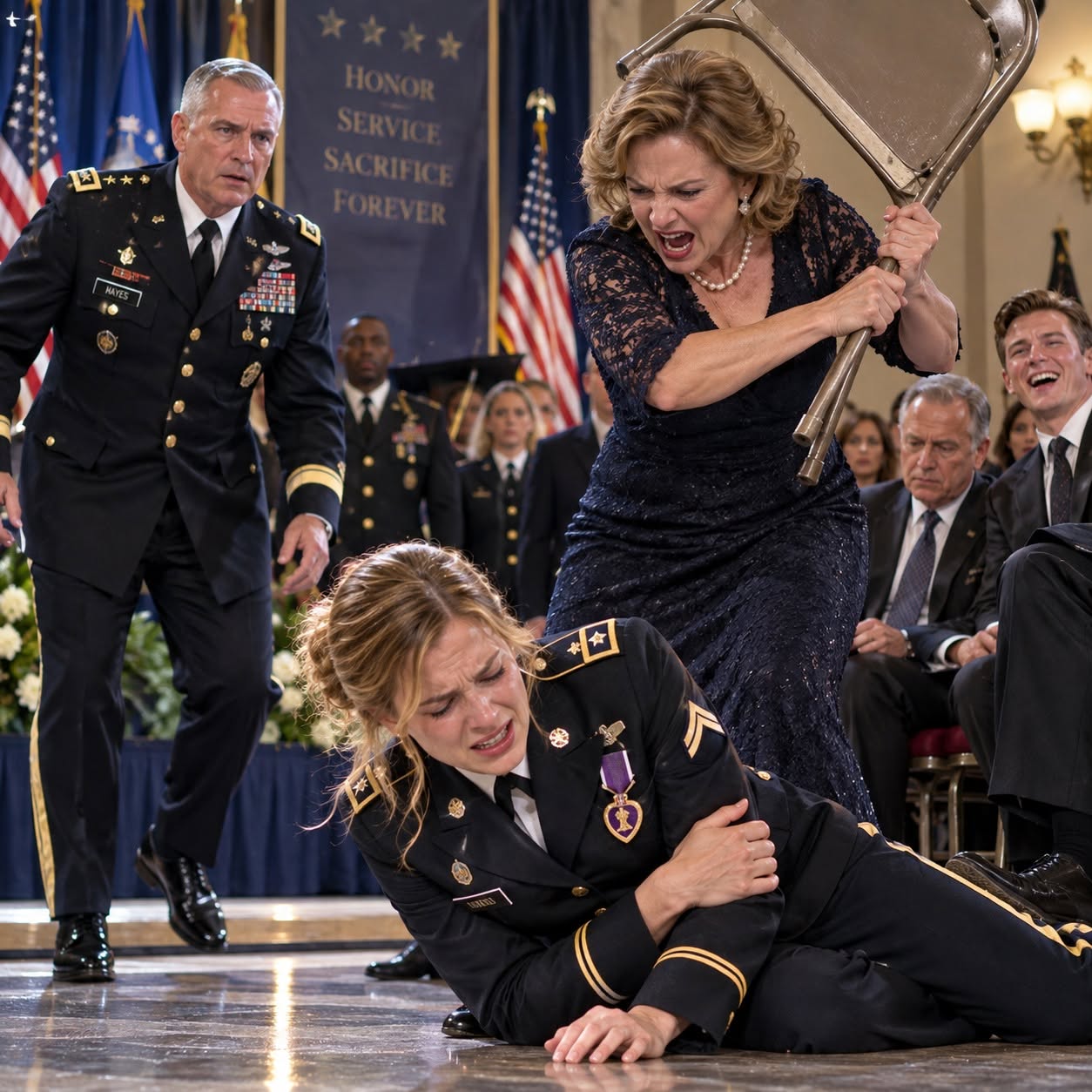
Before anyone could intervene, Linda grabbed the heavy metal folding chair from the empty spot beside her. With a sudden, terrifying burst of violence, she hoisted it overhead and swung it across the wooden railing toward my head.
I had split seconds to react. I threw my left arm up to protect my head and face.
CRACK.
The hollow metal tubing slammed directly into my forearm with the force of a sledgehammer. The sound of bone fracturing was loud enough to echo against the hard walls of the auditorium.
A white-hot wave of agony tore up my arm, radiating into my shoulder and chest. The force of the strike knocked me off balance, and I pitched sideways, collapsing onto the hard wooden floor beside the stage. My vision blurred into a dizzying vortex of white light and dark spots.
“Natalie!” a voice yelled from the crowd, followed by a chorus of shocked gasps and scraping chairs.
I lay on the floor, clutching my shattered left wrist against my stomach, gasping for air as pain surged through my entire body.
Linda stood over the railing, her face flushed red, her fingers still trembling from the impact of the chair. Military police officers were already moving down the side aisles, but she didn’t back down.
“You think that medal makes you better than us?!” she screamed, her voice cracking with wild anger. “You think putting on a uniform erases what you are?!”
The boots of the MPs hit the floor in a rapid cadence, but Linda kept yelling over the growing chaos.
“You’re still trash in uniform!” she shouted. Then, she spat out the word she had weaponized against me behind closed doors for a decade: “Slut!”
Through the haze of blinding pain, I looked toward the third row. My father was standing now, but he wasn’t moving toward me. He wasn’t yelling at Linda. He simply lowered his eyes, staring down at the carpet as if he were trying to disappear into the floorboards.
Beside him, Kyle tilted his head back and laughed—a sharp, amused bark that hit me harder than the metal chair.
Two MPs grabbed Linda by the arms, dragging her back from the railing.
—¡Quítenme las manos de encima! —gritó, forcejeando para liberarse de su agarre—. ¡Es mi hijastra! ¡Esto es un asunto familiar!
