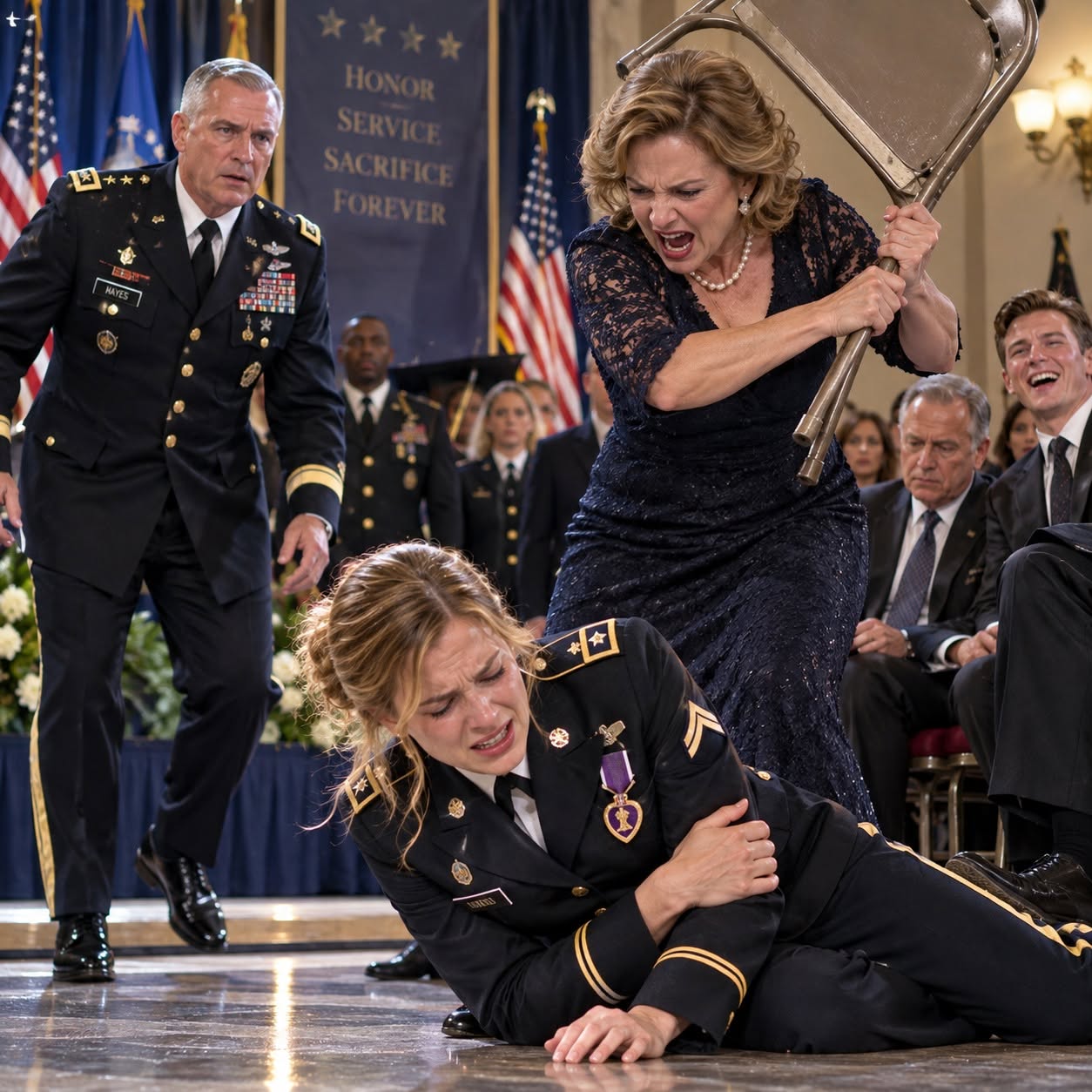
L’auditorium de Fort Liberty était imprégné des effluves de cire à laiton, de laine craquante et de décennies d’histoire militaire. Les hauts plafonds emprisonnaient le murmure des conversations entre les militaires en service actif et leurs familles. Pour la plupart des soldats alignés au garde-à-vous dans l’allée de gauche, cet après-midi était un honneur officiel ; pour moi, c’était une épreuve que j’avais à peine eu le courage d’affronter.
Je me tenais près du devant de la scène, vêtu de mon uniforme de service de classe A, le tissu rigide contre ma peau. Mon regard parcourut le troisième rang du public et s’arrêta sur les trois personnes qui avaient fait de ma vie un véritable enfer bien avant que je ne mette les pieds en zone de combat.
Mon père, Richard, était assis, les mains crispées sur ses genoux, le regard fixe et absent. À côté de lui se trouvait ma belle-mère, Linda, les bras croisés sur la poitrine, les lèvres retroussées en un rictus de mépris qui la caractérisait depuis mes douze ans. À côté d’elle, mon demi-frère, Kyle, était nonchalamment affalé dans son fauteuil, tapotant du bout des doigts son genou comme s’il attendait la fin d’un film ennuyeux.
« Sergent Natalie Porter », annonça la voix du speaker dans les haut-parleurs.
Je m’avançai, me mettant au garde-à-vous à l’approche du lieutenant-général Robert Hayes. Sa poitrine était couverte de rubans – une vie de service inscrite en argent et en or sur sa veste sombre. Il boitait légèrement, une séquelle physique du déploiement que nous avions effectué ensemble deux ans auparavant dans les collines poussiéreuses et instables aux abords d’Al-Asad.
« Sergent », dit doucement le général Hayes, sa voix grave empreinte d’un respect silencieux qui m’était exclusivement destiné. Il épingla la Purple Heart sur ma veste, ses doigts fermes fixant la médaille sur mon cœur. « Pour acte d’héroïsme exceptionnel et blessures subies en service commandé. »
« Merci, Général », ai-je murmuré, en gardant les yeux fixés droit devant moi.
Alors que le général se tournait pour remettre le dossier de présentation à son aide, son pied heurta le bord de la petite estrade en bois qui encadrait les marches de l’estrade. Son corps bascula en avant – un faux pas lourd et inhabituel pour un commandant trois étoiles.
L’instinct a pris le dessus avant même que mon cerveau puisse analyser le mouvement. Je me suis précipité en avant, j’ai tendu le bras et je l’ai rattrapé fermement sous l’épaule, stabilisant sa silhouette d’1,88 m avant qu’il ne tombe.
« Doucement, monsieur », dis-je doucement, en l’aidant à retrouver son équilibre.
General Hayes caught his breath, adjusting his cap, and offered a rare, warm smile. “Still looking after everyone, Sergeant Porter.”
“Always, sir.”
I stepped back toward the edge of the platform to return to my position, but the moment of solemnity was shattered by a sharp, cutting voice from the aisle just below me.
“Look at her,” Linda sneered, her voice carrying easily across the silent room. “Always putting on a show for the brass. Disgusting.”
A few heads in the row behind her turned in mild surprise. I felt a hot flush of embarrassment creep up my neck. I looked down at her, trying to keep my voice flat and non-confrontational.
“Linda, sit down. Please.”
That was all it took. The simple request acted as a spark on dry kindle. Linda’s eyes widened with a strange, frantic fury. For years, any attempt by me to set a boundary was treated by her as an act of open defiance.
“Don’t you dare talk to me like that!” she snapped.
Before anyone could intervene, Linda grabbed the heavy metal folding chair from the empty spot beside her. With a sudden, terrifying burst of violence, she hoisted it overhead and swung it across the wooden railing toward my head.
I had split seconds to react. I threw my left arm up to protect my head and face.
CRACK.
The hollow metal tubing slammed directly into my forearm with the force of a sledgehammer. The sound of bone fracturing was loud enough to echo against the hard walls of the auditorium.
A white-hot wave of agony tore up my arm, radiating into my shoulder and chest. The force of the strike knocked me off balance, and I pitched sideways, collapsing onto the hard wooden floor beside the stage. My vision blurred into a dizzying vortex of white light and dark spots.
“Natalie!” a voice yelled from the crowd, followed by a chorus of shocked gasps and scraping chairs.
I lay on the floor, clutching my shattered left wrist against my stomach, gasping for air as pain surged through my entire body.
Linda stood over the railing, her face flushed red, her fingers still trembling from the impact of the chair. Military police officers were already moving down the side aisles, but she didn’t back down.
“You think that medal makes you better than us?!” she screamed, her voice cracking with wild anger. “You think putting on a uniform erases what you are?!”
The boots of the MPs hit the floor in a rapid cadence, but Linda kept yelling over the growing chaos.
“You’re still trash in uniform!” she shouted. Then, she spat out the word she had weaponized against me behind closed doors for a decade: “Slut!”
Through the haze of blinding pain, I looked toward the third row. My father was standing now, but he wasn’t moving toward me. He wasn’t yelling at Linda. He simply lowered his eyes, staring down at the carpet as if he were trying to disappear into the floorboards.
À côté de lui, Kyle a incliné la tête en arrière et a ri – un aboiement aigu et amusé qui m’a frappé plus fort que la chaise en métal.
Deux députés ont saisi Linda par les bras et l’ont tirée en arrière, l’éloignant de la rambarde.
