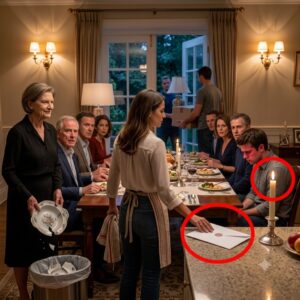
I opened the envelope.
“I hired a lawyer because someone contacted a real-estate attorney three weeks ago asking how Daniel could establish an ownership interest in this house.”
Daniel’s face changed.
Margaret didn’t move.
That told me everything.
I pulled out the first document.
“My attorney found something interesting.”
“Claire,” Daniel said quietly.
I looked at him.
“Did you know?”
“Know what?”
“That your mother had been asking questions about my deed?”
He looked toward Margaret.
Wrong direction.
I felt something inside me break.
Not dramatically.
Quietly.
The way a thread finally snaps after being pulled too many times.
“Daniel?”
His shoulders dropped.
“She asked me some questions.”
“What questions?”
“About what would happen to the house if something happened to you.”
One of Daniel’s aunts put down her fork.
I stared at my husband.
“I’m forty-six.”
“I know.”
“I’m healthy.”
“I know.”
“So why was your mother researching what happens to my property when I die?”
Margaret slammed her hand against the table.
“Oh, stop making everything sound sinister.”
“Then explain it.”
“You don’t have children.”
I blinked.
“What does that have to do with anything?”
“My son has spent seven years in this house.”
“Living here doesn’t make him an owner.”
“It should.”
There it was.
I looked around the table.
Several relatives suddenly became very interested in their plates.
Margaret continued.
“A husband shouldn’t have to worry that his wife can throw him onto the street whenever she gets emotional.”
“Have I ever threatened to?”
“No, but—”
“Have I?”
She hesitated.
“No.”
I turned to Daniel.
“Have I ever threatened to make you leave?”
“No.”
“Have I ever asked you to pay my mortgage?”
“No.”
“Property taxes?”
“No.”
“Major repairs?”
“No.”
Margaret scoffed.
“He contributes in other ways.”
“Yes.”
I nodded.
“He pays half the utilities and groceries.
That’s what we agreed to.”
Margaret leaned forward.
“And what does he get after seven years?”
I stared at her.
“A marriage.”
Someone at the far end of the table coughed to hide a laugh.
Margaret flushed.
“You know exactly what I mean.”
“Yes.”
I looked at the papers.
“And that’s why we’re having this conversation.”
I removed another page.
“This is a copy of an email sent to a property attorney.”
Daniel looked confused.
Margaret looked terrified.
I read aloud.
“My son has lived in the property for seven years and has contributed to household expenses.
What documentation would strengthen a future claim of equitable ownership?”
The room went completely silent.
Daniel turned toward his mother.
“You sent that?”
Margaret lifted her chin.
“I was protecting you.”
“From my wife?”
“From being left with nothing.”
I looked at Daniel.
“Did you ask her to do this?”
“No.”
His answer came quickly.
Then Margaret said something that changed the entire room.
“You didn’t complain when I told you about the refinance idea.”
My eyes moved back to Daniel.
“What refinance idea?”
He closed his eyes.
Margaret realized her mistake too late.
“Daniel?”
He rubbed his forehead.
“Mom thought we could refinance the house and use some of the equity.”
“For what?”
Silence.
“For what, Daniel?”
He looked at me.
“To help with her new place.”
I almost laughed.
Margaret had sold her condo.
She had told us her next home had been delayed.
But apparently there was more.
“How much?”
“Claire—”
“How much?”
Margaret answered.
“About one hundred and eighty thousand.”
One of the relatives actually gasped.
I stared at her.
“You wanted me to borrow $180,000 against my house so you could buy another one?”
“Not borrow.
Access equity.”
“That is borrowing.”
“It would benefit the family.”
“Which family?”
Margaret’s face tightened.
“Daniel would eventually inherit everything anyway.”
I turned toward my husband.
He looked sick.
“Is that what you told her?”
“No.”
“Then why did she believe it?”
“I don’t know.”
Margaret laughed bitterly.
“Because it’s obvious!
You’re married.
You’re not going to leave the house to strangers.”
I reached into the envelope again.
“Actually, that brings us to the documents.”
Her confidence faltered.
My attorney had helped me create a revocable living trust.
The house would remain entirely under my control during my lifetime.
If I became incapacitated, a professional fiduciary—not Daniel and certainly not Margaret—would manage it according to my written instructions.
If I died, Daniel would have a limited right to remain in the property for a specified period, but ownership would eventually pass according to the beneficiaries I had chosen.
No one could borrow against it without my authorization.
No one could quietly add a name to the deed.
And no relative could turn my home into an inheritance plan while I was still alive.
I slid a copy toward Daniel.
His face went pale.
“You put the house in a trust?”
“Yes.”
“When?”
“Friday.”
Margaret shot to her feet.