That was not negotiable.
My house remained legally protected.
That wasn’t punishment.
It was clarity.
Almost a year after the dinner, Margaret asked to meet me.
We chose a café.
Public.
Neutral.
She looked smaller than I remembered.
“I suppose you’re happy,” she said.
“About what?”
“That Daniel barely speaks to me.”
“I don’t control how often your son calls.”
“He changed after you married him.”
I almost laughed.
“No, Margaret.
He changed after he finally stopped being afraid of disappointing you.”
Her face tightened.
Then softened.
“I thought the house would give him security.”
“Daniel has a career.
Savings.
Retirement accounts.
He has security.”
“But it was yours.”
“Yes.”
“That bothered me.”
“I know.”
She looked surprised.
I continued.
“You weren’t afraid Daniel would become homeless.
You were afraid I possessed something you couldn’t control.”
Her eyes filled.
For once, she didn’t argue.
“I sold my condo too quickly.”
That was the first honest sentence she had given me.
“Why?”
“My friend Patricia bought a beautiful place near the lake.
I wanted something similar.”
“So you sold before you could afford the replacement.”
“Yes.”
“And expected us to solve the difference.”
She nodded.
“I convinced myself Daniel would inherit your house someday, so using some of its value now wasn’t really taking anything.”
I stared at her.
“I was still living in it.”
“I know.”
“That’s a fairly important detail.”
A tiny, embarrassed laugh escaped her.
Then she started crying.
“I treated you terribly.”
“Yes.”
“I was jealous.”
That surprised me.
“Of me?”
“You had your own career.
Your own home.
Daniel loved you.
You never seemed to need anyone’s approval.”
I thought of seven years of swallowing insults.
“You’re giving me too much credit.”
She smiled weakly.
“Maybe.”
Then she said the words I had never expected.
“I’m sorry, Claire.”
I accepted her apology.
I didn’t give her a key.
Those are two different things.
Two years later, Daniel and I were still married.
Stronger, actually.
Not because the conflict disappeared.
Because silence did.
Margaret visited occasionally.
She called first.
She didn’t move furniture.
She didn’t criticize dinner.
And she never again referred to my house as Daniel’s inheritance.
One Thanksgiving, she arrived carrying a casserole.
I opened the door.
She smiled nervously.
“I made sweet potatoes.”
“Great.”
She held the dish tighter.
“If nobody likes them, please don’t throw them in the trash.”
I stared at her.
Then we both started laughing.
It was the first time we had ever laughed together.
At dinner, Daniel helped me serve.
Margaret sat with the rest of the family.
No one commanded.
No one inspected.
No one humiliated anyone.
Afterward, Margaret carried her own plate toward the kitchen.
“You’re a guest,” I told her.
She stopped.
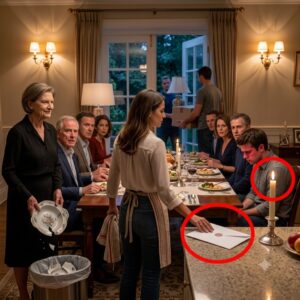
For a second, I remembered the Sunday dinner years earlier.
The serving dish.
The trash.
The apron.
The envelope.
Margaret smiled.
“I know.”
Then she added, “But guests can still help if they’re invited.”
I handed her a dish towel.
“Dry.”
“Yes, ma’am.”
Daniel laughed.
I did too.
The envelope from that terrible dinner is still in my filing cabinet.
The trust has been updated several times.
Daniel knows exactly what it says.
So do I.
But I don’t keep that original envelope because I’m afraid Margaret will come after my house again.
I keep it because of what it represents.
For seven years, I believed keeping quiet was kindness.
It wasn’t.
It was permission.
Margaret didn’t become controlling overnight.
She moved one boundary at a time.
A comment about dinner.
A criticism about money.
A missing photograph.
A changed curtain.
A contractor in my office.
A plan for my equity.
Each time I stayed quiet, she learned she could move another inch.
Until one Sunday evening, she took dinner from my hands and threw it into the trash in front of twelve people.
She thought she was teaching me my place.
Au lieu de cela, elle m’a enfin appris quelque chose de bien plus précieux.
Une maison n’est pas protégée uniquement par un acte de propriété.
Un mariage n’est pas protégé uniquement par l’amour.
Les deux nécessitent des limites.
Et les limites comptent très peu s’il n’y a jamais de conséquences à franchir.
Cette nuit-là, Margaret sourit quand j’enlevai mon tablier.
Elle pensait que je retournais à la cuisine pour préparer un autre repas.
À la place, j’ai pris une enveloppe.
Elle contenait des papiers protégeant la maison qu’elle avait déjà commencé à considérer comme la sienne.
Mais la chose la plus importante dans cette enveloppe n’était pas une fiducie.
Ce n’était pas un langage juridique.
Ce n’était pas le nom de mon avocat.
C’était la décision que j’avais enfin prise avant même de la sceller.
Ma maison était la mienne.
Ma dignité m’appartenait.
Et si quelqu’un voulait une place dans l’un ou l’autre, il devrait apprendre à respecter les deux.