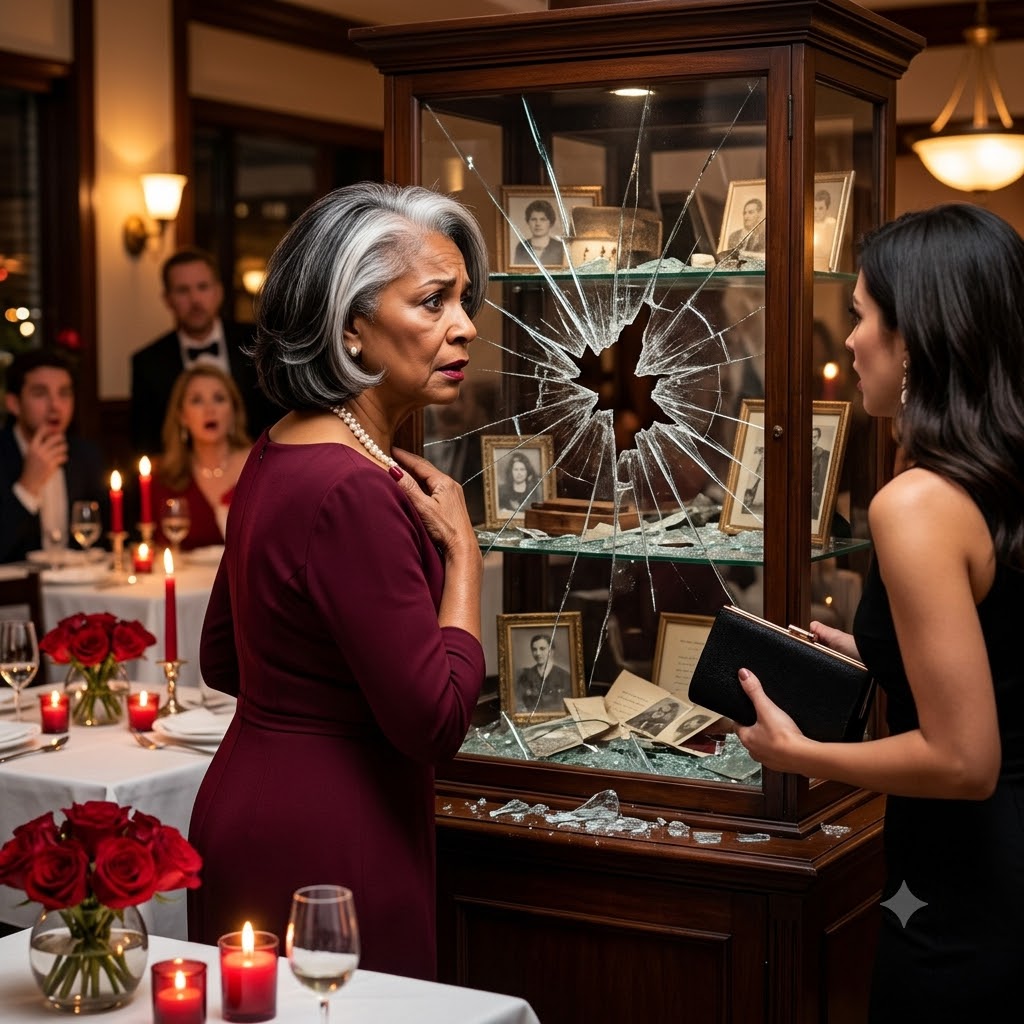
I bent close to Meredith’s ear, and I kept my voice low and even while cream slid from her face onto her gown.
“You smashed my heirlooms. Now you’ve inherited my wrath.”
Meredith remained on one knee among the glass, and the restaurant manager appeared at my elbow holding a telephone against his chest.
Chapter 2: The Manager Explained The Cabinet Was Never Ours Alone
The manager introduced himself to the approaching servers as Bernard, and he ordered them to keep every guest away from the glass.
Bernard asked Meredith to remain seated on the carpet, and he asked me to return to my chair while he telephoned the restaurant owner.
I refused the chair, and I stood where I could watch the broken cabinet and the woman kneeling beside it at the same time.
Two servers brought a low screen from the bar area, and they placed it around the cabinet to shield the glass from curious guests.
A third server began photographing the damage with the restaurant tablet, and the flash lit Meredith’s cream-covered face repeatedly.
Bernard returned from the telephone with a folder in his hand, and he opened it on our table in front of Remy and me.
“These pieces arrived on loan for heritage week, and every lender signed a display agreement with the restaurant last month.”
I stared at the folder because I had signed that same agreement myself, and I had listed my mother’s china among the loaned objects.
Bernard explained that three other families had loaned pieces to the cabinet, including a retired judge and a widow from my own church.
The judge had loaned a silver tray engraved for his parents’ fiftieth anniversary, and the tray now lay bent beneath the fallen shelf.
The widow, whose name was Clara, had loaned a porcelain angel her husband carried home from overseas service before they married.
The angel’s head had separated from its body in the fall, and Clara’s name appeared on the inventory beside a photograph of the intact piece.
Meredith wiped cream from one eye with her fingers, and she demanded to know why anyone displayed valuable objects where guests could reach them.
Bernard answered that the cabinet door had remained locked all week, and he pointed to the bent lock plate hanging from the broken frame.
“The lock held through six days of dinners, madam, and it failed tonight because somebody struck the glass with considerable force.”
Remy stood beside his wife without helping her rise, and he asked Bernard what happened next for the families involved.
Bernard explained that the restaurant’s insurer would inventory every damaged piece in the morning, and the insurer would assign values from the signed agreements.
Each agreement contained an appraised value the lender had accepted in writing before the cabinet was filled for heritage week.
My own agreement listed my mother’s wedding china as a set, and the appraisal had surprised me when the insurer first calculated it last month.
Meredith rose slowly from the carpet using the chair for support, and champagne dripped from her hair onto the restaurant floor.
“This is a family argument in a restaurant, and insurance companies do not get to turn my mistake into some financial disaster.”
Bernard looked at the bent lock, and he looked at the clutch lying beside the cabinet with its beaded strap twisted around a chair leg.
He asked Meredith whether the clutch belonged to her, and she told him the question insulted her in front of the entire dining room.
A guest at the rose table, an older man named Walter, spoke without leaving his seat near the window.
“I watched her swing that bag into the glass, and I will tell the insurance people the same thing I am telling you.”
His companion nodded, and two more guests near the cabinet offered their names to Bernard for the incident record he was building.
Bernard wrote each name carefully in the folder, and Meredith’s objections grew quieter as the list lengthened on the page.
Remy finally asked his wife directly whether she had swung the clutch, and she answered that the cabinet had been flimsy all evening.
I watched my son absorb that answer, and I watched him look at the locked cabinet frame as if the metal might support her story.
Bernard then asked the servers to collect every fragment from the carpet into trays, because Denise would need the pieces for her inventory.
The servers worked on their knees with gloves and small brushes, and they placed glass and china into separate trays as Bernard directed.
One server found the brass frame beneath a napkin, and the photograph inside it had survived although the glass over my parents had cracked diagonally.
I held that frame for several minutes, and I looked at my mother smiling outside this restaurant before I was born into her life.
Meredith asked whether she could leave, and Bernard informed her that the owner wanted a signed incident statement from every person at our table.
She signed the statement after reading only its first page, and she wrote the word accident in the margin beside her signature without permission.
Bernard crossed out nothing, because he explained that her own handwriting would interest the insurer as much as the printed statement did.
Remy signed his statement next, and he wrote that he had watched his wife raise the clutch before the glass broke in front of him.
He showed me that sentence before he handed the page to Bernard, and I understood he had chosen accuracy over protection for the first time.
My own statement took four pages, because I described every object in the cabinet and every question Meredith had asked about inheritance that evening.
Bernard placed all three statements inside the folder, and he added the reservation record showing Meredith had requested our table near the cabinet.
That reservation detail caught my attention, because Remy told me later that Meredith had telephoned the restaurant twice to confirm our seating position.
Bernard closed the folder, and he told us the insurer’s representative would arrive at the restaurant at nine o’clock the following morning.
