Chapter 3: The Appraiser Read Every Value Aloud
The insurer’s representative arrived at nine o’clock wearing a gray suit and carrying a case of labeled bags for the fragments.
Her name was Denise, and she had appraised two of the cabinet pieces herself when the lenders signed their agreements last month.
Bernard unlocked the restaurant early for the meeting, and the morning light showed glass dust across a wider area than candlelight had revealed.
Remy and Meredith arrived together, and Meredith wore dark glasses indoors although the dining room windows faced away from the sun.
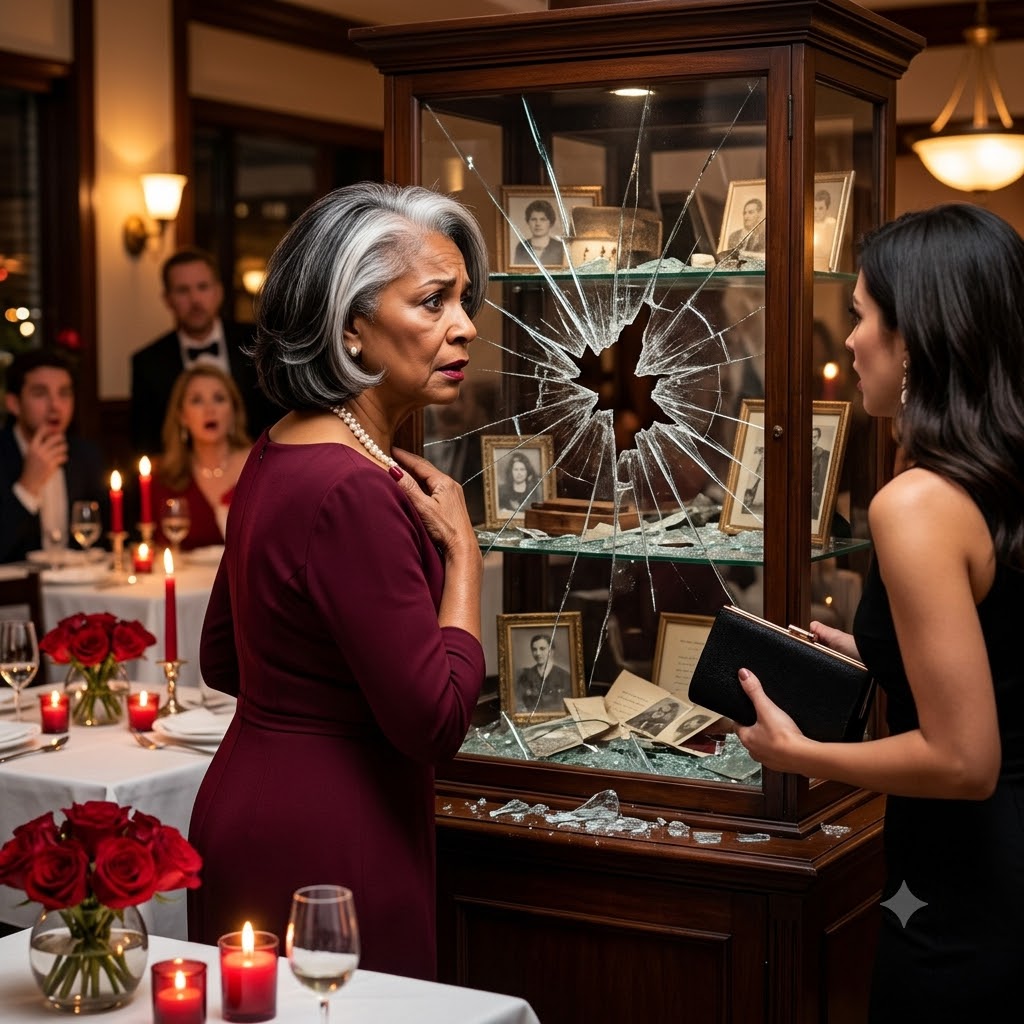
I sat at our table from the night before, and I watched Denise lift each damaged object from the cabinet with gloved hands.
She placed my mother’s wedding plate in a labeled bag, and she recorded the three broken pieces as a complete loss of the set.
A wedding china set lost value as a set, she explained, because collectors and families valued the unbroken service rather than single surviving plates.
The christening cup from 1911 had cracked along its handle, and Denise recorded a partial loss with restoration possible at specialist cost.
Clara’s porcelain angel required a conservator, and the estimated repair exceeded the figure Clara had accepted with such reluctance last month.
The judge’s silver tray could be straightened by a silversmith, and Denise noted the engraving had survived without damage to the inscription.
Two smaller pieces from a fourth family, a pair of candlesticks loaned by a brother and sister, had both snapped at their stems.
Denise read each appraised figure aloud as she entered it into her tablet, and the numbers accumulated in a column on her screen.
Meredith removed her dark glasses when the total passed the cost of the car she drove, and she leaned forward in her chair.
“These are sentimental objects from family shelves, and nobody in this room can pretend they carry prices like paintings in a museum.”
Denise turned her tablet toward Meredith, and she showed her the signed agreements with each lender’s signature beneath the appraised values.
“Every owner in this process accepted these figures in writing, and the restaurant insured the display for exactly these amounts.”
Remy asked what portion of the total belonged to my family pieces, and Denise separated the column into lender totals with two taps.
My family’s share came to less than half the full amount, which meant Meredith had harmed strangers as thoroughly as she had harmed me.
Meredith turned toward Remy with her mouth open, and she asked him whether his mother had known other families had pieces inside.
I answered that question myself before my son could soften it into something more comfortable for his wife to hear.
“I knew my neighbors trusted that cabinet, and I knew the lock had protected their treasures through six evenings of strangers.”
Denise then explained the process that followed her inventory, and her explanation removed any hope Meredith carried about private settlements.
The insurer would pay each lender the agreed value, and the insurer would then pursue the person responsible for the damage for full reimbursement.
Bernard added that the restaurant would cooperate with the claim, including the photographs, the witness names, and the reservation record for our table.
Meredith asked about the restaurant’s own security recording, and Bernard confirmed that a camera above the bar covered the cabinet area.
Denise requested a copy of that recording before she closed her case, and Bernard promised to send it to her office that same afternoon.
Remy covered his face briefly with one hand, and he asked Denise how long Meredith would have before the insurer contacted her formally.
Denise answered that a demand letter usually followed within ten business days, and she advised Meredith to inform her own insurance provider immediately.
Meredith laughed once without humor, and she told Denise that homeowners’ policies were not designed for mother-in-law emergencies at restaurants.
While Denise packed her case, Bernard played the security recording on the office monitor for Remy at his request.
The recording showed Meredith checking the dining room over her shoulder, and it showed her adjusting her grip on the clutch before the swing.
Remy watched the clip three times, and he asked Bernard whether the restaurant could preserve the file beyond its normal retention period.
Bernard assured him the file had already been copied to the owner’s secure drive, because the insurer had requested preservation in writing that morning.
Meredith refused to watch the recording, and she told Remy that repeated viewing turned one bad second into a permanent family legend.
He answered that the second had been bad because she had filled it with a decision, and their exchange followed us into the parking lot.
Outside the restaurant, Meredith demanded the car keys from her husband, and he handed them over without arguing in front of Bernard’s staff.
She drove away alone after that exchange, leaving Remy to accept a ride home from me in a car filled with unspoken calculations.
During the drive, he asked me to describe each piece I had loaned, because he wanted to understand the loss beyond the figures Denise had read.
I described my grandmother’s spoon with its worn handle, and I described the christening cup that had touched the lips of four generations.
He listened to every description, and he wrote the details in his phone at red lights so he would remember them accurately later.
At his house, he stood in the driveway after I stopped the car, and he told me he dreaded entering a home where the recording existed in his mind.
Before I drove away, he repeated Denise’s final warning from the meeting, because the demand would arrive addressed to Meredith alone within days.
