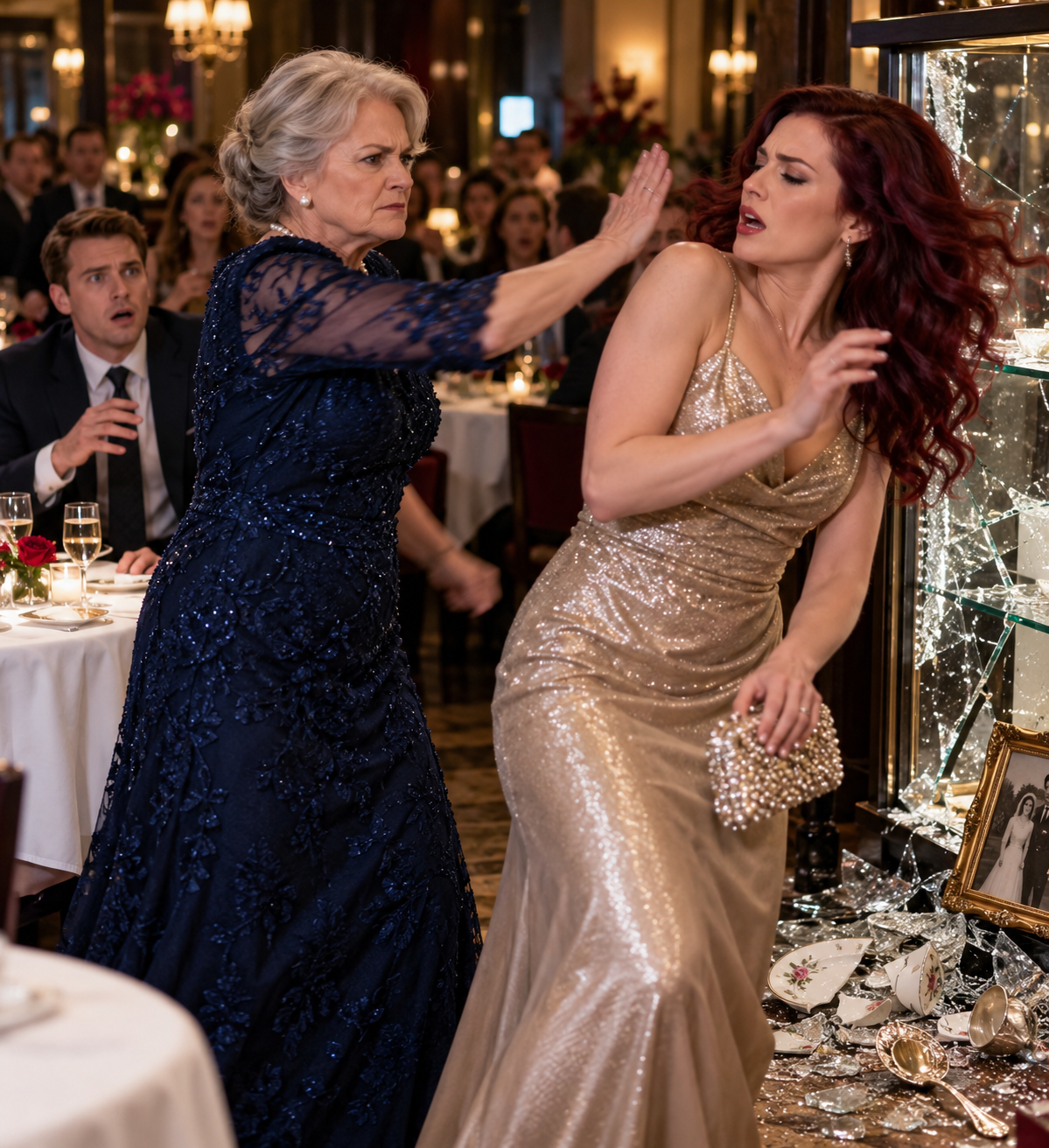
“Oops! Your heirlooms are history!”
My daughter-in-law actually smiled when she said those words.
She stood beside a shattered glass cabinet in the middle of a crowded Valentine’s Day restaurant, holding her expensive beaded clutch as if she had just accomplished something wonderful.
At her feet lay the broken pieces of my mother’s wedding china.
My grandmother’s silver serving spoon had been bent beneath a fallen shelf. A christening cup from 1911 had rolled out through the damaged cabinet door.
And the woman responsible looked directly at me and smiled.
My thirty-five-year-old son, Remy, sat only a few feet away.
“Mom…”
That was all he managed to say.
My name is Leola Daigle. I was sixty-eight years old that Valentine’s Day, and I had never imagined that a family dinner could end with seven generations of memories scattered across a restaurant floor.
But what disturbed me almost as much as the destruction was something Meredith had asked earlier that evening.
Something I had dismissed as an innocent question.
Now, standing in front of the broken cabinet, I understood that her words might not have been innocent at all.
And when I finally pushed my chair back and walked toward her, the smile disappeared from her face.
But I’m getting ahead of myself.
To understand why those broken dishes mattered so much, you need to understand what was inside that cabinet.
And why I had trusted anyone to put them there.
The restaurant had been part of our family’s history for decades.
My parents had stood outside that very building on the Valentine’s Day they became engaged. There was a small photograph of them from that evening, preserved in a brass frame that had grown warm and dull with age.
My mother kept that photograph for the rest of her life.
After she passed, it became one of the possessions I treasured most.
So when the restaurant owner contacted me about a special heritage exhibition, I felt honored.
Several local families had agreed to lend meaningful possessions for a week. The exhibition was meant to celebrate the memories connected to the restaurant and the people who had gathered there over the years.
I decided to contribute some of my family’s most cherished belongings.
There was my mother’s wedding china, the delicate set she had carefully preserved for decades.
There was my grandmother’s silver serving spoon, which had passed through generations of family celebrations.
There was a christening cup dating back to 1911.
And, of course, there was that little photograph of my parents.
None of these things was particularly important to me because of its market value.
The china reminded me of my mother’s hands.
The silver spoon reminded me of family gatherings.
The christening cup represented lives that had begun long before mine.
And the photograph reminded me that love had existed in that restaurant long before I ever entered it.
When I saw everything arranged behind the locked glass, I felt an overwhelming sense of gratitude.
For one week, people who had never known my family could see a little of what we had carried through generations.
I never imagined that someone sitting at my own dinner table would look at those objects and see something entirely different.
But Meredith did.
And her first question should have warned me.
My son Remy arrived with his wife shortly before dinner.
He was thirty-five, and although he had been an adult for many years, I still recognized the small nervous habits he had carried since childhood.
Whenever money became an uncomfortable subject, he twisted his wedding ring around his finger.
Whenever someone was angry, he tended to grow quiet.
I had seen both habits before.
His wife, Meredith, was thirty-six.
She arrived wearing a champagne-colored evening gown, with her long burgundy hair falling over one shoulder.
She carried an expensive beaded clutch that caught the restaurant’s warm lights whenever she moved.
At first, she seemed interested in the heritage exhibition.
She stood near the cabinet, examining the dishes and silver pieces behind the glass.
I thought perhaps she wanted to hear the stories attached to them.
I would have happily told her about my mother’s wedding, or about the old photograph of my parents.
Instead, she turned toward the restaurant manager.
“Do these heirlooms have insurance values?”
The question caught me off guard.
The manager had been helping guests understand the exhibition, and I assumed Meredith was simply curious about how borrowed objects were protected.
Still, there was something strange about hearing her ask about insurance before asking anything about the people who had owned those things.
I told myself not to be suspicious.
People have different interests, after all.
Not everyone looks at an old plate and sees the same memories.
Meredith returned to the table, and we began our Valentine’s dinner.
