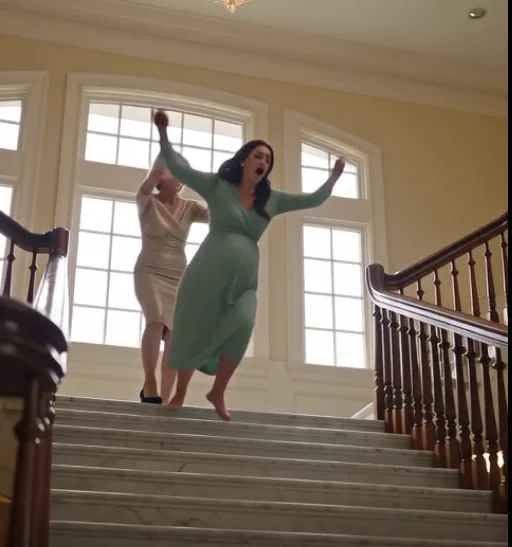
My mother-in-law shoved me down the stairs while I was eight months pregnant. My husband watched her do it. Then he walked outside, came in through the front door, and pretended to find me there.
“DON’T TOUCH ME!”
The last thing I saw before I fell was my mother-in-law’s face. She wasn’t angry anymore. She looked almost relieved.
Her palms struck my back. The box of baby clothes flew from my arms, and eight months of pregnancy suddenly felt like all the weight in the world.
I hit the landing, rolled, and came to rest against the front door. A tiny yellow sleeper floated down after me.
“My baby,” I gasped. “Somebody help my baby.”
Margaret Whitcomb descended slowly, one polished hand sliding along the banister.
“You slipped,” she said.
“You pushed me.”
She crouched close enough for me to smell her expensive perfume. “Tell Ethan you slipped. You don’t want a frightened little girl to start life without her mother.”
The door opened. My husband hurried in, keys still in his hand.
“Claire? Oh, God. What happened?”
“Your mother—”
Margaret began crying before I could finish.
“Ethan, she threatened me. I asked her to calm down, and she threw herself backward.”
Ethan took my hand, but he looked at Margaret first. I noticed it even through the pain.
“Call an ambulance,” I said.
He hesitated. One second. Maybe two.
I had never hated a silence before.
At the hospital, doctors checked the baby’s heartbeat while Margaret told Ethan I was unstable. By morning she’d brought a lawyer and papers asking the court to question my ability to care for my unborn daughter.
“No one saw what happened,” she whispered beside my bed.
Then Nurse Annie Park entered with my phone. Our neighbor, Nina Rivera, had sent a doorbell recording. Through the tall window beside the staircase, it showed Margaret putting both hands on my back.
I almost dropped the screen.
The recording also showed someone standing on the upper landing: Ethan, watching his mother.
She looked up at him. He looked straight back.
And my husband nodded.
I played the clip again. Ethan’s nod was small, deliberate, unmistakable.
“He’s upstairs,” I whispered. “But he came through the front door afterward.”
Annie stood beside the bed. “Do you want me to call hospital security?”
“Not yet. Please call the social worker. And don’t let my husband in until I say so.”
The video continued. After the push, Ethan vanished toward the service staircase. Forty-two seconds later he appeared outside the front door, adjusting his jacket. Then he entered, wearing the expression of a man discovering a terrible accident.
I knew that jacket. I’d bought it for his birthday.
When Ethan called, I answered on speaker with Annie nearby.
“How’s our girl?” he asked.
“Still being monitored. Where were you when I fell?”
“At work. You saw me come home.”
“I asked where you were before that.”
“Claire, you’re on pain medication. Let’s not do this.”
He knew I was being monitored, not drugged. I turned the volume down before he could hear me breathe.
Nina lived across the narrow courtyard in a brick duplex. Her doorbell faced our house, and the staircase was visible through its floor-to-ceiling window when the lights were on. She had sent the entire original clip, not a cropped screenshot.
Annie helped me forward it to a private folder and to the hospital social worker. Nina called a moment later.
“I should have looked sooner,” she said. “I heard you scream and thought somebody had fallen. When I checked the recording, I couldn’t believe it.”
“You didn’t know Ethan was there?”
“I knew a man came through the side gate before you fell. But, Claire, there’s something else. Yesterday somebody asked me to turn off my camera.”
“Who?”
Nina swallowed. “Your husband.”
Nina said Ethan had knocked on her door with a bottle of wine.
“He told me our lights shone through the windows and that the camera invaded his mother’s privacy,” she said. “I told him it recorded my own doorstep.”
“Did he get angry?”
“No. That’s what scared me later. He just smiled and said he’d handle the problem another way.”
At ten, Margaret returned with an attorney named Daniel Voss. He wore a charcoal suit and carried a slim folder. Annie met them outside my room, where I could hear raised voices.
“I’m his mother,” Margaret insisted.
“And she’s our patient,” Annie answered. “You need her permission.”
I let the lawyer in without Margaret. I wanted to know what they’d prepared.
Voss placed three pages on the rolling tray. The first described an alleged episode in which I’d threatened Margaret. The second recommended an emergency assessment of my parental fitness. The third stated that I had voluntarily stepped away from my role as co-trustee of the Robert Whitcomb Maternal Health Trust.
