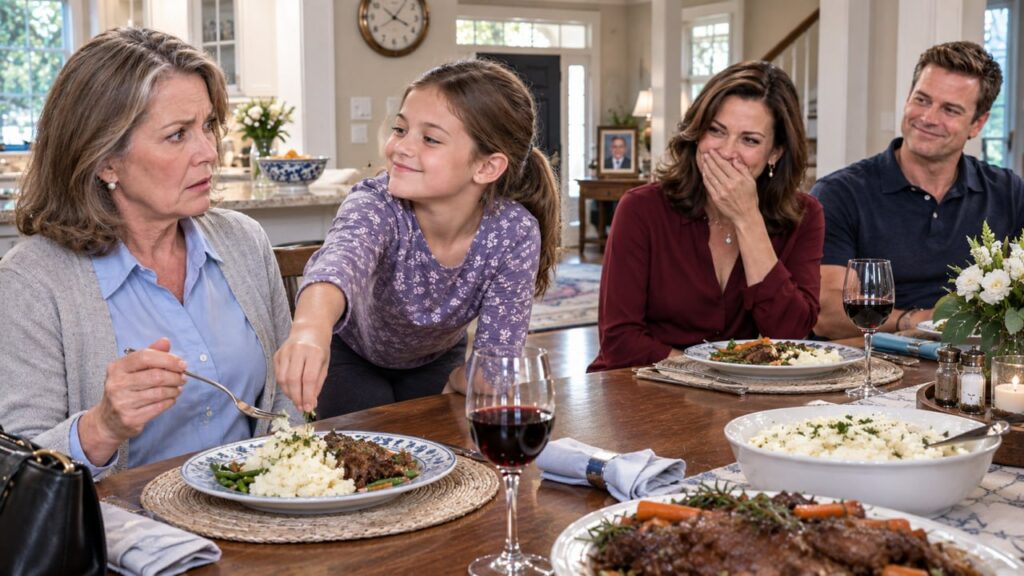
I sat there for another few seconds because some humiliations are so complete that your mind tries to bargain with them.
Maybe Sarah would look up.
Maybe she would finally see my face.
Maybe Greg would realize he had gone too far.
Maybe Lily would whisper that she was sorry.
Nobody did.
Sarah scrolled.
Greg drank his beer.
Lily reached for another dinner roll.
Something inside me became very quiet.
I folded my napkin.
I placed it beside the plate.
Then I stood.
Sarah finally looked up.
“Where are you going?”
I took my purse from the chair near the kitchen doorway.
“Out.”
Greg laughed.
“Oh, boy.”
I walked toward the foyer.
“You’re seriously leaving?” Sarah called.
I took my keys from the ceramic bowl by the door.
Greg said, “She’ll drive around the block.”
Sarah laughed.
“She’ll come back and make everybody feel guilty.”
Neither one asked me to stay.
I reached the staircase.
On the small table beside it was a photograph of Robert.
He was sixty-two in that picture.
Gray beginning at his temples. Blue shirt. Crooked smile.
He had died three years earlier, six months after doctors found pancreatic cancer.
During those six months, I had learned what helplessness really meant.
I learned how to organize pills.
How to sleep sitting upright in a hospital chair.
How to pretend not to be frightened when the person I loved was frightened enough for both of us.
The week before he died, Robert took my hand and said, “Keep the family together.”
I had treated those five words like instructions carved into stone.
Keep the family together.
That was why I said yes when Sarah called after her rent increased.
That was why I opened my home.
Why I added her car to my insurance.
Why I let Greg join my phone plan.
Why I paid for gymnastics.
Why I swallowed arguments.
Why I apologized when I wasn’t wrong.
Because family was something you protected.
But looking at Robert’s photograph that night, another question entered my mind.
When had protecting my family started requiring me to disappear inside my own home?
“Grandma?”
I stopped.
For one foolish second, hope rose in me.
I turned.
Lily stood in the dining room doorway.
Maybe she was going to apologize.
Maybe she understood.
“You forgot to clear your plate.”
Greg laughed first.
Sarah joined him.
I looked at Lily.
Then at my daughter.
And I understood something I should have understood months earlier.
Lily had not created the cruelty in that room.
She had learned it.
I opened the door.
The rain was colder than I expected.
I stepped outside and shut the door behind me.
I drove without knowing where I was going.
Past the pharmacy.
Past Robert’s old hardware store.
Past the church where Sarah had been married.
Past the elementary school where I had once waited forty minutes in a snowstorm because Sarah had forgotten to tell me Lily’s after-school program was canceled.
Eventually I saw the red-and-white sign for Millie’s Diner.
Robert and I had gone there the night we brought our son David home from the hospital because neither of us had slept in two days and I suddenly wanted pancakes at eleven thirty at night.
The place had changed owners twice since then, but the booths were still red vinyl and the coffee still tasted strong enough to remove paint.
I sat in a booth near the window.
A waitress with silver-blond hair brought me coffee.
“Food?”
I shook my head.
“Just this.”
She glanced at me.
“You sure?”
“I’m sure.”
Her name tag said DENISE.
I took my tablet from my purse.
For nearly two years, I had avoided doing what I did next.
I opened my bank records.
Then my credit card statements.
Then my insurance account.
Then the phone bill.
I found a napkin and wrote headings.
Insurance.
Phone.
Groceries.
Gas.
Gymnastics.
Streaming.
Online purchases.
Greg’s gym.
School expenses.
Clothing.
Restaurants.
I added.
Then added again.
The number passed ten thousand.
Then fifteen.
Then twenty.
And I wasn’t even finished.
Sarah and Greg had moved into my house after Robert died.
“Six months,” Sarah had said.
“Eight at the absolute most.”
Their rent had risen. Greg’s overtime had been cut. They wanted to save enough for a deposit somewhere better.
I had been lonely.
That was the part I had never admitted.
The house was unbearable after Robert died.
Every room remembered him.
His coffee mug.
His side of the closet.
His indentation in the mattress.
The loose stair he kept promising to fix.
When Sarah suggested moving in, I had heard something she had never actually promised.
You won’t be alone anymore.
So I said yes.
At first, it felt like salvation.
Lily ran through the hall.
