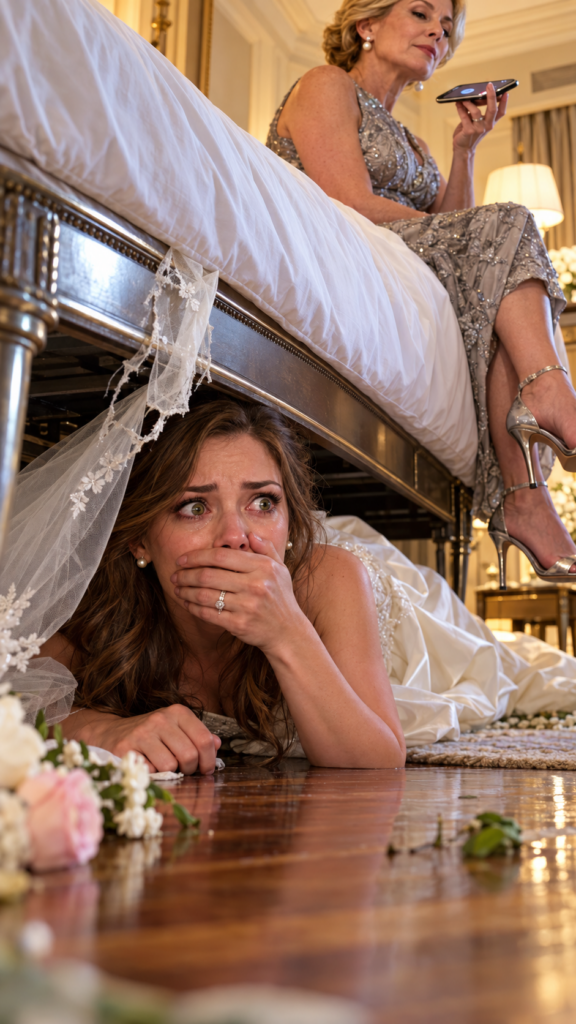
Owen tried to leave the suite with his phone.
I stepped in front of the door.
Not dramatically.
I did not raise my voice.
I simply stood there.
“You wanted me to sign something.”
“Mara, move.”
“I want to know what it is.”
“This is getting out of control.”
“No. It’s finally becoming clear.”
His eyes narrowed.
For the first time, there was no tenderness in them.
Not even imitation.
“You don’t understand what you saw.”
“I understand the sentence.”
He glanced at Dad.
“This is why I didn’t want family involved.”
Dad’s face remained unreadable.
I said, “My father didn’t bring the document.”
Rebecca folded her arms.
“Nor did I.”
Owen turned toward me.
“Mara, I’m asking you privately. Come outside with me.”
“No.”
“Mara.”
“No.”
The word came easier the second time.
Rebecca spoke calmly.
“Mr. Mercer, if you want Mara’s signature on any document involving the Savannah property, she is entitled to review the full agreement and obtain independent advice.”
“I know how contracts work.”
“Then we agree.”
“This isn’t some conspiracy.”
Nobody had used that word.
Owen realized it immediately.
His eyes moved from Rebecca to me.
My heart began beating harder.
I knew then that he suspected I knew more than I was saying.
I let the silence continue.
Finally he exhaled.
“Fine. You want the full document?”
“Yes.”
He unlocked his phone.
Scrolled.
Then forwarded an email to me.
My phone chimed.
I opened it.
PDF attachment.
Nine pages.
Rebecca stood beside me while I downloaded it.
Page one matched the reference in the cream envelope.
Page two outlined Owen’s claimed contribution.
Page three provided a mechanism for reimbursement if the property were sold.
Page four went further.
If the marriage ended within a defined period, I acknowledged that the transfer of title had been made in contemplation of marriage and agreed that Owen’s claimed contribution could be treated as recoverable under specified terms.
Rebecca held out her hand.
“May I?”
I gave her the phone.
She read.
Then looked at Owen.
“This document is materially different from the way you described it.”
“It protects both of us.”
“No,” I said.
He looked at me.
“It protects your claim.”
“Mara, I paid for the condo.”
“You told me it was a gift.”
“It was.”
“Then why do you need me to promise repayment?”
His jaw tightened.
“Because life is unpredictable.”
For one second, I almost admired the audacity.
Life.
Unpredictable.
As though the end of our marriage were a natural disaster rather than a schedule he had discussed with his mother while I hid beneath our wedding bed.
Rebecca kept reading.
“What is the purpose of this provision?”
Owen did not answer.
She turned the phone toward him.
“This paragraph contemplates dissolution very shortly after marriage.”
“It’s boilerplate.”
Rebecca’s expression changed.
Barely.
“Which firm drafted this?”
“Richard’s.”
“Richard Hale?”
“Yes.”
Rebecca looked at Dad.
Something passed between them.
Not surprise.
Recognition.
I noticed.
“What?”
Dad answered.
“Hale has done work for the Mercers.”
“You know him?”
“I know of him.”
Owen gave a bitter laugh.
“Of course you do.”
I looked at him.
“What does that mean?”
“Nothing.”
“No. Say it.”
He shook his head.
“You and your father act like you’re above everyone.”
The sentence was so different from every version of Owen I had known that it took me a second to absorb it.
Dad remained calm.
“I’ve never discussed my finances with you.”
“That’s exactly the point.”
I stared at Owen.
“What point?”
He looked at me.
There was resentment in his face now.
Old resentment.
Not something born that morning.
“You both hide everything.”
“We’re private.”
“You let people assume things.”
My voice became quiet.
“Assume what?”
He knew he had gone too far.
I saw it.
But there was nowhere for him to go.
Dad asked, “What did you assume?”
Owen laughed without humor.
“That you were some retired engineer hanging onto an old apartment because you couldn’t afford something better.”
The room became completely still.
Dad did not react.
I did.
I felt heat rise through my chest.
Not because Owen had underestimated Dad’s money.
Because he had measured Dad’s value by it.
My father had sat beside my mother through fourteen months of cancer treatment.
He had packed my lunches after she died because I was seventeen and he was terrified grief would make him forget how to parent.
He had attended every terrible student design exhibit I had ever had.
He saved handwritten birthday cards.
He still called his sister every Sunday.
And this man had called him nobody.
I stepped closer.
“You thought my father was poor.”
Owen’s face changed.
“That’s not what I said.”
“That is exactly what you said.”
“You’re twisting—”
I took out my phone.
Rebecca looked at me.
Dad said nothing.
