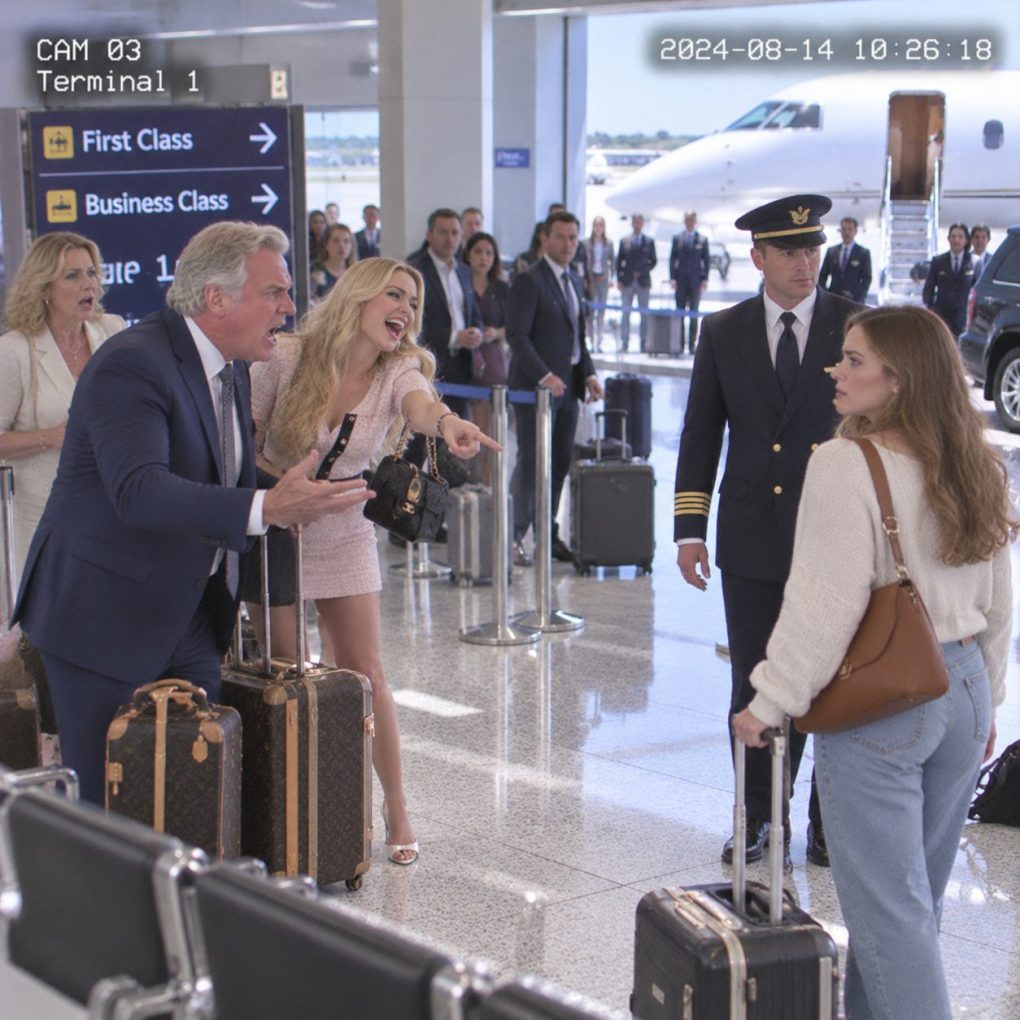
Papá lo dijo en voz alta, hasta que la recepcionista de la sala VIP lo oyó: «No te preocupes por Claire. Ni siquiera puede permitirse un billete de clase económica». Mi hermanastra Savannah se rió, ajustándose la bufanda de seda alrededor del cuello mientras su prometido empujaba dos maletas de diseño hacia la fila de embarque prioritario. «Quizás pueda pedir un asiento cerca del baño», dijo. Mi madrastra se tapó la sonrisa con una taza de café. Me quedé de pie junto a mi equipaje de mano y no dije nada.
Estábamos en Dulles, supuestamente todos viajando a San Francisco para la celebración de la jubilación de papá. Al menos, eso fue lo que me dijo cuando me invitó tres semanas antes. Lo que omitió mencionar fue que había comprado boletos de primera clase para él, mi madrastra, Savannah, y el prometido de Savannah, Grant. Dio por sentado que yo compraría los míos. Cuando le pedí el itinerario, papá me respondió por mensaje de texto: ” Tienes treinta y cuatro años. Arréglatelas”. Y así lo hice. Simplemente nunca le dije cómo.
Durante la mayor parte de mi vida adulta, mi familia creyó que trabajaba en el sector del transporte marítimo. Mi padre usaba esa palabra porque sonaba apropiadamente poco impresionante al lado de la carrera de Savannah en el sector inmobiliario de lujo. La verdad era que había dedicado doce años a construir Meridian Aero Logistics, una empresa que transportaba equipos médicos esenciales, componentes de semiconductores y carga de emergencia por todo el país. Empezamos con un turbohélice alquilado y cinco empleados. Seis meses antes, una inversión de capital privado valoró la empresa en poco más de 190 millones de dólares. Yo seguía siendo el accionista mayoritario.
Papá no sabía nada de eso porque hacía años que había dejado de hacerme preguntas importantes sobre mi vida. Cuando le dije que me había convertido en directora ejecutiva, me dijo: «Qué bien». Cuando Meridian abrió oficinas en Dallas y Seattle, las viejas amigas de mamá me felicitaron por internet antes de que mi propio padre se enterara. Mientras tanto, cada pequeño ascenso que recibía Savannah le valía una cena familiar.
El agente de la puerta de embarque anunció el embarque en primera clase. Savannah abrazó a papá. «El mejor viaje de jubilación de mi vida». Luego me miró. «En serio, Claire, ¿qué vuelo vas a tomar?». Miré mi reloj. «El mío sale en unos veinte minutos». Grant sonrió con picardía. «¿Spirit?». Papá se rió. «Si tiene suerte».
Fue entonces cuando un hombre con uniforme de vuelo de la marina se acercó por detrás. El capitán David Lawson había pilotado el avión ejecutivo de Meridian durante casi tres años. Saludó cortésmente a mi familia con un gesto de cabeza y luego se dirigió a mí: «Señorita Bennett, su avión está repostado. Podemos despegar cuando usted lo desee».
Nadie se movió.
La sonrisa de Savannah desapareció primero.
Dad stared at the captain, then at me. “Your what?”
Through the terminal windows, across the service road toward the private aviation ramp, a black SUV was already waiting to transfer me to a Gulfstream G500 carrying Meridian’s silver insignia near the tail.
I picked up my bag.
Dad grabbed my arm—not hard, but fast. “Claire, whose plane is that?”
“Meridian’s.”
“You mean your company lets you use that?”
I looked at him.
“My company owns it.”
Grant’s expression changed instantly. Unlike my family, he knew exactly what Meridian Aero Logistics was.
And that was when I noticed something even stranger.
He looked frightened.
“Claire Bennett?” he repeated.
“Yes.”
Grant slowly lowered his phone.
Dad frowned. “What’s wrong with you?”
Grant ignored him and stared at me.
“Meridian Aero?”
“Yes.”
His face went pale.
Then he whispered, “You’re the Claire Bennett reviewing the Pacific Crest contract?”
I stopped.
Pacific Crest was the logistics contract Meridian’s board would vote on the following morning.
A contract worth nearly $38 million over five years.
And the company bidding for it belonged to Grant’s family.
Nobody had ever told me Savannah’s fiancé was connected to it.
Before I could answer, my phone buzzed.
My general counsel.
Urgent: We found undisclosed related-party payments in Pacific Crest’s proposal. Do not discuss the bid with anyone connected to the applicant.
I read the message twice.
Then looked up at Grant.
Dad was still smiling proudly at Savannah, completely unaware that the “poor daughter who couldn’t afford economy” was about to board the aircraft carrying the person who could expose the deal his golden child had been bragging about for months.
I did not discuss the Pacific Crest bid at the airport. In fact, I told Grant immediately that because of my newly discovered family connection, I could no longer speak with him about the proposal outside formal channels. Then I boarded Meridian’s plane and asked our general counsel, Monica Reyes, to document the conflict.
The family arrived in San Francisco almost two hours after I did. By then, Monica had already briefed me. Pacific Crest Freight Systems was seeking to become one of Meridian’s preferred domestic ground carriers. The bid was not glamorous, but it was valuable: roughly $38 million in expected revenue over five years if service targets were met.
Grant was not merely connected to Pacific Crest. His father owned 61 percent of it, and Grant served as vice president of business development. Savannah had never mentioned that detail when she spent the previous four months telling everyone her fiancé had “personally landed a massive aviation deal.”
The problem uncovered by our compliance team involved consulting payments. Pacific Crest had paid nearly $240,000 to a firm called Northline Strategy during the bidding period. Northline’s listed manager was a college friend of one of Meridian’s regional procurement employees.
That did not automatically prove bribery. There could have been legitimate consulting work. But Pacific Crest had certified in its bid that it had disclosed all intermediaries and potential conflicts connected with the contract. Northline was not listed anywhere.
