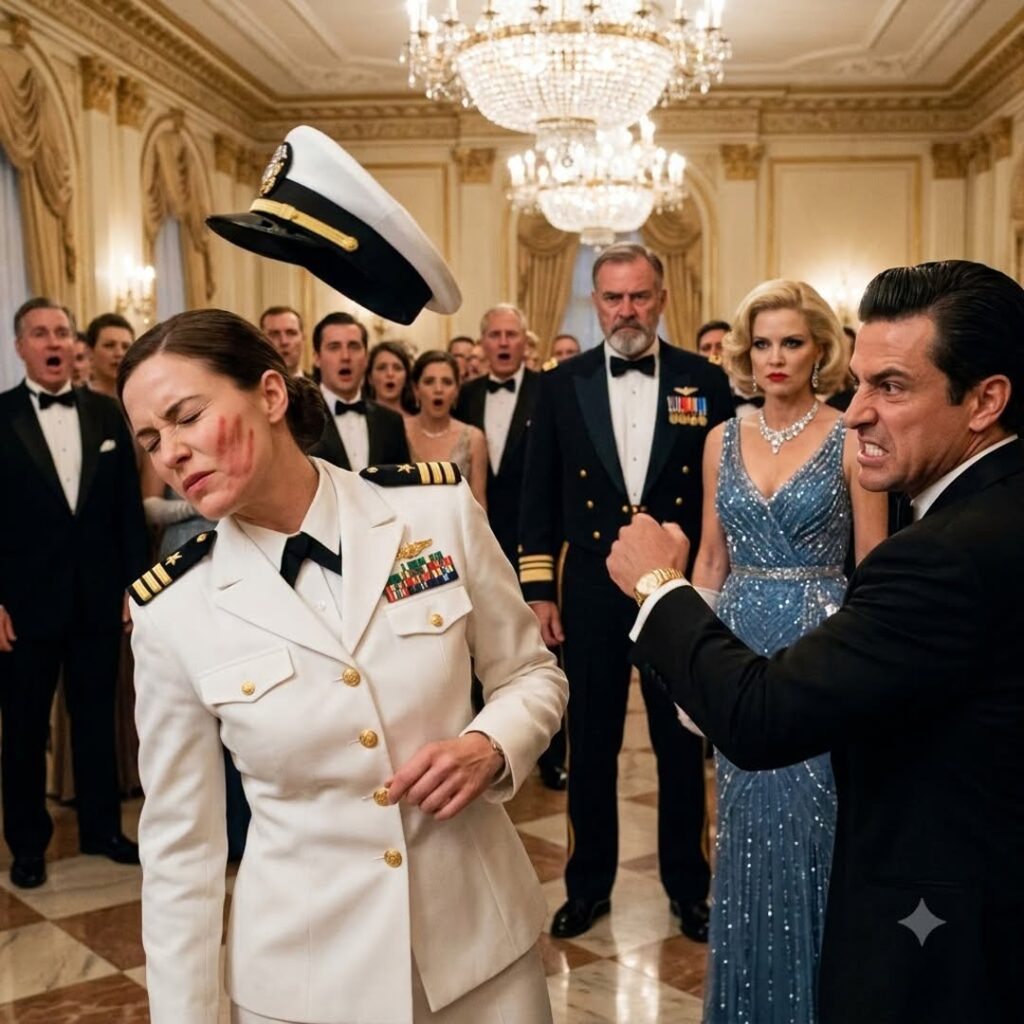
PART 1
My brother’s palm hit my face before I could answer. The crack echoed through the ballroom.
“Don’t embarrass us again,” Evan said.
My white cover fell from my hand and slid under a chair. Four hundred veterans went silent.
My name is Rear Admiral Claire Whitmore. I’m forty-three. Twenty-five years in the Navy. I’ve been shot at, stranded at sea, responsible for people whose names will never appear in any public report. Nothing prepared me for being struck by my own brother next to my father’s wheelchair.
Here’s what my family didn’t know. For twenty-five years, I’d been secretly sending money home. Every month. Since I was an ensign eating ramen. All of it for my father’s lungs. Over a million dollars, delivered through an old Navy chaplain so my family would never know it came from me.
And my father had been told they couldn’t afford his treatment.
“You walk into a room dressed like that and expect everyone to treat you like royalty,” Evan said.
Across from us, my father, a retired Army colonel, sat in his wheelchair, a portable oxygen unit behind him. Severe lung disease. Every breath sounded too expensive.
“Enough,” he rasped, reaching weakly toward us.
My mother, Gloria, ignored him. “Your brother is right. This evening is to honor your father.”
“It’s the National Veterans Honor Gala. I was invited.”
“Because of HIS name.” She looked straight at me. “You left chasing uniforms because you never learned how to belong anywhere else.”
At eighteen, Dad had needed treatment our insurance barely covered. I’d told my mother I wanted to enlist. She laughed, then told me if I left, not to come back asking for help. So I didn’t. I slept in a motel twelve nights, waited tables, reported for training with sixty-three dollars.
Then Dad started coughing. Hard. Folding forward, lips turning gray-blue. I knelt beside him. The prescription label on his oxygen unit said 3 liters per minute. The dial was set to 1.
I turned it up. My sister, Natalie, stood behind the wheelchair, hands on the grips.
“Nat. His oxygen was on one.”
“Was it? He must have bumped it.”
He couldn’t reach that dial from where he sat. I didn’t say anything. I just remembered it.
Then a chair scraped back. Another. Then dozens. Then hundreds. All across the ballroom, men and women rose to their feet.
“Admiral,” a voice called.
One man stayed standing longest. Gray at the temples. A gold Trident pin. Commander Jack Mercer, retired Navy SEAL. He’d kept one of my secrets for eleven years.
PART 2
Mercer stopped in front of my family. He didn’t look at Evan or my mother. He looked at me, and he came to attention.
“Admiral Whitmore,” he said, loud enough for the standing room. “Chaplain Doyle passed three weeks ago.”
Something in my chest went cold. Chaplain Doyle. The old Navy chaplain who’d been my go-between for twenty-five years. The one man besides me who knew about the money.
“He left instructions,” Mercer continued. “And this.” He held out the envelope. “He said if anything ever happened to him, I was to find you, and give you this, in person, wherever you were. I’ve been carrying it for three weeks waiting to catch you in the same room.” He glanced, just once, at my mother. “I didn’t expect the room to be this one.”
I took the envelope. My hands were steady; twenty-five years teaches you that. I opened it.
Inside was a letter in Chaplain Doyle’s handwriting, and beneath it, a thin stack of bank records.
Claire, the letter began. If Jack is handing you this, I’m gone, and there’s something I should have told you years ago and was too much of a coward to. I kept your secret for twenty-five years. The monthly money. For your father’s lungs. You trusted me to deliver it to your family for his treatment, and never let them know it came from you.
I delivered every dollar. I want you to know that first. I never took a cent.
But Claire, I have to tell you where it went. Because I don’t think your father ever saw most of it.
My breath stopped.
For the first twelve years, Doyle wrote, the money went where you intended. Your father’s treatments. His medication. I watched him get the care. Then, about thirteen years ago, your mother asked me to deliver the money to her directly instead of to the clinic. She said she’d handle his care herself, that it was humiliating for a chaplain to be involved in family medical business. I believed her. I was wrong to.