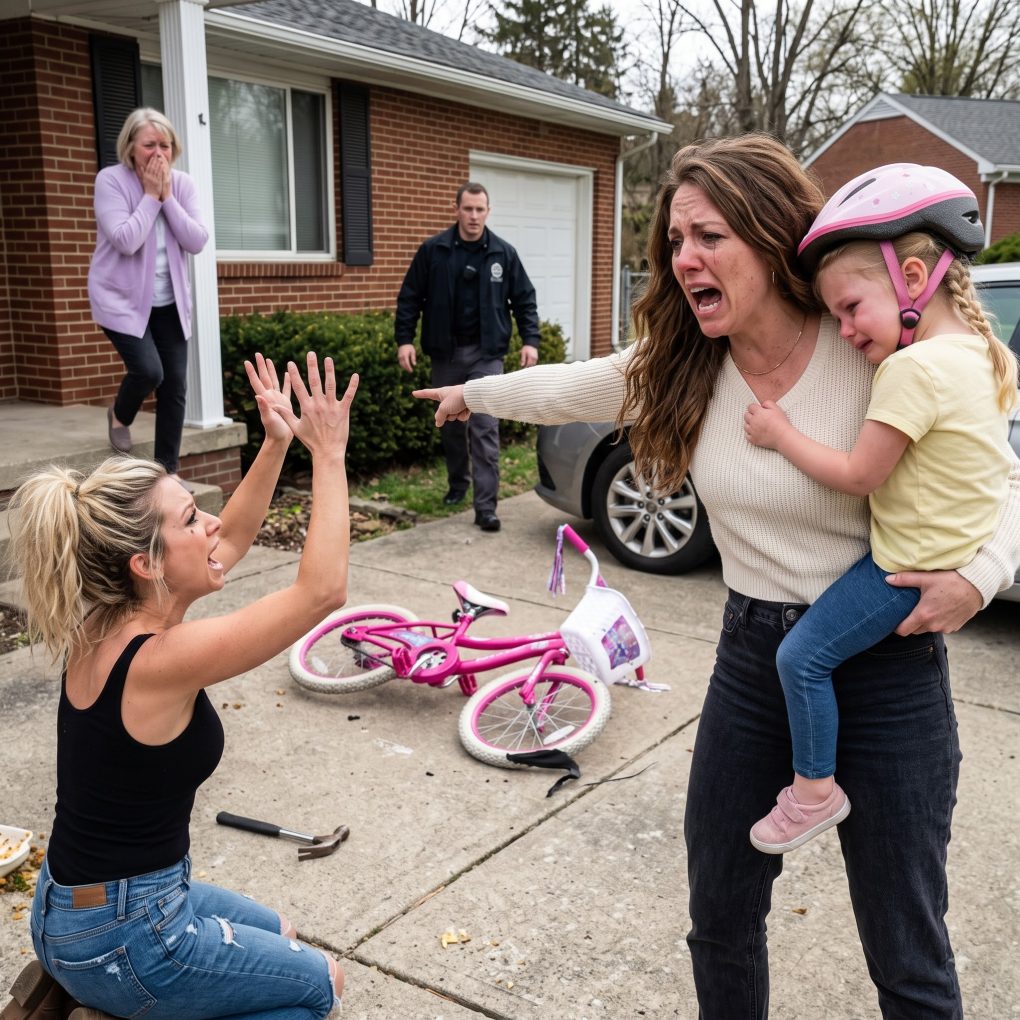
I was carrying a casserole dish up my mother’s driveway in Dayton, Ohio, when I saw my sister Dana standing over Lily’s brand-new bike, swinging a claw hammer like she was chopping wood.
The pink frame bent. A tire popped. The little white basket I’d let Lily decorate with sparkly stickers went flying across the concrete.
“Mommy?” Lily whispered. She stood on the porch steps, six years old, clutching her helmet in both hands. She had worn it since six that morning, even while eating cereal.
I dropped the casserole.
“Dana, what are you doing?!”
My sister wiped her forehead and shrugged. “Teaching her a lesson. Kids today think everything just falls from the sky. Your daughter needs to learn she can’t have everything.”
“It was her birthday present,” I said. My voice sounded strange, flat, far away.
My mother, Carol, stepped onto the porch with her arms crossed. She didn’t look at the bike. She looked at me. “You shouldn’t have bought it for her, Rachel. Honestly, that’s on you.”
On me.
Lily started to cry without making a sound, the way kids do when they’ve learned that crying makes things worse. I walked over and picked her up.
Dana was still gripping the hammer, smirking, waiting for me to scream. Mom was waiting too. They wanted me to be the hysterical one so they could say I was overreacting.
Instead, I smiled.
I pulled my phone from my pocket, where a call had been running for ten minutes, and said one calm sentence.
“Mr. Whitaker, did you get all of that? Because I’d like you to read them Dad’s letter now.”
Dana’s smirk fell off her face. My mother’s lips went the color of paper. The hammer slipped from my sister’s hand and clanged against the driveway.
“Rachel,” Mom said, barely audible. “You… you didn’t.”
Oh, I did.
Teaser:
Everyone on that driveway thought they knew what Dana was really punishing my daughter for. They were wrong. The bike was never the point, and the hammer was only the beginning. Somewhere behind my mother’s frightened eyes was a secret my father had been protecting for two years, and a phone I hadn’t noticed was recording us from the wrong side of the porch. By the time the sirens started, I realized someone had been planning this day far longer than I had.
For three seconds, nobody breathed.
Then Mr. Whitaker’s voice came through my phone speaker, calm and unhurried, the voice of a man who had spent thirty years reading wills to people who hated what they heard.
“Good afternoon, Carol. Dana. Yes, I heard everything. So did the recording app on Rachel’s phone. Ohio is a one-party consent state, in case you were wondering.”
“You recorded us?” Dana lunged for my phone. I stepped back, Lily’s legs tight around my waist.
“I recorded a family meeting,” I said. “You just made it more interesting.”
Mom gripped the porch railing. “Tell that man to hang up, Rachel. This is a family matter.”
“Carol,” Whitaker said, “your husband made me promise to say this out loud, in front of witnesses, if it ever came to this. The house you’re standing in is not yours. It belongs to the Monroe Family Trust, and Frank named Rachel as trustee. You’ve lived there at her discretion for two years.”
My mother laughed, a thin, broken sound. “That’s ridiculous. Frank would never—”
“Section Nine,” he continued, “ends your right to live there the moment anyone in your household harms or frightens Lily. Frank wrote that clause himself.”
Dana’s face had gone from white to red. “She’s six! It’s a bike! You’d throw Mom out over a bike?”
“No,” I said quietly. “Over forty-nine thousand dollars.”
I pulled folded papers from my jacket, bank statements I’d carried for nine days. “Lily’s college fund. Dad’s life insurance. Eleven withdrawals, all signed with my name. None by my hand.”
“That’s a lie,” Dana whispered.
“Then why is every signature spelled Rachel Monroe-Hayes? I dropped that name after my divorce. You only know it from the old birthday cards Mom keeps in her kitchen drawer.”
Mom turned slowly toward her. “You told me it was a loan from the estate. You said Rachel knew.”
“Mom, shut up—”
That was when I noticed the phone. A small black rectangle, propped inside the flowerpot beside the porch steps, its red recording light blinking.
I looked at my sister. Then at my mother. “You were filming me.”
Nobody answered. Nobody had to. They had planned it all: smash the bike, push me until I screamed, then show a judge the video of an unstable mother who couldn’t be trusted with Lily’s money.
“Dana said it would only be a lesson,” Mom whispered. “She said you’d just cry.”
Whitaker cleared his throat. “Rachel, I’ve been on a second line with Detective Reyes for eleven minutes. He’s turning onto your street right now.”
Behind us, tires hissed on asphalt. A car door opened. And my mother, finally, looked frightened of something other than losing the house.
Detective Marcus Reyes climbed out of an unmarked sedan, a uniformed officer right behind him. He took in the whole scene in one slow sweep: the mangled pink bike, the hammer on the concrete, the shattered casserole dish, my daughter’s tear-streaked face against my shoulder.
“Ms. Monroe?” he said. “Mr. Whitaker briefed me. I’d like to hear it from you.”
“It’s all on the recording,” I said. “So is the video from the flowerpot, if you want that too.”
Dana tried to laugh. “It’s a bicycle. Mom’s house, Mom’s driveway. Since when is that a crime?”
“Criminal damaging, for starters,” Reyes said evenly. “But that’s not why I’m here. The fraud unit at Buckeye Federal flagged eleven forged withdrawals three weeks ago. I’m here for those.”
Dana’s knees actually buckled. The officer caught her elbow before she hit the driveway.
“I was going to put it back!” she screamed as he cuffed her. “Every dollar! Rachel doesn’t even need it. She makes good money, she’s always been so perfect—”
