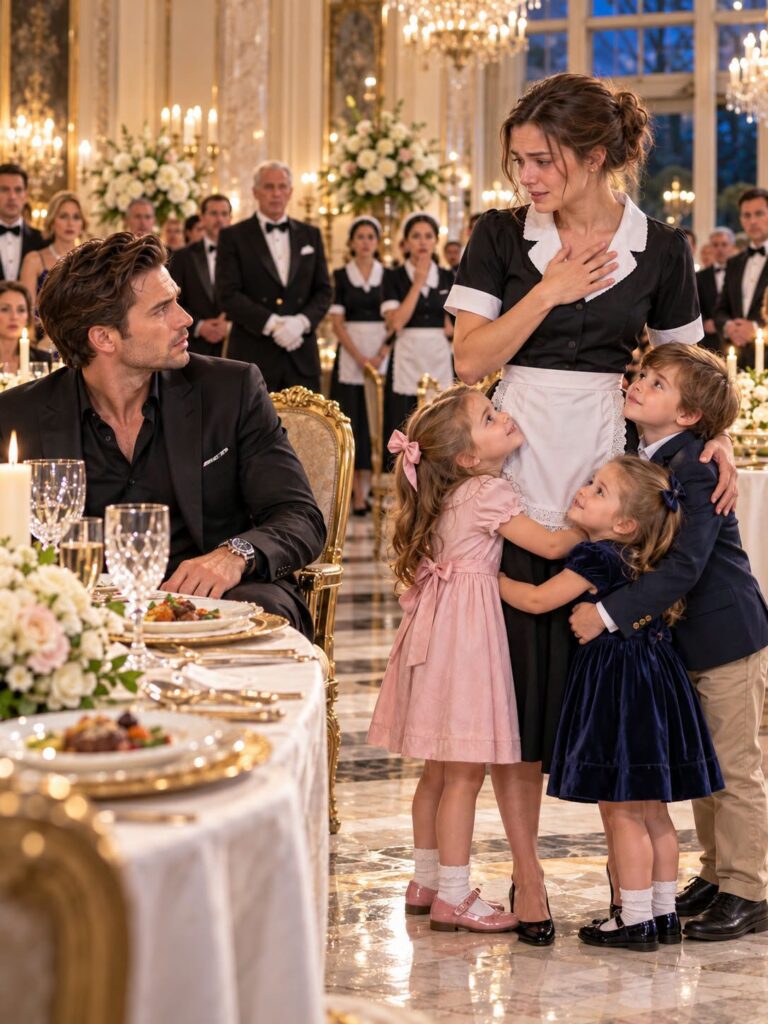
The Grand Aurelia had never been so quiet.
Not when the cellar flooded in the spring of the flood year. Not when the health inspectors came with their clipboards. Not even on the night two of the city’s oldest families met in the back room and left without shaking hands.
The chandeliers hummed above empty glass. The piano in the corner had stopped mid-phrase, the player’s hands frozen above the keys. Every waiter, every busboy, every guest in evening silk had turned toward the private dining room at the same moment, drawn by something none of them could name.
Evelyn Hart felt it first as a pressure behind her eyes.
She had been carrying the same silver tray for eleven hours. Her feet had gone past pain into a dull, patient ache. Six days until rent. The electricity bill sat folded in her apron pocket like a small stone she kept touching to remind herself it was still there.
She was twenty-six, and she had learned long ago that if you kept your head down and your hands steady, the world let you pass through it unharmed.
Then the smallest of the three children looked up at her.
The Belandi triplets had been at table nine for an hour. Evelyn had served them twice—water, then bread, then nothing, because no one ate.
Two boys in identical navy blazers.
One girl in a white dress, her hair pinned with a small silver clip.
They sat in a row like three birds on a wire, and they had not made a sound. Not a word to the nanny hovering behind them. Not a word to the man at the head of the table.
Everyone in the restaurant knew who the man was.
Adrien Belandi did not need a bodyguard to make a room careful. He was thirty-seven, black-shirted, dark ink climbing above his collar, and he moved through the city the way weather moved through it—not by threat, but by the simple fact that he could not be stopped.
People said he owned the docks.
People said he owned the men who owned the docks.
People said his name opened doors that had been bricked shut.
People also said his wife had run.
Two years ago, Celeste Belandi had walked out of a life most women would have bled for. She had taken twelve million dollars, a passport, and nothing else—not the children, not a photograph, not a note.
The police had closed the file in a month.
The city had closed its mouth in a week.
But the children had closed something else.
They had stopped speaking.
Not one word in two years. Not to the specialists flown in from three countries. Not to the therapists who came and went with their soft voices and their clipboards. Not to the father who had spent, by the estimate of the men who kept his accounts, more than four million dollars trying to reach them.
That was why, when the smallest triplet looked at Evelyn Hart and whispered, the entire restaurant stopped breathing.
“Sellar.”
The tray almost slipped.
Evelyn caught it against her hip.
Adrien Belandi stood so quickly his chair scraped back like a warning.
The nanny made a small strangled sound.
One of the boys turned his head toward his sister, eyes wide.
The other stared at Evelyn as though she had somehow opened a door inside the child with nothing but water and bread.
Adrien’s voice was low.
“What did she say?”
No one answered.
Not because they hadn’t heard.
Because nobody wanted to be the first person to tell Adrien Belandi that his daughter had spoken her first word in two years to a waitress.
The little girl looked at Evelyn again.
Her lips trembled.
“Sellar.”
Evelyn swallowed.
She crouched slowly so she would not tower over the child. That was something she had learned from her brother Jamie, who had stopped talking for six months after their father left. Adults had leaned over him, begged him, bribed him, demanded words like they were rent overdue.
Evelyn had been fourteen then.
She had learned that silence was sometimes the only room a child could lock.
So she did not smile too hard.
She did not gasp.
She did not clap.
She only said, softly, “Do you mean cellar?”
The girl blinked.
Then nodded once.
Adrien stepped closer.
“Isabella.”
The child flinched.
Not from fear of him, Evelyn realized.
From the weight of expectation.
Every adult in the room wanted another miracle now.
One word had escaped, and already they were crowding the door it had come through.
Evelyn lifted one hand slightly without thinking.
“Please don’t.”
The room turned toward her.
Adrien’s eyes found her.
“Don’t what?”
“Push.”
The manager, Mr. Voss, went pale behind the bar.
“Evelyn,” he whispered.
She should have apologized.
She should have lowered her eyes.
She should have remembered the electricity bill in her pocket and the rent due in six days.
Instead, she looked at the child.
“If you scare the word, it may not come back.”
Adrien Belandi stared at her for a long second.
Then, to the shock of everyone in the Grand Aurelia, he stepped back.
The little girl’s shoulders loosened.
Evelyn kept her voice gentle.
“What is in the cellar, sweetheart?”
The child’s fingers tightened around the napkin in her lap.
Her brothers watched her with identical stillness.
Then one of the boys whispered, “Mama.”
A woman at a nearby table gasped.
Adrien went motionless.
The word did not soften him.
It hollowed him out.
The second boy covered his mouth as if surprised by his own breath.
“Mama cried,” he said.
The nanny began crying silently.
Evelyn felt the floor move beneath her, though she knew it had not.
Adrien looked from one child to the next.
His voice had lost all its command.
“You saw her?”
The little girl, Isabella, nodded.
“Red door.”
The first boy added, “Downstairs.”
The second boy whispered, “Behind bottles.”
