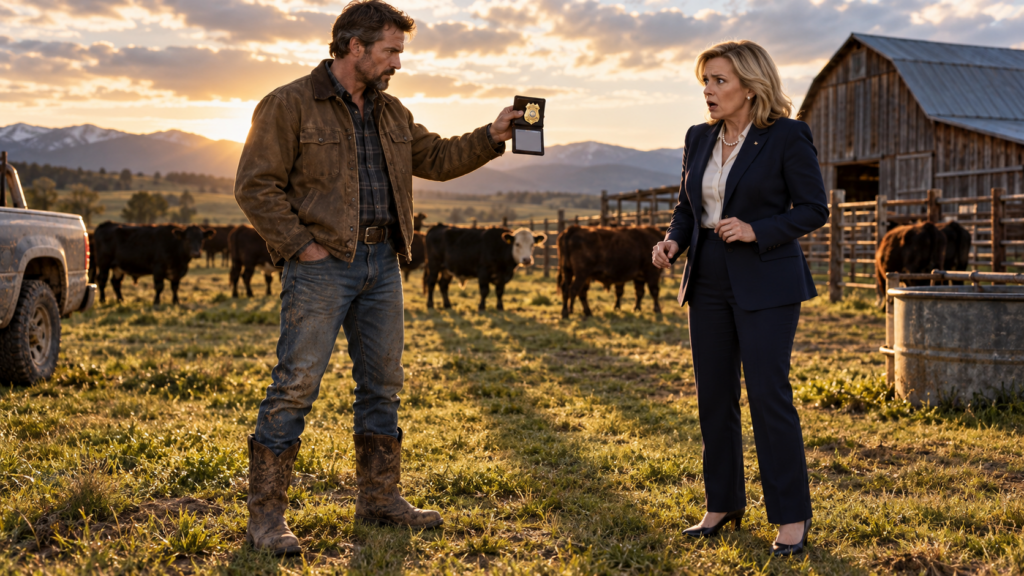
The woman in the white SUV drove past three PRIVATE PROPERTY signs before she parked beside my cattle gate.
That told me almost everything I needed to know about her.
I was checking a water trough when she stepped into the pasture wearing a navy blazer, expensive boots, and an expression that suggested the entire county had been waiting for her approval.
“Mr. Bennett?”
I rested one hand on the fence.
“Who’s asking?”
“Vanessa Whitmore. President of the Silver Creek Homeowners Association.”
She raised her phone and photographed my barn.
Then my tractor.
Then seventeen head of cattle standing beneath the cottonwoods.
“I’m conducting a property compliance inspection.”
I almost laughed.
Almost.
“My ranch isn’t in Silver Creek.”
She smiled.
“We’ve received complaints.”
“That doesn’t put my land in your HOA.”
Vanessa looked toward my equipment shed as if I hadn’t spoken.
Silver Creek Estates sat along the eastern edge of my ranch outside Fort Collins, Colorado. Eighty-six expensive homes, landscaped entrances, matching stone mailboxes, and enough architectural rules to regulate the angle of a porch swing.
My family had owned the adjoining 117 acres for more than sixty years.
Silver Creek had been built much later on farmland my grandfather sold to a developer.
He kept the ranch.
And the recorded deeds made one fact extremely clear:
Our property had never joined their association.
Apparently nobody had explained that to Vanessa.
“Your livestock fencing fails community standards,” she said.
“My fencing predates your neighborhood.”
“You also have visible agricultural machinery.”
“It’s a ranch.”
“And several outbuildings that haven’t received architectural approval.”
“From whom?”
She lowered the phone.
“From the association.”
I stared at her.
“Vanessa, you’re standing on private agricultural property outside your HOA. You need to leave.”
She gave me the kind of patient smile adults use on stubborn children.
“Mr. Bennett, HOA regulations affect neighboring properties when conditions negatively impact community values.”
“Show me the recorded document giving your association enforcement authority here.”
Her smile tightened.
“I’m not required to carry legal files during an inspection.”
“Then you’re not conducting an inspection.”
I opened the gate behind her.
“You’re leaving.”
Instead, Vanessa walked deeper into the pasture.
She photographed an old stock trailer.
Then a hay baler.
Then the cattle again.
“I’m documenting everything.”
“Stop taking photographs and step back toward the road.”
“Are you threatening me?”
“No.”
I pointed toward the gate.
“I’m telling you you’re on land where you’ve been expressly told you don’t have permission to remain.”
She laughed.
Then she said something that made the situation more interesting.
“You should cooperate. The board can issue fines exceeding ten thousand dollars for continuing violations.”
“What violations?”
“Nonconforming agricultural use, commercial equipment storage, unscreened livestock, exterior structures—”
“Unscreened livestock?”
She didn’t appreciate the question.
“You can joke now. You won’t be laughing when liens become involved.”
That word changed my tone.
“Liens?”
“If assessments remain unpaid.”
I studied her for a moment.
This wasn’t just a neighbor with a clipboard pretending to be important.
Vanessa genuinely believed she could create debt against property she didn’t govern.
Or she wanted me to believe it.
“Who authorized you to come here?”
“The board.”
“Names.”
“I don’t answer to you.”
“You’re on my property.”
“And I’m acting in my official capacity.”
I had heard enough.
I reached slowly inside my jacket.
Vanessa stopped talking.
Her eyes followed my hand.
I pulled out a leather identification wallet and opened it.
The gold badge caught the afternoon light first.
Then she read the credentials beneath it.
SPECIAL AGENT
FEDERAL BUREAU OF INVESTIGATION
Vanessa’s phone lowered.
Her face changed so quickly it was almost impressive.
For the first time since she drove through my gate, she stopped performing authority.
My name is Daniel Bennett.
I had spent sixteen years as an FBI special agent, mostly working financial fraud and public corruption cases throughout Colorado and neighboring states.
The badge did not give me special property rights.
It did not magically transform HOA trespassing into a federal crime.
And I had absolutely no intention of abusing federal authority to settle a private land dispute.
But Vanessa had spent fifteen minutes assuming the rancher in muddy boots was someone she could frighten with invented fines.
Now she understood that I made a living asking people to document their claims.
I closed the wallet.
“Let’s try this again.”
She swallowed.
“I didn’t realize you were—”
“It doesn’t matter what I do for work.”
I pointed toward the PRIVATE PROPERTY sign beside the gate.
“That matters.”
She glanced at it.
“We were simply responding to resident complaints.”
“Then respond from the public road.”
“The association is entitled to investigate conditions affecting property values.”
“Not by entering land it doesn’t control after the owner tells you to leave.”
Vanessa shifted her weight.
“This has clearly been a misunderstanding.”
“No. I told you three times.”
She opened her mouth.
I continued.
“I want the names of the board members who authorized this inspection and a copy of whatever document you believe gives Silver Creek jurisdiction over my ranch.”
“I’ll have our attorney contact you.”
“Good.”
I gestured toward the gate.
“The inspection is over.”
This time she moved.
I watched her walk back toward the SUV.
The swagger was gone.
Once outside the gate, she immediately called someone.
She turned away from me and spoke rapidly, one hand pressed against her ear.
I couldn’t hear the words.
But I could see the panic.
I went back to checking the cattle.
Then I did what sixteen years of investigations had trained me to do.
I documented everything.
Time.
Location.
Statements.
Photographs.
Vehicle plate.
The signs she passed.
The threats about fines and liens.
That evening, I pulled the ranch deed, survey, county records, and every letter Silver Creek had sent me over the previous two years.
Most people would have considered them annoying paperwork.
I noticed something else.
Vanessa’s visit wasn’t the first time the HOA had tried to treat my ranch like its property.
