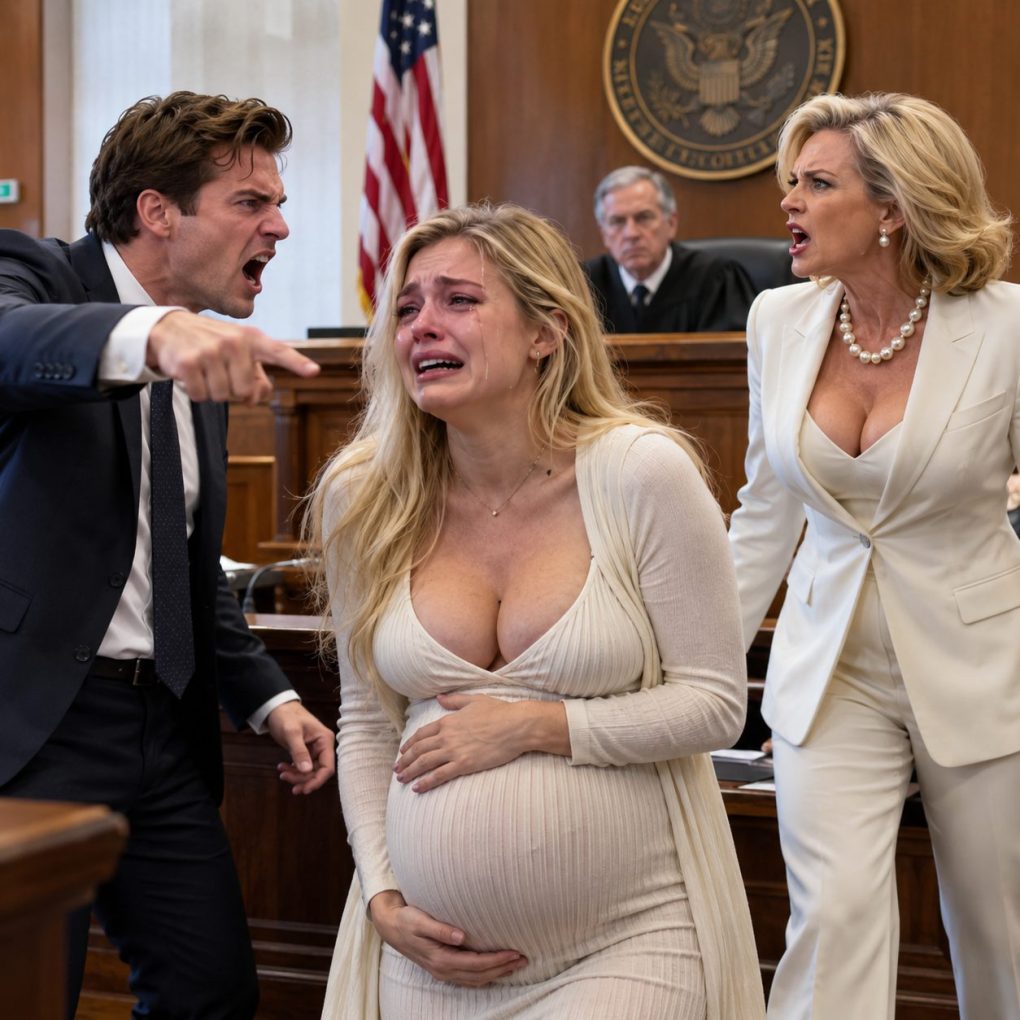
“You leave with nothing,” the judge said.
My baby kicked as I gripped the table. Eight months pregnant, I had just lost the home I had helped pay for and the savings I thought we shared.
Beside me, Daniel smiled.
“Let’s see how you and that baby survive without me,” he whispered.
I looked toward the judge. “I never signed that agreement.”
“Your signature is in the record, Mrs. Hayes.”
Daniel’s attorney closed his folder. My own lawyer had withdrawn three weeks earlier, after the money in our joint account vanished. I had come alone with bank statements, unpaid bills, and a birth plan that still listed my husband as my emergency contact.
None of it had been enough.
The judge moved to the next matter. I reached for my bag, trying to keep my hands from shaking.
Then the courtroom doors opened.
A woman in a navy suit stepped inside with an attorney carrying a thick black binder.
I knew that face before I could make myself look at it.
My mother.
Eleanor Bennett. The billionaire whose calls I had stopped answering four years ago, after she warned me about the man I was about to marry.
Daniel turned, still wearing his victory smile.
It disappeared.
“My daughter will live far better without you,” she said.
The judge frowned. “Ma’am, this court is in session.”
Her attorney approached the rail. “Your Honor, I’m requesting permission to appear for Mrs. Hayes and present an urgent motion concerning the agreement just relied upon.”
Daniel grabbed his lawyer’s sleeve.
“Get her out,” he whispered.
My mother looked at me. Her eyes dropped to my stomach, then returned to my face.
“You should have called,” she said softly.
“I thought you wouldn’t answer.”
Something in her expression broke.
Her attorney opened the binder and placed two documents side by side.
“Your Honor, these signatures belong to the same woman. These agreements do not.”
I thought the binder held the worst thing Daniel had done. Then I learned how my mother had found out about the hearing—and why my husband suddenly looked more frightened of his phone than the judge.
The judge leaned forward.
Daniel’s attorney stood. “We object to this interruption.”
“So noted,” the judge said. “Counsel, explain what you’re presenting.”
My mother’s lawyer, Rachel Kim, pointed to the first document.
“This is the original premarital agreement, retained by the attorney who drafted it. It preserves Mrs. Hayes’s interest in marital savings and provides temporary housing support if the marriage ends.”
Then she touched the second.
“This is the copy submitted by Mr. Hayes. The signature page is identical. The pages immediately before it are different.”
Daniel laughed once, too loudly.
“She’s confused. Pregnancy has been hard on her.”
My mother’s jaw tightened. Rachel kept her voice level.
“The original drafting attorney is available to testify. We also have the email in which the executed agreement was sent to both parties.”
The judge looked at me. “Did you approve any amendment?”
“No.” My voice barely carried. “I kept asking why it said I gave up everything.”
For the first time that morning, someone wrote down my answer.
The judge paused entry of the written order and set an expedited hearing on the disputed agreement. He made no promises about the final outcome.
That small pause felt like air entering a sealed room.
Outside, Daniel caught up with us before we reached the elevators.
“You think her money makes you a mother?” he asked.
Rachel stepped between us. “Speak through counsel.”
He looked past her at me.
“Tell them about the hospital.”
My stomach tightened.
Six months earlier, I had gone to the emergency room after a panic attack. Daniel had told me to describe it as stress from work. Later, he said nobody would trust me with a baby if they knew.
Now he lifted his phone.
“I have the records.”
Rachel held out her hand. “Send whatever you intend to rely on to my office.”
Daniel’s smile returned.
My mother guided me toward a bench. “What hospital, sweetheart?”
I told her. She listened without once asking why I had stayed.
Then I asked the question burning through everything else.
“How did you know about today?”
She took a printed email from her bag.
Daniel had sent it two nights earlier.
Two million dollars. That was his price for a settlement he claimed would keep me housed and prevent an ugly custody dispute after the birth.
“He said you refused to let me help,” she whispered. “Then he attached the agreement.”
I stared at the page.
My husband had tried to sell my safety to my mother.
Rachel’s phone rang. She listened, then turned toward me.
“Daniel filed another document this morning.”
Her expression changed.
“It says you threatened to hurt yourself—and the baby.”
“I never said that.” The words came out so sharply that people near the elevators turned. Rachel sat beside me and showed me the declaration. Daniel had attached what looked like a hospital summary, complete with my name, my birth date, and a sentence recommending psychiatric supervision. I remembered that visit. I remembered a nurse bringing me juice and asking whether I felt safe at home. That sentence had never been there.
Rachel did not promise that everything would disappear by afternoon. She requested my actual records with my written consent, preserved Daniel’s email, and asked his attorney to identify where the attached report had come from. My mother offered her hand. For four years, I had imagined our reunion would begin with an argument. Instead, she asked, “Have you eaten?” That was what finally made me cry. She stayed beside me while I answered the question.
At her house, I slept behind a door that nobody demanded I unlock. The next morning, Rachel arrived with the first answers. The hospital had supplied the original summary. It documented a panic attack, a medical evaluation, and my denial of thoughts of self harm. There was no recommendation for psychiatric supervision. Rachel arranged for a hospital records custodian to authenticate it. Daniel had not exposed a secret illness. He had altered the account of a frightening evening and counted on my shame to keep me quiet.
