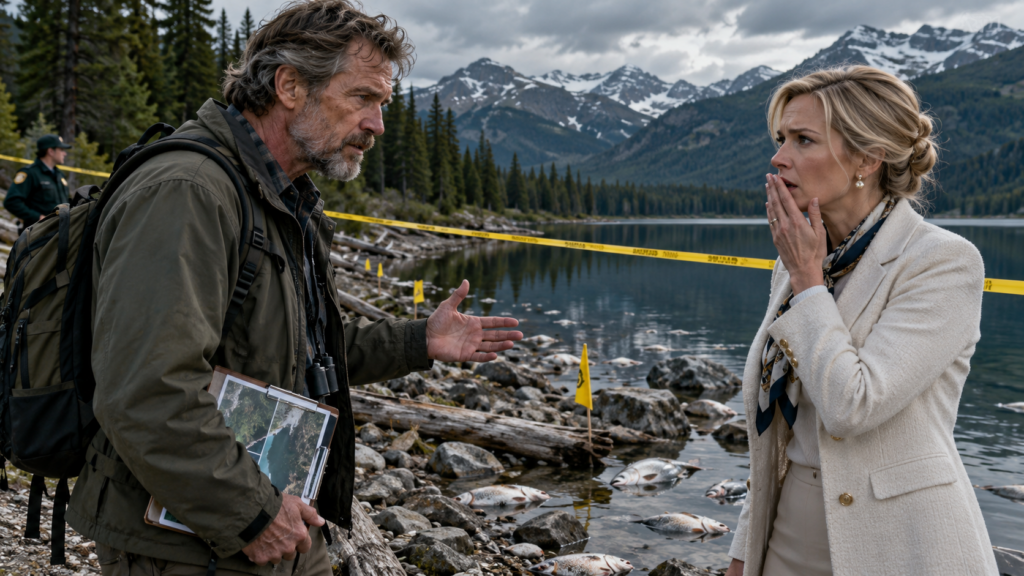
The first dead fish floated up at 6:20 on a Tuesday morning.
By noon, there were more than two hundred.
By sunset, a county water plant had shut down, National Guard trucks were hauling bottled water into the valley, and 207 families had been told not to drink from their own faucets.
And the woman responsible had no idea she’d poisoned anything beyond a fishing lake she considered ugly.
Her name was Margot Sinclair.
She was president of Crest View Point, a luxury HOA built along the ridge above my property.
Three months earlier, she’d stood on my shoreline in Italian boots and told me exactly what she wanted.
“Your little fishing hole is disgusting. The trucks, the coolers, the people. I want it gone.”
I looked at the eighty acres of clear mountain water behind her.
“Ma’am, this lake was here before your subdivision.”
She smiled.
“I paid seven hundred thousand dollars for my view. I refuse to stare at poor people dragging coolers across my landscape.”
“You can’t get rid of a lake.”
Her smile widened.
“Watch me.”
What Margot didn’t know was that Briggs Lake wasn’t just where locals fished.
It was connected to a county treatment plant.
That plant supplied drinking water to more than two hundred homes.
And before the week was over, investigators would trace four industrial chemical drums, an eight-thousand-dollar HOA check, and sixty-one text messages directly back to her.
My name is Nathan Briggs.
I’m sixty years old, a retired environmental scientist, and Briggs Lake had been in my family since 1957.
My grandfather Elden built the dam by hand.
Thirty-two feet across.
Fourteen feet high.
Fieldstone, concrete, and three years of work.
Sweetwater Creek backed up behind it and filled the valley until eighty acres of cold spring-fed water spread between the ridges.
In 1965, county officials approached my grandfather.
The homes scattered through Sweetwater Hollow had unreliable wells.
The county wanted to build a treatment intake on our lake and run gravity-fed lines down the valley.
Grandpa agreed.
He kept ownership of the land and lake.
The county operated the treatment plant.
“Water’s supposed to be shared,” he said.
That system had supplied the hollow for six decades.
By the time I retired, 207 homes depended on it.
The lake also remained open for free weekend fishing.
No entrance fee.
No reservation.
No membership.
Just respect the property and clean up after yourself.
My grandfather started that tradition.
My father continued it.
So did I.
Every Saturday, Earl Parsons parked his ancient Dodge in the same spot he’d used since 1991.
He was seventy-two and released every fish he caught.
The Rivera family came Sundays after church.
Their seven-year-old daughter Lucia named every fish before putting it back.
She kept a notebook.
Captain Whiskers.
Princess Fins.
Mr. Bigmouth.
Forty-seven names at last count.
Those were the people Margot wanted removed from her view.
Crest View Point had fifty-five expensive homes.
Stone facades.
Three-car garages.
Monthly HOA dues that cost more than some families’ grocery budgets.
The sales brochure advertised “private mountain lake views.”
The lake wasn’t theirs.
The phrase apparently sounded better than “view of somebody else’s property.”
Margot became HOA president shortly after moving in.
She’d spent decades in pharmaceutical sales and ran the association like a regional sales division.
Metrics.
Compliance reports.
Violation charts.
Escalation.
The first letter she sent me complained about “sightline intrusion.”
She wanted vegetation planted so residents wouldn’t have to see fishermen from their decks.
The second complained about coolers and parked trucks.
Then came noise complaints.
Environmental complaints.
Zoning complaints.
She even argued my free weekend fishing operation was a commercial recreational business requiring a special-use permit.
The county rejected that.
She appealed.
Rejected again.
Then she tried to convince planning officials that the HOA should be granted environmental authority over any private body of water within fifteen hundred feet of a residential development.
That would’ve included Briggs Lake.
Her proposal would’ve allowed the HOA to restrict access, dictate shoreline structures, and even regulate fish populations.
The county commission rejected it unanimously.
The chair called it what it was.
A rule written to target one neighboring property owner.
Margot walked out without saying a word.
Then she went quiet.
Six weeks.
No letters.
No complaints.
No visits.
After fifteen months of harassment, I should’ve been relieved.
Instead, I became nervous.
People like Margot don’t suddenly discover peace.
They discover another strategy.
Still, I was tired.
I stopped watching her and went back to living.
Then came Tuesday morning.
I was walking the north shoreline with coffee when I noticed the water looked wrong.
Normally Briggs Lake had a deep green clarity.
That morning, it looked pale and cloudy.
Then I saw the first bass floating belly-up.
Another appeared near the reeds.
Then three bluegill.
Then a catfish.
I counted sixty-one dead fish along the first stretch of shoreline.
My training took over.
Twenty-seven years in state water-quality work had taught me what a chemical fish kill looked like.
Red, damaged gills.
Abnormal water color.
A sharp pH change.
A metallic sheen.
I collected samples from eight points around the lake.
Then I followed the strongest contamination signature toward the northeast inlet.
Fresh tire tracks crossed the fire road.
Bootprints cut through the clay.
Vegetation had been crushed beside the spring feed.
Two hundred yards uphill, behind a wall of rhododendron, I found four empty fifty-five-gallon drums.
Two were labeled copper sulfate pentahydrate.
The other two had contained commercial aquatic herbicide.
I photographed everything.
Labels.
Lot numbers.
Tracks.
Location.
Then my phone rang.
Bill Calder operated the Sweetwater Community Water District treatment plant.
His voice was shaking.
“Nathan, something’s wrong with the intake.”
“How bad?”
“Turbidity alarms. pH is dropping. I’m seeing a chemical signature I don’t recognize.”
“Shut the intake.”
“I already did.”
I closed my eyes.
“Did any water reach distribution?”
A pause.
“The lines were pressurized for about thirty minutes before isolation.”
Two hundred seven homes.
Kitchen faucets.
Showers.
Coffee makers.
