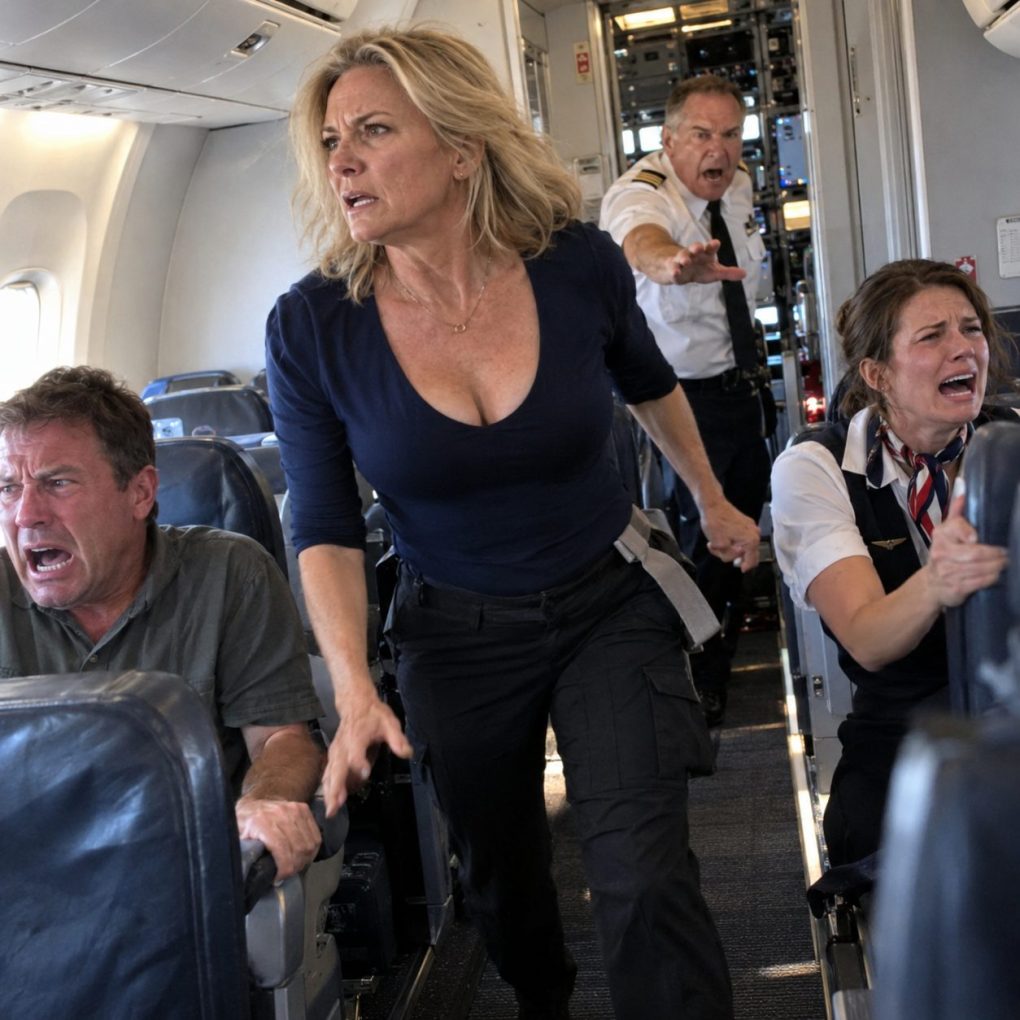
Ein kleines Mädchen, das ihrer Mutter gegenüber saß, hielt ihren Ärmel fest.
“Das heißt also, wir werden gleich einen Unfall haben?”
Ich habe meinen Sicherheitsgurt gelöst.
Die Flugbegleiterin hielt meinen Arm fest, bevor ich den Gang erreichte.
“Madam, bitte nehmen Sie Platz.”
„Sagen Sie dem Kapitän, dass auf Platz Nummer vierzehn ein Pilot sitzt.“
„Er hat einen Kopiloten.“
„Und sie stehen vor einem Problem, mit dem keiner von ihnen jemals zuvor konfrontiert war.“
Der Boden schien sich zu neigen. Ein Getränkewagen knallte gegen einen Türriegel. Irgendwo hinter uns begann ein Mann zu beten.
Ich ließ meinen Sitz so lange zurückgelehnt, bis das Flugzeug eine bestimmte Höhe erreicht hatte.
Diese langsame Rollbewegung. Eine kurze Korrektur. Dann stürzte die Flugzeugnase wieder nach unten.
Ich kenne diesen Rhythmus.
Vor 32 Jahren habe ich es am eigenen Leib erfahren, mit Rauch in den Augen und Blutspritzern an den Schuhen.
„Wie heißen Sie?“, fragte der Kellner.
„Margaret Hayes. Ehemalige Fluglehrerin. Davor diente sie bei der Luftwaffe.“
Ihr Gesichtsausdruck veränderte sich.
“Was soll ich ihm sagen?”
“Sag ihm, dass Phoenix hier ist.”
Sie starrte ihn aufmerksam an und griff dann nach der Gegensprechanlage.
Jahrzehntelang habe ich mich geweigert, mit diesem Namen anzusprechen. Jetzt ist er das Einzige, was mir den Zugang zum Cockpit ermöglicht.
Wenig später führte sie mich vorwärts.
Der Kapitän blickte zurück. Er war jünger, als ich ihn mir vorgestellt hatte, vielleicht um die vierzig, mit einer leichten Falte am Kinn.
Sein Kopilot deutete auf einen Bildschirm.
„Jedes Mal, wenn wir versuchen, das Problem zu beheben, verschlimmert es sich nur.“
„Dann leiste keinen Widerstand mehr auf die alte Art“, sagte ich.
Der Blick des Kapitäns verengte sich.
Haben Sie das schon einmal gesehen?
“Ja.”
“Wo?”
„Flug 406. Pennsylvania. Vor 32 Jahren.“
Seine Hände waren erfroren.
Es gibt Gründe, warum sich Piloten an diesen Unfall erinnern. Und es gibt Gründe, warum ich ihn nie erwähnt habe.
Er sah mich an, als wäre ich gerade einem Foto entsprungen.
Dann zog er ein altes Foto aus der Seite seiner Reisetasche.
Ein Flugzeug steht in Flammen. Eine Frau kniet neben einem Kind.
ICH
„Bevor du irgendetwas anfasst“, flüsterte er, „sag mir, warum du meine Mutter im Haus wohnen lässt.“
Der Kapitän erkannte mein Gesicht. Er wusste von dem Unfall. Doch das Foto, das er bei sich trug, hielt nur einen einzigen Moment fest – und uns lief die Zeit davon, uns mit allem außerhalb dieses Bildausschnitts auseinanderzusetzen.
Das Flugzeug stürzte ab, bevor ich antworten konnte.
The copilot, Luis Ortega, gave me a quick account of what had failed and what they had already tried. I had retired eighteen months earlier from this aircraft type. The displays were familiar. The way the airplane resisted them was worse than familiar.
“I can help assess it,” I said. “You’re still the captain.”
Daniel nodded.
We worked together, checking the indications against the airplane’s actual movement. Nothing was simple. Some responses were delayed; others barely registered. Every small gain cost altitude.
Outside, the Pennsylvania countryside rose toward us.
Air traffic control cleared the airspace and directed us toward the nearest suitable runway. Emergency crews were already moving.
“How long?” Daniel asked.
“Long enough to keep working.”
He glanced at me.
“That’s what you told me back then.”
The words opened a door I had kept shut.
A boy pinned beneath a seat. One sneaker missing. A woman calling from farther back.
I had been an off-duty airline pilot on Flight 406, years after leaving the Air Force. After the crash, I had crawled back through the broken fuselage.
I had brought Daniel out.
I had come out without Helen.
“You were eight,” I said.
“I remember more than people think.”
Another warning sounded.
Luis spoke sharply, pulling us back to the cockpit.
We found a limited response we could work with. Daniel held it while Luis coordinated with the ground. I watched the changing indications and called out what mattered.
The shaking eased.
Then Daniel said, “There’s an envelope in my bag. From the foundation.”
The foundation had invited me to Pittsburgh to speak about aviation safety. I had accepted only after they promised there would be no cameras.
“You sent the invitation?”
“I wanted an answer.”
“You arranged this?”
“The invitation,” he said. “Nothing else.”
His voice cracked.
“My father died last month. I found something he kept from me.”
We were still losing altitude.
“What?”
“A letter from my mother. Written before that flight.”
I looked at him.
“And a statement you gave investigators.”
The runway appeared ahead, small and impossibly far below.
Then Luis went still.
“We’re not going to reach it.”
Daniel turned toward me.
“Phoenix,” he said, “what did you land on the first time?”
“A closed airfield,” I said. “But we don’t need the same place. We need somewhere we can actually reach.” Luis relayed that to the controller. Seconds stretched while Daniel held the airplane as steady as its damaged controls allowed. Then the controller gave us another option: an old municipal field several miles short of the airport. Its remaining runway served an industrial property now. It was shorter, with no promise of a clean approach. But it was beneath us, and someone on the ground was already trying to clear it.
Daniel studied the view ahead. “I see it.” There were buildings off one end and trucks near the pavement. We could not wish ourselves higher. We could only use what remained. Daniel made the decision, Luis handled the radio and landing checks, and I kept watching for the changes we had learned to recognize. Behind the cockpit door, the flight attendants were getting everyone ready. Their voices carried forward, firm and clear. Nobody back there knew their captain was flying beside the woman he had spent his life trying to forgive.
