La noche anterior a la boda de mi hijo, su prometida me dijo que el mejor regalo que podía hacerles era desaparecer de su familia.
A medianoche, me llamaban desde una casa de la que era copropietario, rogándome que restableciera la señal que acababa de cancelar.
Esa tarde, Amanda estaba en la cocina con su vestido de novia colgado detrás de ella en una funda para ropa.
—El mejor regalo sería que desaparecieras de nuestra familia —dijo con una sonrisa.
Michael asintió sin mirarme.
“Se supone que este es nuestro fin de semana especial, mamá.”
“Tu negatividad lo está arruinando todo.”
Pasé la mañana arreglando flores y la tarde ayudando con los preparativos de última hora.
La única opinión que ofrecí fue que quizás no necesitaban esculturas de hielo con forma de cisne.
—¿Adónde se supone que debo ir? —pregunté.
“El hotel.”
“Las de tus hermanas.”
“Me da igual, Dorothy, siempre y cuando no estés aquí mañana.”
Miré a Michael.
“Esta también es tu casa.”
Se aclaró la garganta.
“Ahora es más la casa de Amanda.”
“Ella se encarga de las finanzas y de todas las mejoras.”
“Solo nos diste algo de dinero una vez.”
Algo de dinero una vez.
Tres años antes, había vendido la casa victoriana que mi difunto esposo Robert y yo habíamos restaurado.
Destinaba 87.000 dólares de mis ahorros a la casa de los sueños de Michael y Amanda.
Me prometieron que siempre tendría un lugar con ellos.
Durante los últimos seis meses, viví en su habitación de invitados y ayudé a pagar la boda que celebraban mañana.
—Tienes razón —dije.
“Debería irme.”
Amanda parecía sorprendida.
Michael parecía aliviado.
“Podemos hablar después de la luna de miel”, dijo.
Arriba, doblé mi ropa y la metí en una maleta.
Incluso después de seis meses, siempre la habían llamado la habitación de invitados, nunca mi habitación.
Desde abajo, pude oír a Amanda hablando de cómo podría usar el espacio después de que yo me fuera.
Ella quería un estudio de yoga.
Michael sugirió una oficina.
Me detuve junto a la fotografía de Robert que estaba en la mesita de noche.
En los cuarenta y tres años que estuvimos juntos, nunca me hizo sentir incómoda en casa.
Metí la fotografía en mi bolso y me marché en menos de una hora.
En mi coche, aparcado frente a la casa, llamé a Margaret Chen, la abogada que se había ocupado de mis asuntos desde la muerte de Robert.
“Es sábado por la noche”, dijo.
“¿Está todo bien?”
“Necesito que reúnas todos los documentos relacionados con la compra de la casa de Michael y Amanda.”
Margaret escuchó mientras le contaba lo que había sucedido.
Luego me preguntó si recordaba los documentos adicionales que había insistido en que firmara cuando empecé a preocuparme por los gastos de Amanda.
“Los 87.000 dólares no fueron documentados como un regalo”, dijo.
“Fue un préstamo, y su nombre figura en la escritura como copropietario.”
Me quedé mirando la ventana iluminada de la cocina.
“How much of the house do I own?”
“Thirty-five percent.”
“You’re also listed as a co-borrower on the mortgage.”
“Amanda never signed the acknowledgment forms I sent her.”
For years, I had let Michael call my contribution a gift rather than argue about the paperwork.
I had nearly forgotten what Margaret had arranged.
“What happens if I want to sell my share?” I asked.
“We’d need to follow the proper process,” she said.
“We can discuss whether Michael and Amanda can buy you out and what happens if they can’t.”
Through the window, I saw Michael open a bottle of champagne.
“Start looking into it,” I said.
Margaret paused.
“Are you sure?”
“Yes.”
I ended the call and made another one.
“Sunset Gardens Country Club,” a woman answered.
“This is Jessica.”
“This is Dorothy Mitchell.”
“I need to speak with your catering manager about tomorrow’s wedding reception.”
Jessica checked the booking.
The contract and deposit were in my name, with my credit card attached.
I told her I wanted to cancel.
“But the wedding is tomorrow,” she said.
“The food has been prepared, and the staff is scheduled.”
“There will be cancellation fees.”
“I understand.”
“I’ll pay the fees.”
She hesitated.
“Have you spoken with the bride and groom?”
“They’ve told me they no longer want me involved in their lives.”
Jessica confirmed the details and processed the cancellation.
Twenty minutes later, I checked into a Hampton Inn across town.
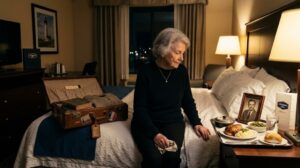
I ordered room service, put Robert’s photograph on the bedside table, and tried to eat.
My phone rang at 11:47 p.m.
“What did you do?” Amanda shouted.
“I left, as you asked.”
“The country club called.”
“You canceled our reception!”
“Two hundred people are expecting dinner tomorrow.”
Michael took the phone.
“Mom, you can’t cancel our wedding over a disagreement about where you’re sleeping.”
“I didn’t cancel the wedding.”
“I canceled the reception I contracted and paid for.”
He went quiet.
“It was costing me $14,000,” I said.
“Fourteen thousand?” Amanda’s voice sounded much smaller.
“What about the flowers, the photographer, the band?”
I had been covering those expenses too.
Until that moment, I had spared them the totals whenever they asked.
“We can’t tell two hundred people there’s no reception,” Michael said.
“I know this is difficult,” I replied.
“You still have tomorrow to decide what you want to do.”
Amanda began to cry.
“How could you do this?”
“We trusted you.”
“You told me to leave your family.”
“I didn’t mean forever.”
“I meant for the weekend.”
“That isn’t what you said.”
Michael’s voice softened.
“Come back to the house.”
“We’ll talk.”
I thought of Amanda’s wedding dress in the kitchen and the two of them planning what to do with my room before I had even reached my car.
“I’m staying where I am tonight.”
“Where are you?” Amanda asked.
I didn’t tell her.
“Please,” Michael said.
“Call the country club.”
“Tell them it was a misunderstanding.”
I looked at Robert’s photograph, then at the room-service tray beside it.
