Le portrait d’Audrey Whitmore trônait toujours au-dessus de l’escalier est, bien que presque tous les convives de la salle de bal aient pris l’habitude de passer dessous sans lever les yeux. La photographie avait été prise six mois avant sa disparition : cheveux noirs ramenés sur une épaule, main posée sur la rampe, le sourire discret d’une femme qui n’aurait jamais imaginé que son visage deviendrait un jour un monument. Ce soir-là, masques argentés et smokings noirs défilaient sous le portrait, tandis qu’un quatuor jouait près des fenêtres. Chaque surface polie du manoir Whitmore reflétait la lueur des bougies, le champagne et les personnes qui avaient appris à se comporter comme si de rien n’était face à une tragédie qui ne les concernait plus.
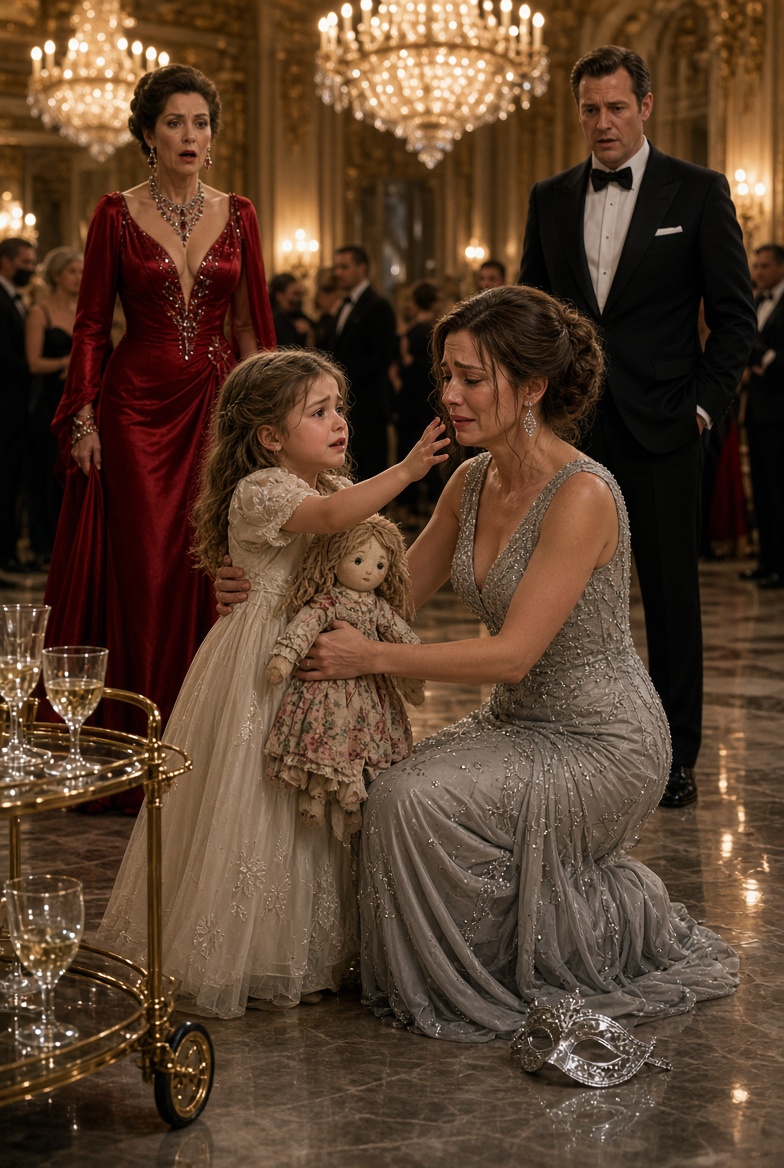
Au fond de la salle de bal, Ellie Whitmore, six ans, était assise sur un banc de velours, une vieille poupée de chiffon posée sur ses genoux. La fête semblait tourner autour d’elle plutôt que de l’inclure ; chaque fois que le quatuor à cordes prenait de l’ampleur, elle pressait deux doigts contre le ruban de la poupée et frottait le tissu jusqu’à ce que sa respiration se calme. Graham avait préparé un salon plus tranquille à l’étage au cas où elle serait submergée par l’émotion, mais Ellie avait insisté pour rester là où elle pouvait le voir, et toutes les quelques minutes, il attirait l’attention d’un donateur ou d’un membre du conseil d’administration juste le temps de s’assurer qu’elle était toujours là.
Camille Arden remarqua ces regards car elle avait passé trois ans à apprendre à percevoir ce que Graham avait perçu. Elle se tenait à ses côtés, vêtue d’une élégante robe rouge, répondant aux questions sur le développement de la fondation et détournant la conversation des audiences prévues le lendemain matin, toujours avec cette chaleur naturelle qui avait inspiré confiance aux donateurs après la disparition d’Audrey. Lorsqu’un membre âgé du conseil d’administration félicita Camille d’avoir « maintenu la famille unie », le visage de Graham se crispa presque imperceptiblement, et Camille répondit avant même qu’il ait pu dire un mot.
« Nous avons assuré la continuité des activités de la fondation », a-t-il déclaré. « C’était tout ce que nous avions le droit de faire. »
Graham fit lentement tourner son verre entre ses doigts. « Il y a des choses qui ne devraient pas faire l’objet d’un discours de victoire. »
Camille soutint son regard un instant, puis esquissa un sourire avant que quelqu’un à proximité ne remarque sa correction. « Je ne voulais pas le corriger. J’essayais juste d’empêcher Ellie de reparler de “demain”. »
« Alors ne parle pas de demain devant elle. »
«Je ne l’ai pas fait.»
« Il n’est pas nécessaire de le dire pour que les enfants sachent que quelque chose est en train de changer. »
The exchange ended when another donor approached, but something remained unsettled behind Camille’s composure. She had wanted this gala to feel controlled: the trustees reassured, the donors impressed, Graham exhausted enough to accept that life could not remain suspended around a missing woman forever. Instead, there was an unfamiliar tension in the room, subtle enough that she initially blamed the approaching court date, until she saw the woman in silver standing beneath Audrey’s portrait.
The stranger wore a pale evening gown and a delicate masquerade mask that covered the upper half of her face. Nothing about her should have held Camille’s attention for more than a second; the guest list was large, and half the room had arrived through corporate sponsors Camille herself had approved. Yet the woman was not watching the orchestra, the donors, or Graham. Her attention rested on Ellie with such unwavering concentration that Camille stopped listening to the trustee beside her.
Across the room, Audrey kept both hands folded loosely in front of her because she no longer trusted them not to betray her. Three years had altered Ellie in ways photographs had failed to prepare her for: longer legs, darker hair, a more deliberate way of turning the doll’s ribbon between her fingers when the room became too loud. Audrey had imagined this moment during hospital nights, during physical therapy, during every silent hour in which returning home had remained a future tense, but imagination had never included the simple cruelty of standing thirty feet from her own daughter and having no right to cross the distance.
A waiter approached Ellie from behind carrying a tray of champagne. The child did not see him, but her shoulders rose when the glasses touched with a bright, brittle chime, and Audrey’s weight shifted forward before she caught herself. The waiter reached toward Ellie’s shoulder, perhaps intending to ask whether she wanted to move, and Audrey’s hand lifted a fraction from her side; Graham saw the waiter at almost the same moment and crossed the room to redirect him without touching his daughter.
Camille saw both reactions.
She watched Graham crouch beside Ellie until the girl’s shoulders relaxed, then turned back toward the masked stranger. The woman’s chin had lowered, her fingers still slightly curled as if she had interrupted an instinctive movement halfway through. Camille felt a pressure gather beneath her ribs that had nothing to do with fear yet and everything to do with recognition arriving before reason could explain it.
She moved closer without appearing to hurry. “I’m sorry, I don’t believe we’ve met.”
Audrey looked at her.
Camille had prepared herself for many things during the past three years, although never for the possibility that a stranger’s silence could feel familiar. The lower half of the woman’s face offered nothing Camille recognized, and her voice, when it came, was lower than the one preserved in old videos.
“We haven’t.”
“Are you here with one of our sponsors?”
“A friend invited me.”
“Which friend?”
Audrey’s eyes moved briefly toward the ballroom rather than supplying a name. “Does it matter?”
“It does when someone spends half the evening watching a child she doesn’t know.”
