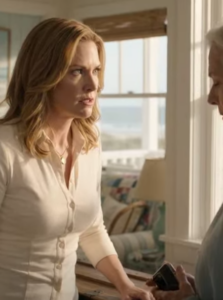
À soixante-dix ans, je me tenais dans la maison de plage où mon mari avait construit nos plus beaux souvenirs et j’écoutais ma belle-fille annoncer qu’il n’y avait plus de place pour moi.
« Il n’y a vraiment pas de place pour elle », dit Megan en jetant un coup d’œil autour de mon salon encombré, comme si j’étais une cliente d’hôtel inattendue.
Pendant plusieurs secondes, je me suis vraiment demandé si je n’avais pas mal compris ce qu’elle voulait dire.
Puis j’ai regardé mon fils, Robert, et j’ai compris, à son expression, que j’avais parfaitement compris.
« Maman, tu n’étais pas censée rentrer avant demain », dit-il, l’air plus irrité que surpris.
J’avais passé soixante-dix ans à apprendre les bonnes manières, mais rien, durant toutes ces années, ne m’avait préparé à être traité comme un intrus chez moi.
Six voitures inconnues étaient garées devant chez moi, vingt et une personnes s’étaient apparemment installées dans mon chalet, et quelqu’un buvait du café dans la tasse préférée de mon défunt mari.
Pourtant, le plus pénible dans cette pièce n’était ni le désordre ni le manque de respect.
C’était la façon dont Robert refusait de croiser mon regard.
Le chalet nous appartenait, à Henry et à moi, depuis plus de trente ans.
Nous l’avions achetée lorsque Robert était encore à l’école primaire, à l’époque où le toit fuyait lors des fortes tempêtes et où le sol de la cuisine penchait légèrement vers la porte arrière.
La plupart des gens avaient regardé la petite maison et avaient vu les réparations qu’ils ne pouvaient pas se permettre.
Henry l’avait contemplé et avait vu l’endroit où nous vieillirions ensemble.
Il travaillait les week-ends à remplacer des planches, à réparer les fenêtres et à remettre le porche en état pendant que je peignais les pièces et que j’économisais le moindre sou pour acheter des meubles.
Nous n’avons jamais eu beaucoup d’argent, mais cette maison nous donnait le sentiment d’être riches de toutes les manières qui comptaient vraiment.
Henry adorait s’asseoir sur les marches de derrière avec son café, à regarder les bateaux de pêche se déplacer à l’horizon avant le lever du soleil.
J’ai adoré la petite véranda qu’il m’a construite après notre vingt-cinquième anniversaire de mariage.
Il a dit que je méritais un bel endroit pour m’asseoir avec mes livres, surtout les matins où le vent rendait la plage trop froide.
Les fenêtres donnaient sur l’eau, et il a placé mon fauteuil préféré de façon à ce qu’il soit baigné par les premiers rayons du soleil.
Parfois, il m’apportait le petit-déjeuner là-bas et faisait semblant d’être le serveur d’un restaurant chic en bord de mer.
Après sa mort, cette pièce est devenue l’endroit où je me sentais le plus proche de lui.
Sa photo était posée à côté de la fenêtre, et sa tasse à café bleu marine ébréchée restait dans le placard de la cuisine.
J’aurais pu remplacer cette tasse cent fois, mais je n’en ai jamais voulu une autre.
Chaque petite égratignure me rappelait l’homme qui m’avait aimée pendant quarante-trois ans.
That was the home I expected to return to that Friday afternoon.
I had been away for several days and decided to come back one day earlier than planned.
The weather was beautiful, the highway was quiet, and I imagined spending the evening reading in the sunroom with the windows open.
Instead, I turned into my driveway and found so many vehicles that I could barely reach the garage.
At first, I wondered whether someone nearby was having a party and using my driveway without permission.
Then I recognized Robert’s silver SUV and Megan’s white crossover parked near the front porch.
My first feeling was relief because I assumed something had happened and my son had come to check on the house.
That relief lasted until I heard shouting from inside.
Children were running through the hallway, the television was playing loudly, and music thumped from a speaker in the living room.
I opened the front door and nearly collided with a little boy carrying a plastic bucket of beach toys.
He stared at me with wide eyes before racing past without a word.
There were sandy shoes scattered across the entryway and unfamiliar jackets hanging over Henry’s antique coat rack.
A dripping beach towel lay across the upholstered bench I had restored myself.
Someone had moved my framed photographs to make room for bags of snacks.
I walked farther inside, feeling as though I had entered a stranger’s vacation rental.
Two women sat on my sofa eating sandwiches, while a man I had never met was opening cabinets in my kitchen.
Another guest was talking loudly about where everyone planned to eat dinner.
Nobody seemed particularly concerned about the elderly woman standing in the doorway holding her overnight bag.
Then I saw the navy mug.
A young man leaned against the kitchen counter with Henry’s mug in his hand, laughing at something on his phone.
There was nothing extraordinary about someone using a coffee mug.
But I felt a sharp pain in my chest when I saw that familiar blue handle between a stranger’s fingers.
“Excuse me,” I said quietly.
The young man looked up.
“Could you please put that mug down?”
He seemed confused but immediately placed it beside the sink.
“Sorry, ma’am, I didn’t know it was special.”
I thanked him because he had done nothing intentionally cruel.
Then Megan appeared from the hallway wearing a bright beach cover-up and carrying a glass of iced tea.
Her smile disappeared when she recognized me.
“Oh,” she said.
That single word told me more than an elaborate explanation could have.
She was not delighted to see me, and she was certainly not expecting to welcome me home.
“Hello, Megan,” I said.
She glanced toward the living room, then at the bag in my hand.
“We thought you were coming tomorrow.”
“I decided to return early.”
She pressed her lips together.
“Well, that’s a little complicated.”
