The group replaced several abstract scenarios with concrete procedures giving any employee the right to suspend an action imposed on a vulnerable person without having to obtain prior authorization from a superior.
A simple rule was added to the seating plans: the wheelchair, cane, walker or any other personal equipment should never be moved without explicit consent.
Ms. Beaumont rarely attended meetings, in accordance with her promise not to use her authority to dictate reform.
She sometimes met Nora in the cafe next to the headquarters, where they talked about things that would not appear in any report.
Madame Beaumont told him about the anger she felt when she realized that her own name would save her from a system that others would continue to suffer.
Nora confided in him that she had long believed that dignity consisted of never needing anyone.
“You agreed to let your brother help you choose,” observed Mrs. Beaumont.
“He couldn’t pay my bills.”
“No, but he prevented you from believing that his future depended on your silence.”
Six months after the gala, a position for coordinator of inclusive reception and team protection was opened within the group.
Nora could have received the position directly, but she demanded that the offer be published and that her application be reviewed like those of other candidates.
She attended the interviews, presented an operational project and answered questions posed by a jury including an employee representative, an external accessibility specialist and the new general manager.
When she was chosen, the decision was based on a process that everyone could verify, not on a reward given out of gratitude.
Her first day in this role coincided with a more modest charity dinner held in the same room where Celeste had tried to move Madame Beaumont.
The chandeliers hadn’t changed, the tables still had white tablecloths, and the employees used the same service aisles.
However, the space behind each chair had been measured, the access paths remained clear, and no photographer could request that a guest be moved to improve a picture.
Nora arrived before the doors opened in order to check the routes with the team.
The new banquet manager handed him a small, flat box.
Inside was his old gold badge, cleaned but marked with a fine scratch near the first letter of his first name.
“Ms. Beaumont thought you might want to get it back.”
Nora ran her finger over the scratch.
For months, she had imagined this object as proof of what had been taken from her.
Now, he mostly represented the person she had been before she understood that keeping a job and keeping her voice were not always the same struggle.
“My new position has a different badge,” she said.
“I know.”
Nora closed the box, then slipped it into her bag instead of throwing away the old badge or hanging it up like a trophy.
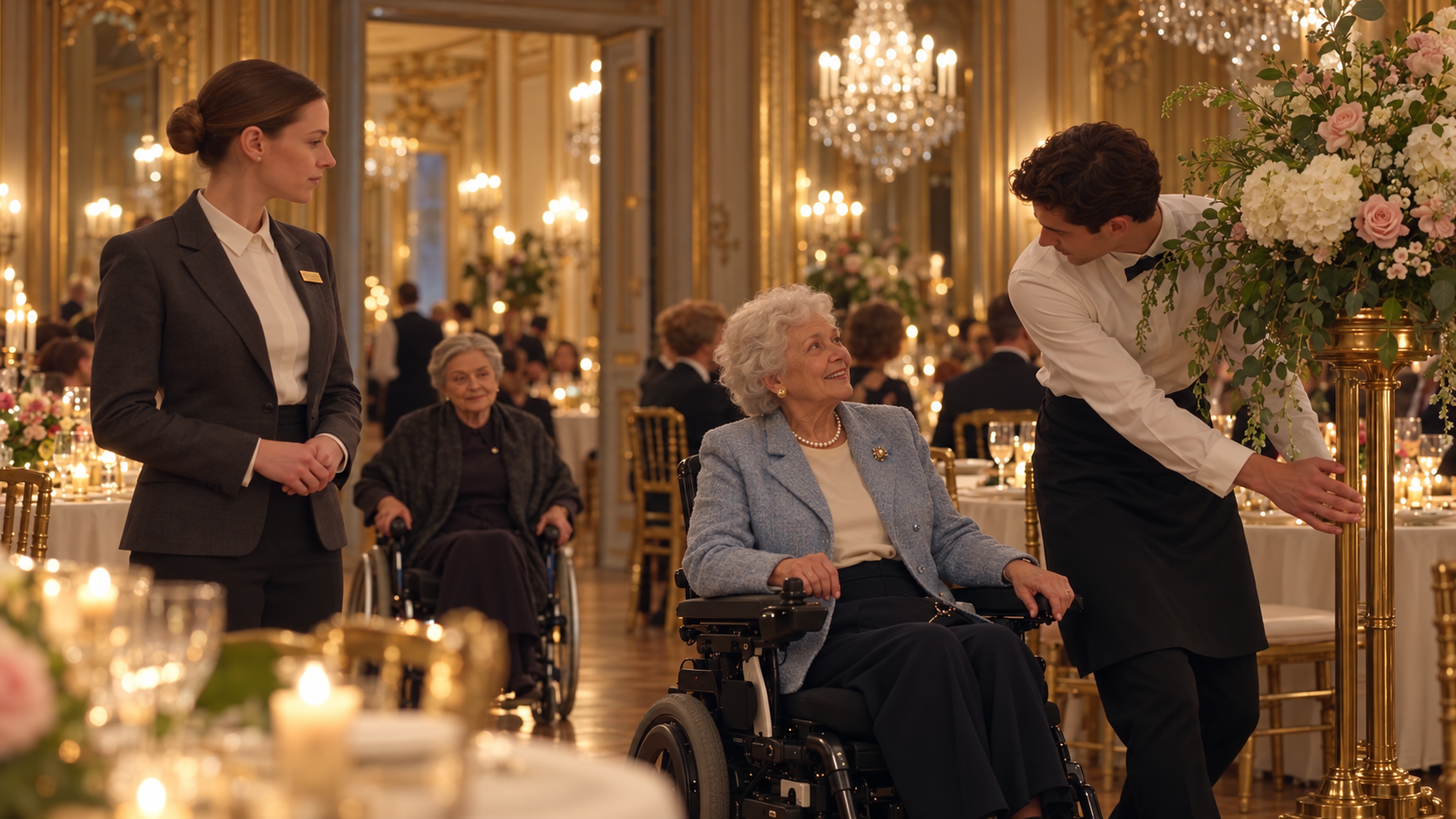
Shortly before dinner began, an elderly woman entered with her granddaughter and stopped a few meters from the table that had been assigned to them.
His electric wheelchair could not get around a floral support installed after the last check.
A young waiter rushed to the back of the chair, offering to push it.
Nora gently raised her hand.
“First, ask her what she prefers.”
The waiter stopped, then positioned himself at the guest’s level.
“Madam, would you like me to move the support or would you prefer another route?”
The woman examined the obstacle.
“Please move the stand, as this table suits me very well.”
The waiter smiled and asked a colleague to clear the way without touching the chair.
No one applauds.
No director entered the room to reveal the guest’s hidden identity.
No photographer captured the moment.
The correct action took place without fanfare, exactly as it should always have taken place.
Nora watched the woman return to her table, then she attached the new badge bearing her name and position to her jacket.
Ms. Beaumont appeared a few minutes later through the main entrance, this time announced as chair of the supervisory board, but Nora did not head towards her first.
She first finished helping the unknown guest to place her bag within easy reach.
When she finally looked up, Madame Beaumont gave her a simple nod from across the room.
Nora responded in the same way.
Their victory was not that a powerful woman was recognized in time.
It lay in the fact that another woman, whose name no one knew, had not needed to be [named] for her choice to be respected.
