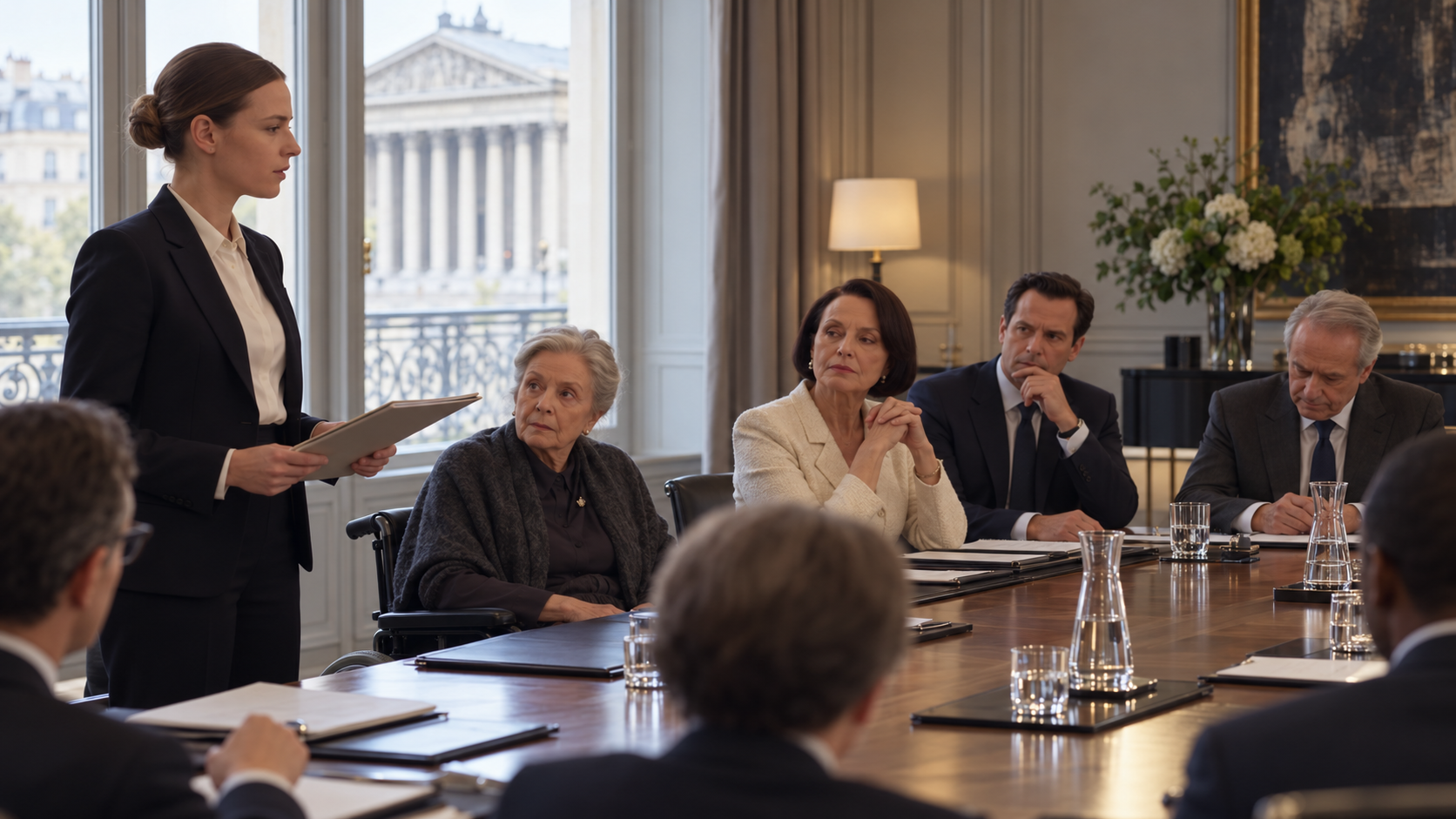
The supervisory board met a week later in a sober room at the group’s headquarters, near the Place de la Madeleine, far from the chandeliers and decorated tables of the gala.
Nora arrived with Sophie, a folder of notes, and the feeling of entering a place where all the chairs seemed to have been designed for people who had never waited for a withdrawal with forty-three euros in their account.
Ms. Beaumont usually presided over the session, but she had entrusted the direction of the debates to the vice-president in order to be able to testify without controlling the agenda.
Armand occupied a seat on the side, without a backrest in front of him for the first time since Nora had known him.
Céleste Varenne had come with her lawyer and a representative of the family foundation.
Damien had chosen to submit a written statement rather than attend the meeting.
The vice-president reminded everyone that the council was not intended to replace ongoing social procedures, but that it should examine governance responsibilities, the relationship with the Lumière Foundation and practices that may have created a lasting risk for employees as well as guests.
Celeste immediately requested that the phrase “forced displacement” be removed from the documents.
“I wanted to help an elderly person reach a more suitable table, and an employee interpreted my gesture with disproportionate aggression.”
Madame Beaumont waited until she finished.
“You asked me if we were obligated to make the situation embarrassing.”
“I don’t remember those words.”
“The cameras, however, remember it.”
Celeste’s lawyer intervened to challenge the use of a sound recording taken in a reception area, but the vice president interrupted the legal debate before he could erase the essential part.
“We are not gathered here to determine a sentence, but to understand why three successive refusals were not enough to stop an action that the staff should have prevented.”
The representative of the Varenne family then placed an envelope on the table.
He confirmed that future payments would be suspended if the foundation publicly associated Celeste’s name with discriminatory behavior or if Nora remained affected by events supported by the family.
Eight hundred thousand euros suddenly took the form of a blank sheet of paper between two perfectly manicured hands.
The vice-president asked the chief financial officer to clarify the consequences of a withdrawal.
The response was concrete and painful, as several cultural access programs risked being reduced in the absence of replacement funding.
Celeste turned towards Nora with calculated gentleness.
“You can see that this crusade is no longer just about your pride.”
Nora felt the old reflex return, the one that ordered her to measure her words by the price she would make others pay.
She thought of the beneficiaries of the programs, the employees whose hours could be reduced, and the colleagues who had written to her privately without daring to support her publicly.
Then she looked at Madame Beaumont’s chair, placed so as to allow her to reach the table without obstruction, not as a symbol, but as proof that an organization could anticipate dignity instead of waiting for a scandal.
“It is not my word that puts these programs in danger,” she replied, “it is your family’s decision to condition its aid on the silence of those you have humiliated.”
Celeste pressed her lips together.
“You think too highly of yourself.”
“No, I’m precisely trying to understand why my importance should change the value of the facts.”
Nora then recounted the incident from the beginning, without dramatizing her action or concealing the fact that she had grabbed Celeste’s wrist.
She explained her fear of losing her job, the amount of her rent, the repairs to her car, and her brother’s university deadline.
She also described the initial proposal, because the council needed to know how easy it was to turn a financial difficulty into a tool for silence.
“If Julien Morvan hadn’t taken those photographs, what would have happened?” she asked.
No one answered.
“If Mrs. Beaumont had been a retiree invited by chance, what would have happened?”
Once again, there was complete silence.
“And if I had signed because I needed the money, would your investigation have concluded that the system worked?”
Armand lowered his eyes.
The vice-president gave him the floor.
He did not seek to protect his title.
“I established a culture in which the swift resolution of a conflict mattered more than the manner in which it was resolved.”
He acknowledged having approved the principle of a negotiated separation before the end of the examination of the evidence.
He also admitted that his internal memos on strategic partners had created an implicit hierarchy of credibility among the people present in the establishment.
