Jacob didn’t move.
Then, slowly, he nodded.
Deputy Brooks unlocked the front door.
He walked toward it.
At the threshold, he stopped.
He turned back.
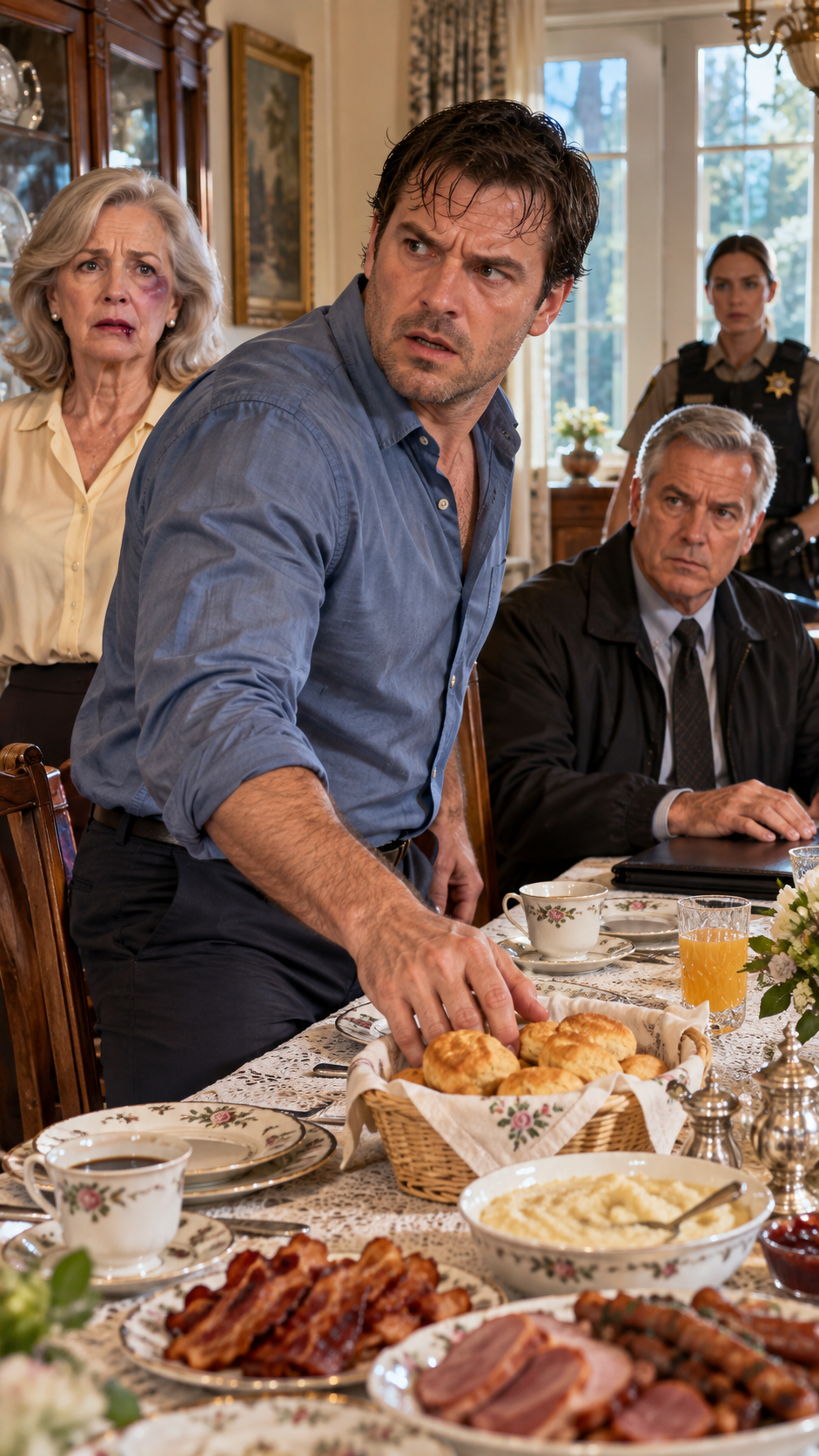
His gaze moved across the table.
The food.
The lace cloth.
The flowered china.
The breakfast of his childhood.
His eyes landed on the biscuits.
For a second, I thought of that little boy again.
Bare feet.
Messy hair.
Honey on his fingers.
Then Jacob looked at me.
“Did you make all this for me?”
I answered truthfully.
“No.”
His face tightened.
“Then why?”
I looked at the table I had spent a lifetime using to keep my family together.
“Because I needed to remember that I could still make something good in this house after what happened here.”
Jacob lowered his eyes.
Then he stepped outside.
PART 5: THE MORNING AFTER
The house became impossibly quiet after Jacob left.
I expected relief to arrive like a wave.
It didn’t.
Grief came first.
I stood in the hallway watching the patrol car disappear beyond the trees.
The sky had cleared.
Rainwater dripped from the gutters.
Sunlight flashed on every wet leaf.
The whole world looked freshly washed.
I felt filthy.
Bruised.
Exhausted.
Old.
Evelyn came beside me.
“You did well.”
I shook my head.
“No.”
“You did.”
“I feel terrible.”
“Those aren’t opposites.”
That sounded like something Robert would have said.
I started crying then.
Not carefully.
Not silently.
I cried so hard my ribs hurt.
Evelyn guided me into a chair.
Carla quietly gathered her papers.
Detective Mercer waited near the door.
Deputy Brooks returned to the table and wrapped two biscuits in a napkin.
I laughed through my tears when I saw her.
She froze.
“I’m sorry.”
“No.”
I wiped my face.
“Take three.”
That was the first laugh in my house after Jacob hit me.
Small.
Wet with tears.
But real.
The weeks that followed were not clean or simple.
Real consequences rarely are.
There were interviews.
More documents.
Calls from the bank.
Calls from investigators.
Paperwork from Evelyn.
Photographs of bruises that turned from purple to green to yellow before disappearing.
My lip healed faster than my arms.
The bank froze the disputed line and continued its review.
Investigators collected records connected to the withdrawals and the disputed authorization.
I gave statements.
I signed affidavits.
I repeated details until I hated the sound of my own voice.
Jacob called seven times in the first week.
I did not answer.
On the eighth call, he left a message.
“Mom, please.”
I listened once.
Then gave the recording to Evelyn.
Not because the message was threatening.
It wasn’t.
That almost made it harder.
He sounded sober.
He sounded frightened.
He sounded sorry.
For two full days I carried the phone from room to room wanting to call him back.
On the third day, Evelyn came over.
“You can love him without rescuing him,” she said.
“I don’t know how.”
“Then learn.”
So I did.
Slowly.
Badly.
Painfully.
I learned not to answer every crisis.
I learned not to explain my boundaries five different ways.
I learned that “no” was a complete sentence even when my son hated it.
I learned that guilt was not proof I’d done something wrong.
And I learned something else.
Jacob had counted on my silence more than he’d counted on any forged paper.
He knew I would be embarrassed.
He knew I would protect his reputation.
He knew I would remember him as a child whenever I needed to judge him as a man.
That knowledge had been his real access to my house.
Not the key.
Not the mail.
Me.
Months passed.
The legal and financial matters moved at the slow pace such things move.
I will not pretend I enjoyed watching my son face consequences.
There was no triumph.
No sweet revenge.
Some mornings I woke before dawn and wondered whether I could have stopped everything years earlier if I’d been stronger.
Then I remembered something Detective Mercer said during one of our later meetings.
“Mrs. Callahan, you’re responsible for what you choose now. You’re not responsible for every choice he made before you were ready to see it.”
I held onto that.
Jacob eventually entered a treatment program for alcohol abuse after his attorney advised him that ignoring his drinking would not help anything.
I was glad.
I did not pay for it.
That mattered.
His attorney contacted Evelyn about arrangements to retrieve the rest of his belongings.
We chose a Saturday afternoon.
A deputy was present.
Jacob looked thinner when he came.
He had been sober for several weeks.
The bruise on my face was gone.
I wondered if that disappointed him.
Not because he wanted me hurt.
But because visible injuries are easier to understand than invisible consequences.
He carried boxes from the guest room to his truck.
Neither of us spoke much.
Then he entered the dining room.
I was packing some of his old things into a carton.
School photographs.
A Little League trophy.
A ceramic handprint he’d made in second grade.
Jacob stopped beside the table.
“You’re keeping that?”
He pointed to the handprint.
“Of course.”
He looked confused.
“After everything?”
I touched the small painted fingers pressed into clay thirty-three years earlier.
“What happened doesn’t erase this.”
His eyes filled.
I continued.
“But this doesn’t erase what happened either.”
He nodded slowly.
That was the closest we’d come to understanding each other.
He glanced toward the china cabinet.
The empty space was still there.
“You never replaced the vase.”
“No.”
“I can buy you another.”
“You can’t.”
He looked down.
“I know.”
For once, neither of us pretended a replacement would make something the same.
He picked up another box.
At the front door, he stopped.
“I’m sorry.”
I believed he meant it.
That didn’t mean I trusted him.
People sometimes confuse those things.
Forgiveness.
Trust.
Reconciliation.
Access.
They are not the same.
“I’m glad you’re sorry,” I said.
He waited.
I knew what he wanted.
I love you.