You’re forgiven.
Come home when you’re ready.
Some version of the old promise.
Instead, I gave him the truth.
“I hope you become someone who never does it again.”
He swallowed.
“Do you hate me?”
“No.”
That answer came easily.
Perhaps too easily.
“I hate what you did.”
“Is there any chance…”
He stopped.
“Any chance what?”
“That someday we can be normal again?”
I looked around the house.
At the clean floor.
The quiet staircase.
The sunlight on the dining table.
“No,” I said.
Pain crossed his face.
Then I finished.
“I don’t want normal again.”
He stared at me.
“Normal was killing us.”
His eyes dropped.
I stepped closer, but I did not touch him.
“If we ever build anything again, Jacob, it has to be something different.”
He nodded.
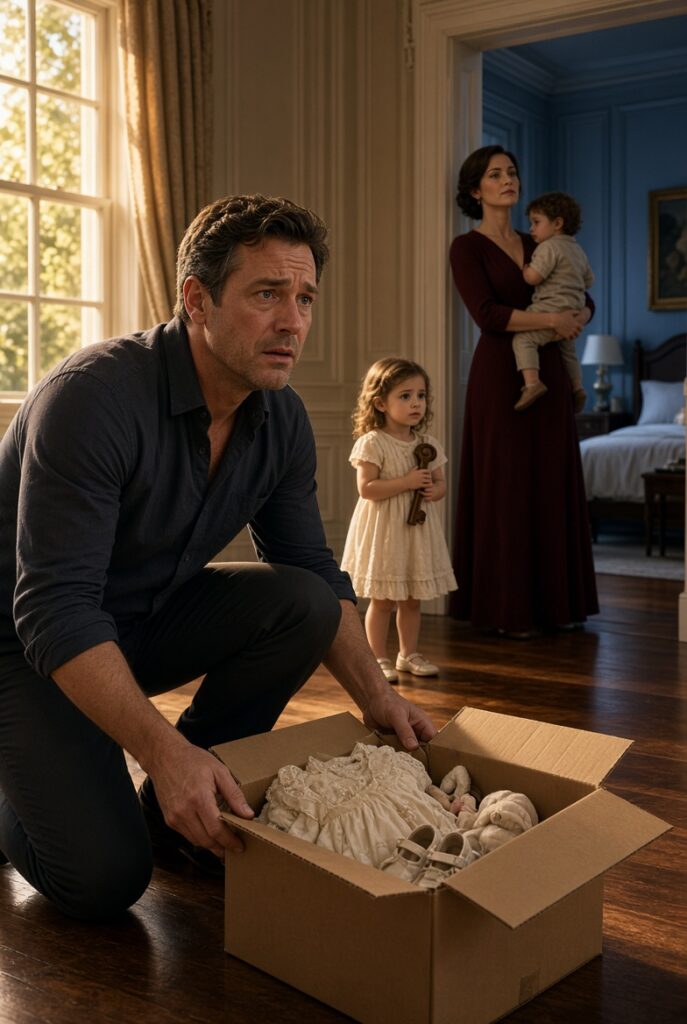
Then he carried the box outside.
That evening, after he left, I went into the kitchen.
For months, I had avoided making biscuits.
The smell reminded me too strongly of that morning.
But grief cannot be allowed to claim every good thing.
So I took down the flour.
I cut cold butter into it.
Added buttermilk.
Folded the dough.
Pressed it flat.
Cut six circles.
While they baked, I took the cardboard box from the top shelf of the pantry.
Inside were the pieces of my grandmother’s vase.
I had considered throwing them away many times.
Instead, I chose three pieces.
One white.
One blue.
One with half a painted rose.
I placed them in a shallow wooden frame beneath glass.
Not repaired.
Not disguised.
Just preserved.
I hung the frame near the dining-room door.
People sometimes ask me why.
I tell them it reminds me of the night I finally stopped cleaning up every broken thing as if nothing had happened.
A few minutes later, the biscuits began to brown.
Their smell filled the house.
Warm butter.
Flour.
Home.
I brewed coffee and carried one plate to the dining table.
Only one.
For the first time in my life, that did not feel lonely.
It felt peaceful.
I sat in my chair and looked toward the head of the table.
Robert’s old place.
The place where Detective Mercer had sat the morning Jacob came downstairs expecting obedience.
Durante años, pensé que la fuerza se sentiría como la ira.
Pensaba que enfrentarme a mi hijo implicaría dejar de quererlo.
Pensaba que la justicia tendría sabor a venganza.
Me equivoqué en todo.
La fuerza se sentía como desayunar en una casa tranquila con la boca sanando.
Fue como abrir mi propio correo.
Revisando mis propias cuentas.
Cerrar mis propias puertas con llave.
Decir que no sin escribir un ensayo después.
Sentía como si quisiera a mi hijo desde la distancia, de modo que ya no pudiera usar ese amor para hacerme daño.
Unté mantequilla de manzana sobre una galleta caliente.
El vapor se elevaba en espiral hacia la luz de la mañana.
Por un instante, recordé a Jacob de niño otra vez.
Me permití recordar.
Entonces dejé que el recuerdo se desvaneciera.
Porque los recuerdos no son contratos.
El amor no es rendición.
Y ser madre no significa enseñarle a alguien que aceptarás cualquier cosa de él.
Esa mañana, meses antes, Jacob había bajado las escaleras creyendo que por fin me había enseñado a obedecer.
En cambio, se encontró con un detective sentado en la silla de su padre, un abogado junto a la ventana, un investigador bancario que sostenía los papeles que él creía que nunca entendería, y un agente del sheriff de pie detrás de él.
Pero la persona que más miedo le daba era yo.
No porque yo gritara.
No porque lo haya amenazado.
No porque haya dejado de amarlo.
Porque, por primera vez en mi vida, me quise lo suficiente como para dejar la verdad sobre la mesa.
Y no lo limpié por él.