The screen of my phone stayed dark for all of four seconds before it buzzed again.
This time it was not a text, but a direct call from my son, Ethan.
I stared at the glowing caller ID resting on the scarred wooden kitchen table—a table David and I had sanded and stained ourselves thirty years ago—before I swiped the screen and pressed it to my ear.
“Mom, what on earth did you just say to Vanessa?” Ethan’s voice burst through the speaker, tight, defensive, and carrying that familiar edge of exhaustion that always seemed to accompany his marriage.
“I told her no, Ethan,” I said, my voice completely level. “Which part of that word required clarification?”
“She’s crying in the other room!” Ethan hissed, his voice dropping an octave as if he were trying to keep the kids from hearing. “Do you have any idea how hard it has been to get her to agree to a family trip? The kids are out of school next week, Vanessa has been stressed out of her mind with the clinic, and we just wanted a clean break. It’s your beach house, Mom. Why are you acting like this over a couple of days?”
I closed my eyes for a fraction of a second, feeling the old, familiar ache of guilt trying to wind its way around my ribs.
For sixty-six years, I had smoothed down my edges so nobody else would get scratched. I had swallowed my opinions, stepped backward in hallways, and apologized when other people bumped into me.
“It isn’t just a couple of days, Ethan,” I replied, keeping my eyes fixed on the salt-weathered windowpane where the live oaks outside were bending in the coastal breeze. “And it isn’t about the house. It’s about the fact that your wife didn’t ask me. She issued a royal decree. She told me to stock the fridge by Thursday as if I were her personal maid.”
“She was joking!” Ethan snapped, though the lie sounded thin even to his own ears. “You know how Vanessa types when she’s rushing. She didn’t mean it like an order, Mom. But you had to go and slam the door in her face. Now she’s packing a bag and telling me we’re staying home, and Leo and Maya are already crying because they thought they were going to see the ocean.”
The manipulation was so classic, so deeply ingrained in the rhythm of their household, that I felt a cold wave of clarity wash over me.
If I gave in now—if I packed up my groceries, drove down to Oak Island, and played the accommodating, sweet-tempered grandmother who smiled while her boundaries were trampled—I would be confirming what Vanessa had believed from the very beginning: that my space, my grief, and my life did not actually belong to me.
“If Vanessa wants to stay home, that is her choice,” I said quietly. “And if you want to bring the children down when you have actually asked me, in a civil tone, whether the house is available… we can talk about it. But nobody is showing up on my doorstep uninvited on Thursday.”
There was a long, heavy silence on the line.
I could hear the faint sound of a television cartoon playing in the background of Ethan’s house, followed by the sharp, muffled sound of a door slamming upstairs.
“You’re being unreasonable, Mom,” Ethan whispered, his voice cracking with a sudden, genuine vulnerability that used to break my heart instantly. “Dad would have let us use the place. You know he would have.”
The mention of David hit me like a physical blow, but this time, instead of making me fold, it straightened my spine.
“Your father and I worked eighty-hour weeks for that cottage, Ethan,” I said, every word weighted with steel. “We didn’t sacrifice our savings so it could become a free hotel room for people who treat me like an inconvenience. When you are ready to talk to your mother with basic respect, call me back. Until then, do not text me about the fridge.”
I hung up before he could answer.
The kitchen went dead silent, save for the hum of the refrigerator and the ticking wall clock. My hands were trembling slightly—not from weakness, but from the sheer adrenaline of standing upright for the first time in my life.
For forty years, I had kept that house sacred. Every shell Lily collected, every tackle box David left on the back shelf of the closet, every framed photograph of salt-crusted sunsets—they were the physical architecture of our survival.
If I let Vanessa roll over it, I wouldn’t just be losing a weekend. I would be erasing the last piece of ground where David and I had built something real.
By Wednesday afternoon, the wind had picked up, driving low, slate-colored clouds across the sky above Oak Island.
I had driven down from Raleigh early that morning, refusing to wait for Thursday. I wanted to smell the salt, to walk the creaking floorboards, and to make sure the front lock actually held.
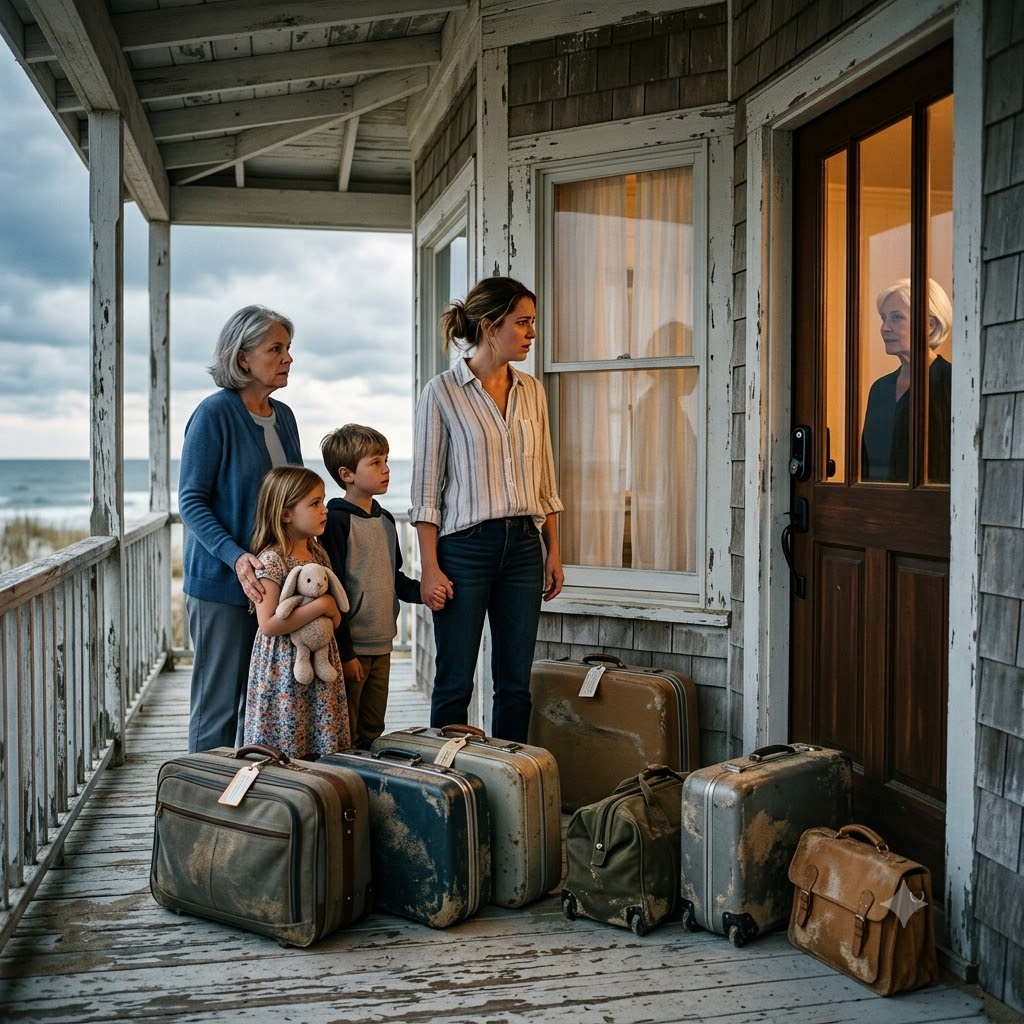
The cottage looked smaller than it used to, weathered silver-gray by decades of nor’easters and salt spray.
The hydrangeas along the side porch were dry and brown from the winter chill, waiting for the spring rain to coax them back to blue.
When I unlocked the front door, the familiar scent hit me instantly—old cedar, damp sand, and the faint, ghostly trace of the pipe tobacco David used to smoke out on the steps on quiet Sunday mornings.
I carried my canvas bag up the narrow stairs, my knees clicking softly with every step, and set it on the foot of the twin beds in the back room where Lily and Ethan used to sleep when they were small.