“That is not what I said.”
“You thought I would help declare my mother incompetent.”
“I thought once we were married, you might finally start behaving rationally about that property.”
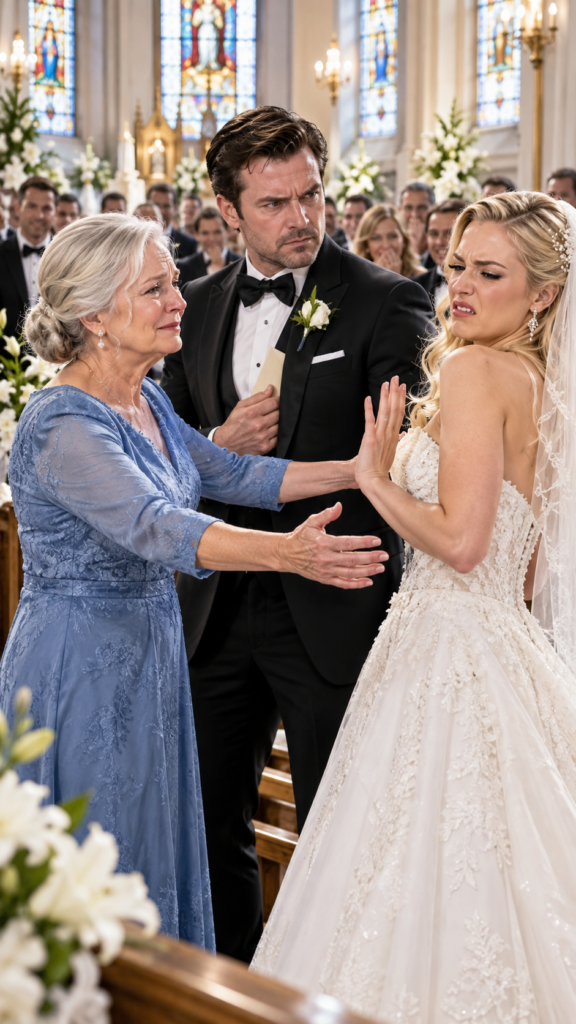
The cruelty at the church had hurt.
This was different.
This did not hurt in the same immediate way.
It reorganized the last year of my life.
Questions I had dismissed.
Why is the farm still only in Margaret’s name?
Has she made a will?
Does she have long-term care insurance?
Have you ever thought about putting the land into something easier to manage?
Wouldn’t she prefer a senior community someday?
At the time, I had thought Stephanie was trying to understand my responsibilities.
Now every question had a price tag attached.
I picked up the envelope from my father’s law office.
Stephanie noticed it.
“What’s that?”
I looked at her.
“You recognize it?”
“No.”
Her father did.
The change in his expression was tiny.
But I saw it.
“You know the law firm?”
He said nothing.
The envelope bore the name AVERY & COLE.
The firm had handled the estate after Dad died.
I had contacted them six weeks earlier because Stephanie had repeatedly asked whether Mom had ever added my name to the property title.
I had finally realized I did not know the exact answer.
Dad had died when I was twelve. Mom handled everything afterward.
I knew Willowbrook belonged to her.
I had simply never cared how the paperwork described it.
Stephanie had cared a great deal.
I opened the envelope.
My hands shook slightly.
The first page was a cover letter.
Mr. Hartwell,
At your request, enclosed are certified copies of the deed, estate settlement, and subsequent title confirmations concerning Willowbrook Farm.
I kept reading.
The farm had transferred fully to my mother after my father’s death.
No joint ownership with me.
No automatic authority for me.
No existing power of attorney transferring control to another party.
The most recent title certification, updated that spring, listed one legal owner.
Margaret Hartwell.
I looked at Stephanie.
“You knew.”
She folded her arms.
“Knew what?”
“That I couldn’t sell the farm.”
“We never asked you to sell it.”
“You planned to make my mother legally incompetent.”
“That isn’t the same thing.”
“It’s exactly why you needed the guardianship.”
Her father finally lost patience.
“Enough.”
He walked toward me.
“You are taking a set of preliminary documents and constructing the ugliest possible interpretation because you are angry about yesterday.”
“Yesterday?”
“Yes. Stephanie behaved badly. She was under pressure. She said something offensive. That does not transform every conversation into a conspiracy.”
I held up the forged signature.
“What does this transform into?”
His jaw tightened.
“A document that was never filed.”
“Why was it created?”
“For internal review.”
“Whose internal review?”
He did not answer.
I pointed to the architectural plans.
“Who commissioned these?”
Silence.
I looked at the title block.
A development company name sat in small print.
Harrow Ridge Development.
I had heard the name before.
At dinners.
On calls.
Stephanie’s father had invested in several Harrow Ridge projects.
The exact ownership arrangement did not matter to me.
His involvement did.
“You were planning houses on my mother’s farm.”
He corrected me immediately.
“We were evaluating feasibility.”
“Without the owner.”
He gave me a tired look.
“Charles, mature families discuss assets.”
“Not by forging signatures.”
Stephanie slammed her hand onto the desk.
“Oh, stop repeating that like we dragged your mother into a basement and forced her to sign something.”
Emma whispered, “Stephanie.”
“No. I’m done.”
Stephanie faced me.
“I spent three years listening to you worship that farm like it’s some sacred kingdom. Do you know what that land is worth? Do you know what we could have built there?”
“We?”
“Yes, we.”
“There is no we.”
Her face tightened.
“You’re still angry.”
“I ended the wedding.”
“You had a tantrum.”
“I gave you the ring back.”
“You embarrassed me in front of everyone who matters.”
I stared at her.
There it was again.
Everyone who matters.
Not everyone.
The right people.
I thought of my mother apologizing on the church steps.
“You told my mother she smelled like manure.”
“She did.”
Emma covered her mouth.
Even her father closed his eyes briefly.
Stephanie realized she had done it again.
But instead of retreating, she straightened.
“I am not going to pretend I want to spend the next thirty years arranging my life around a failing farm and a woman who refuses to accept that she is aging.”
I nodded.
“Thank you.”
“For what?”
“For finally saying it without pretending.”
I began gathering documents.
Her father moved forward.
“You are not taking those.”
“I already photographed them.”
Stephanie grabbed for Emma’s phone.
Emma pulled back.
“Don’t touch me.”
The words surprised everyone.
Especially Emma.
Stephanie stared at her younger sister.
“You have no idea what you just did.”
Emma’s chin trembled.
“I know exactly what I did.”
I turned to leave.
Stephanie caught my sleeve.
“Charles.”
I looked at her hand.
She released me.
Her voice softened.
“We can fix this.”
“Fix what?”
“The wedding. Everything.”
I almost admired the certainty.
Twenty-four hours earlier, I had been standing beside her beneath white lilies believing I knew what my future looked like.
Now she was asking me to step back into that future after I had seen the machinery underneath it.
“No.”
“Don’t be stupid.”
“I’m not marrying you.”
Her father said, “Think carefully before making permanent decisions while emotional.”
I looked at him.
“My mother has spent her whole life telling me not to make people uncomfortable.”
He frowned.
“I’m done following that advice.”
I walked toward the door.
Emma followed.
Stephanie called after us.
“Charles, if you leave with those documents, you will regret it.”
I stopped.
Not because the threat frightened me.
Because of how naturally she had said it.
I turned.
“Is that a threat?”
Her father immediately said, “No.”
Stephanie held my gaze.
“I’m telling you this can become very ugly.”