I ducked behind the bus station to set down a tray of dirty glasses. Tony was standing there, staring fixedly at the floorboards, his knuckles white against the stainless steel counter.
“Tony,” I whispered, keeping my voice low beneath the soft jazz filtering through the speakers. “Who is she? What happened to her?”
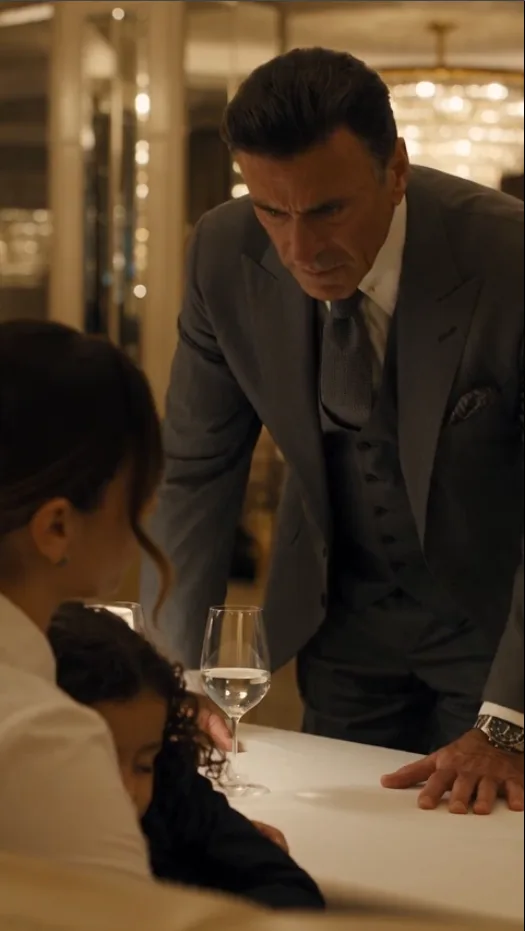
Tony’s eyes darted toward table forty-four, his skin gray beneath the dim amber lights. “You keep your mouth shut and your eyes down, Elena,” he muttered through clenched teeth. “That’s Sophia. His only kid.”
“Why looks like she’s in shock,” I pressed gently.
Tony exhaled a jagged breath, leaning in an inch closer. “Her mother, Giselle. Three days ago, she packed every piece of jewelry in the penthouse, cleaned out three safe deposit boxes, and disappeared into thin air. Didn’t say goodbye. Didn’t leave a note for the kid. Sophia was in the playroom waiting for her to read a bedtime story, and the woman just… vanished. The girl hasn’t spoken a single word since. Won’t take a sip of broth. Won’t sleep. The rumors say she just screams until her vocal cords bleed, and then sits staring at walls.”
A cold ache settled in the pit of my stomach. I looked back through the green leaves of the ficus divider.
To be five years old, in a vast, cold world of glass and stone, and have the person who was supposed to be your sun simply turn out the lights and walk away. I knew that kind of absence. I had grown up in an orphanage on the edge of Philadelphia, clutching an empty blanket and waiting by the iron gates every Sunday afternoon for a mother who had surrendered me to the state and never looked back. The silence that Sophia Russo carried in her eyes wasn’t sullenness. It was the desperate, terrifying conviction that she was unlovable, that the universe was a void that swallowed everything whole.
A minute later, Dante’s phone vibrated violently against the dark wood of the table.
He glanced at the screen, his jaw hardening into iron. He looked at his daughter, murmured something against her forehead, and rose from the booth. He strode toward the mahogany foyer near the coat check to take the call, his voice dropping into a harsh, commanding baritone as he stepped out of sight.
I was two booths away, balancing a small bus tub on my hip as I wiped down table forty-two with a warm, damp cloth.
Then, I felt a feather-light tug against the hem of my black apron.
I stopped.
I looked down.
Sophia was standing in the aisle. She had slipped down from the booth without making a sound. Her patent leather shoes were dusty, her velvet coat hanging open. She was staring straight up at me with enormous, amber-brown eyes that were so full of unshed tears they looked like liquid glass.
My breath caught in my throat. Rule number one of high-end service: never interact inappropriately with the clientele. Rule number one of Manhattan: never, under any circumstances, touch a Russo.
Every self-preservation instinct screamed at me to step back, to call for Tony, to point her toward the foyer where her father was speaking.
Instead, my knees bent on their own. I lowered myself down to the hardwood floor until my eyes were level with hers. The sharp smell of the restaurant’s floor cleaner mixed with the faint, sweet scent of baby powder and unshed grief coming off her small frame.
“Hey there, sweetheart,” I murmured, keeping my tone as warm, steady, and low as the pilot light on my grandmother’s old oven. “Are you looking for your dad?”
She didn’t speak. Her throat bobbed as she tried to swallow, but her mouth remained tightly shut.
Then, her bottom lip began to tremble violently. A single, heavy tear spilled over her dark eyelashes, carving a clear, pale path through the dust on her cheek.
Without a word, she raised both of her small, fragile arms straight toward my neck.
The world seemed to stop spinning. The music, the clinking silverware, the murmurs of the diners—everything receded into dead silence. She wasn’t asking for food. She wasn’t looking for her billionaire father. She was a drowning soul, five years old, reaching for the nearest piece of driftwood in an endless ocean of abandonment.
“Oh, baby,” I whispered, the word slipping past my lips before I could censor it. “I’ve got you. Come here.”
I slid my hands gently under her arms and lifted her up against my chest.
The moment her feet left the floor, Sophia collapsed into me. It wasn’t a gentle hug; it was a desperate, violent clinging. Her tiny fingers buried themselves deep into the worn cotton of my white shirt, bunching the fabric until her knuckles turned ivory. Her face burrowed beneath my chin, right into the hollow of my throat, and her entire little body began to shudder with deep, silent, racking sobs.
She was so light. Too light for a healthy child. I could feel every rib through her coat.
“Shh,” I whispered, walking slowly toward an empty, dimly lit booth in the back corner of the room, far from the center traffic. I sat down on the leather cushion and pulled her closer, wrapping both arms securely around her trembling back. “You’re okay. You’re safe. I’ve got you, little one.”
I began to rock her. It was an instinct older than memory, drawn from the quiet kitchen mornings of my childhood when my grandmother would hold me while the bread dough proved under clean linen towels. I began to hum—a slow, rhythmic, wordless melody that tasted of brown sugar, warm vanilla, and rain falling against window panes.
Breathe, I willed through the rhythm of my chest. Just breathe.