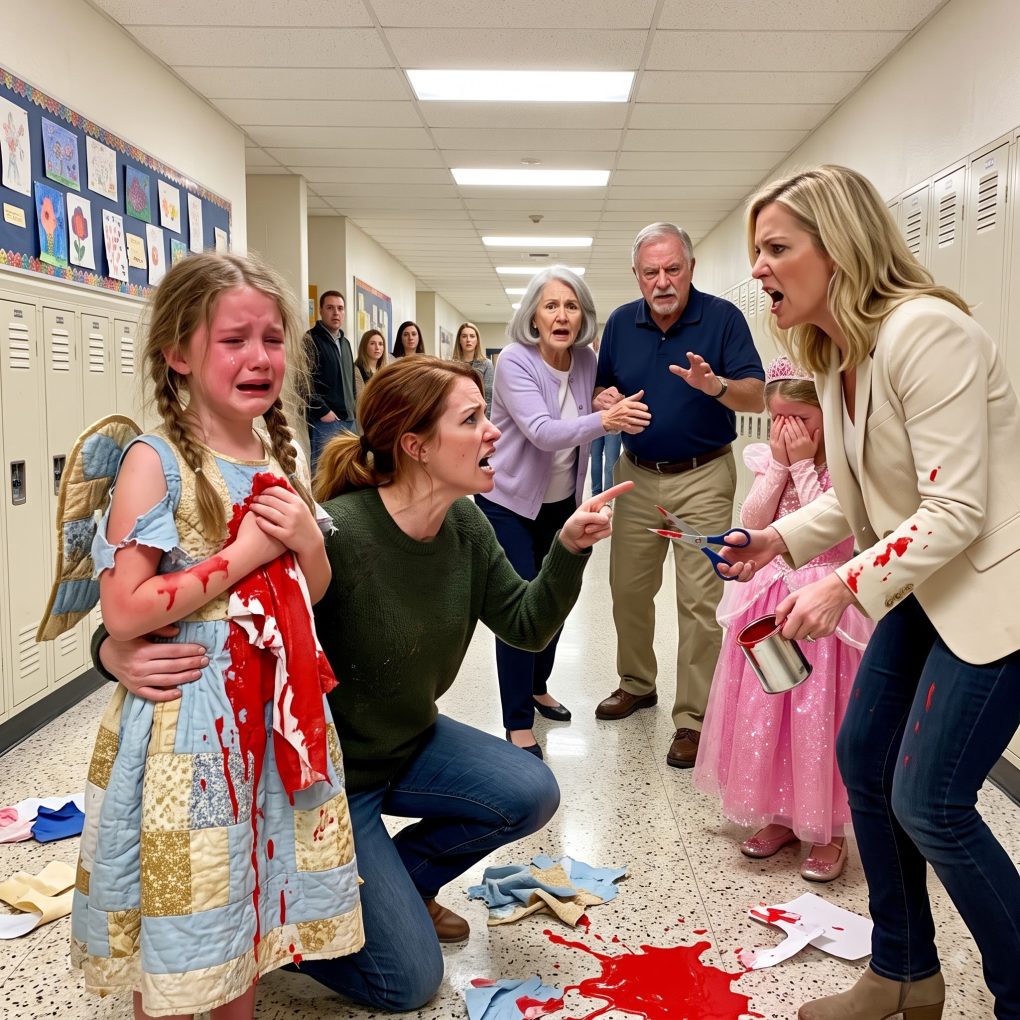
The red paint was still dripping off the hem of my daughter’s costume when she started to shake.
“Mom?” Lily whispered. She was nine years old, standing in the hallway of Jefferson Elementary in Naperville, Illinois, holding a ruined sleeve like it was a dead bird. “The contest starts in thirty minutes.”
My sister Brooke stood over her with an empty paint can in one hand and a pair of scissors in the other. Torn fabric lay at her feet. She was smirking.
“Now my girl will win for sure,” she said.
I stared at her. “You did this on purpose.”
“Oh, relax, Emily. It’s a school costume contest, not the Oscars.” Brooke tossed the can into a trash bin. Behind her, her daughter Madison, also nine, stood frozen in a glittering princess gown, eyes on the floor.
My mother, Patricia, hurried over, not to Lily, but to Brooke. “Honey, don’t upset yourself. Accidents happen.”
“It wasn’t an accident, Mom. She cut it.”
“Don’t make a scene,” my father, Frank, muttered, checking his watch. “Everyone’s watching. Just let Lily sit this one out. There’s always next year.”
Next year. Lily had spent three months on that costume. She’d stayed up past bedtime stitching sleeves. I could still see the glue on her small fingers.
Lily’s lip trembled, but she didn’t cry. She just looked up at me. “Mommy, it’s okay. I don’t need to win.”
Something in my chest went very still.
I didn’t shout. I didn’t argue. I knelt, took Lily’s face in my hands, and said, “Baby, go wash your hands and wait for me by the stage door. I’ll be right there.”
When she left, I turned to my family. My mother was already patting Brooke’s arm. My father looked relieved the problem was gone.
I pulled out my phone and tapped one number I had not called in two years.
“Hello, this is Emily Carter,” I said, calm as glass. “I need you at Jefferson Elementary in twenty minutes. Bring everything.”
Brooke’s smirk wobbled. “Who was that?”
I looked at her and smiled for the first time all morning.
“Someone who’s very interested in that costume.”
Teaser:
Brooke thought she’d destroyed an ordinary homemade costume. She had no idea whose work she’d really put her scissors through, or who was about to walk through those school doors. In half an hour, my parents would stop defending her. And the hallway outside that stage would go dead silent. Want to know who I called?
Brooke laughed, but it came out thin. “Who did you call, Emily? Your little boutique friend?”
“Something like that.”
I left them in the hallway and found Lily by the stage door, drying her hands on her jeans. Her eyes were red. I crouched beside her, and she whispered, “Is Aunt Brooke mad at me?”
“No, sweetheart. She’s mad at me. It’s a long story.”
Twenty minutes later, the double doors at the end of the hall swung open.
A tall woman in a charcoal coat strode in, silver bob, leather portfolio under her arm, followed by a younger man carrying a garment bag and a camera case. The hallway chatter died. Parents turned. Even the principal, Mr. Hendricks, stopped mid-sentence.
“Emily!” the woman called, opening her arms. “Where’s my favorite designer’s kid?”
My mother’s mouth fell open. “Who is that?”
“Margaret Voss,” I said evenly. “Artistic director at the Chicago Costume Guild. She’s also the woman who chose Lily’s design for the Young Creators Showcase last spring.”
Brooke’s face went pale. “What showcase?”
“The one I never mentioned,” I said. “Because every time I tell you about something good, you find a way to take it.”
Margaret crouched to Lily’s height. “Sweetheart, I’ve been looking forward to seeing this in person. Where is it?”
Lily’s eyes filled. She pointed down the hall, to the red-soaked heap lying in a trash bin.
Margaret’s smile vanished. She stood very slowly. “Who did that?”
No one spoke. Then the young man, Daniel, lifted his camera. “Ma’am, the hallway has security footage. And I’ve been filming Lily’s entry since she arrived for the guild’s feature.”
My father went gray. My mother grabbed Brooke’s arm.
Margaret turned to me. “Emily, you told me Lily’s costume was stitched from the old Carter family quilt. The one your grandmother made.”
“It was.”
The color drained out of my mother’s face.
“Mom,” I said quietly, “you told me that quilt was lost in the move. Remember? You said it got thrown out by mistake.”
“I… I thought…”
“Brooke kept it in her attic for eleven years,” I said. “Lily found it there last summer, and Brooke let her take it. She said it was worthless.”
Margaret opened her portfolio. Inside was a sheet of stamped paper. “This is an appraisal. That quilt, handmade in 1962 by Eleanor Carter, a Chicago textile artist, is catalogued in the Guild’s archive. Insured value: forty-two thousand dollars.”
Brooke dropped the scissors.
Everyone stared at her. Then Mr. Hendricks stepped forward, his voice low and cold. “Mrs. Dalton. Please come with me to my office. We have a lot to discuss.”
Brooke followed Mr. Hendricks to his office like someone walking to a firing squad. My parents trailed behind, my mother whispering, “This is a misunderstanding, Brooke, tell them it was a misunderstanding.”
I stayed in the hallway with Lily, who had gone very quiet in my arms.
“Mommy,” she said. “Was Great-Great-Grandma Eleanor’s quilt really that important?”
“To me it was the most important thing in the world,” I said. “But not because of the money. Because she made it with her hands, and you finished it with yours.”
Margaret rested a gentle hand on Lily’s shoulder. “Sweetheart, I need to tell you something. When the Guild reviewed your design last spring, we hadn’t known about the quilt. We only knew a nine-year-old girl had reworked fabric into something extraordinary. Nobody knew what it was made from until Emily told me last week.”
