“Last week?” I asked. “I told you in confidence.”
“You did. And I asked Daniel to document everything, in case anyone ever asked.” Margaret’s eyes hardened. “Frankly, in case something like this happened.”
I stared at her. “You thought someone would ruin it?”
“Emily, I’ve watched families do worse over less.” She squeezed my hand. “I kept every piece of paperwork. The appraisal, the provenance, the ownership transfer. Your grandmother’s will left that quilt to you, not to Brooke.”
The words landed like a stone dropped in still water.
“Mom and Dad told me it was lost,” I said slowly.
“They said it in the will reading, according to the archive notes,” Margaret said. “Your parents claimed it had been ‘misplaced.’ The Guild flagged it years ago as a missing piece. I never expected it to turn up at an elementary school costume contest.”
That was the secret none of us had known. Brooke hadn’t just found a worthless old quilt in her attic. She’d been hiding it. For eleven years. The woman who’d told me my grandmother’s last gift was gone forever had quietly kept it in a cedar chest under a stack of Christmas decorations.
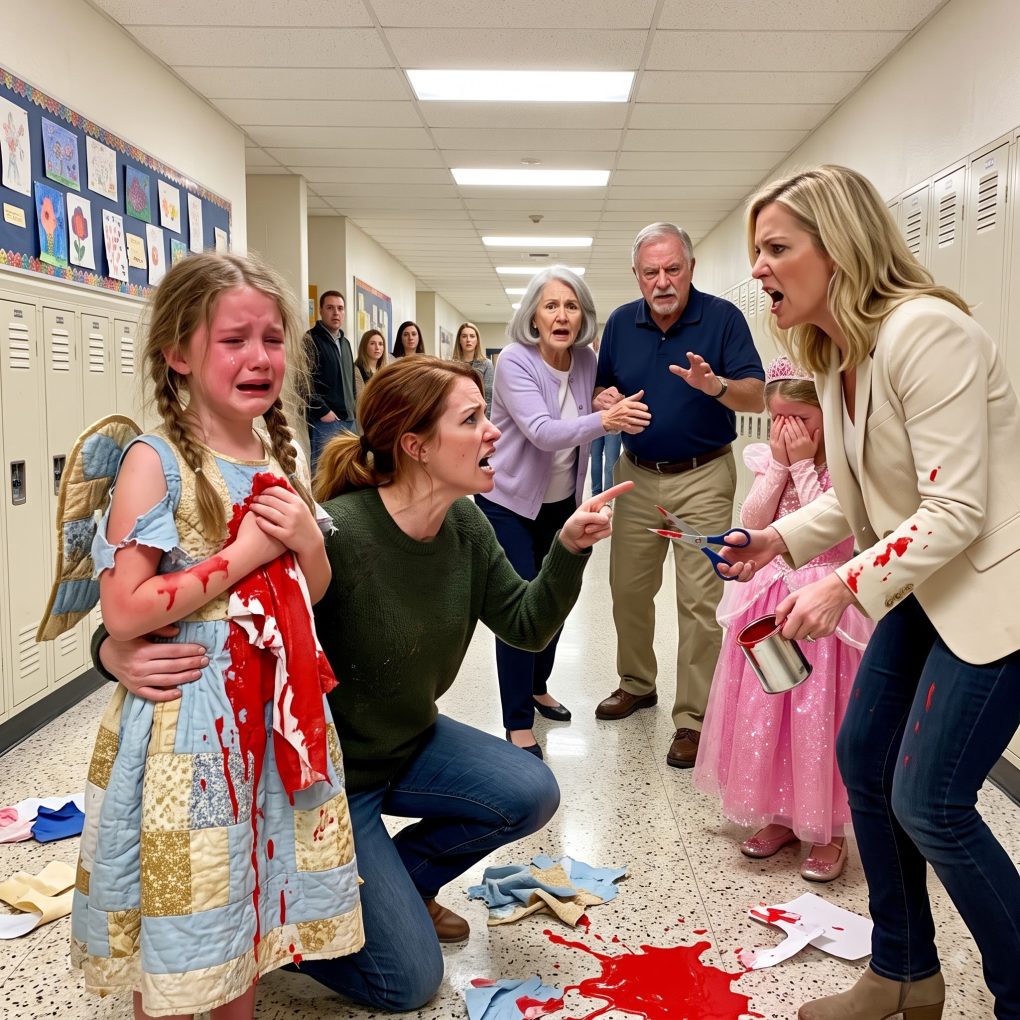
Mr. Hendricks’s office door opened. Brooke stumbled out, blotchy and shaking, my parents behind her. The principal’s voice carried down the hall. “I’ve reviewed the security footage. Ms. Dalton, you’re banned from this campus pending the district’s review. I’m also required to report property destruction. Whether the owner presses charges is Mrs. Carter’s decision.”
All eyes turned to me.
Brooke rushed toward me. “Emily, please. I was stressed. Madison’s been working so hard, and I just wanted her to have one thing. I didn’t know it was worth anything!”
“You didn’t know it was worth anything,” I repeated. “You thought it was worth nothing. So it was fine to pour paint on my nine-year-old’s work.”
“I’ll pay for it! I’ll pay whatever you want!”
“You’ll pay for the appraisal,” Margaret said crisply. “And the restoration costs. And the legal fees.”
My mother stepped in, her voice breaking. “Emily, honey, please. She’s your sister. We can fix this inside the family. No lawyers.”
I looked at her. At the woman who’d handed Lily a lie about a family heirloom and then stood in a school hallway telling my crying daughter there’s always next year.
“Mom,” I said, “when Lily was standing there, holding that torn sleeve, you walked right past her to comfort Brooke. Do you understand that I saw that?”
She opened her mouth. Nothing came out.
“I’m not doing this to hurt you,” I said quietly. “I’m doing it because my daughter is watching how I respond. And I want her to learn that nobody gets to destroy her work and walk away smiling.”
Margaret turned to Mr. Hendricks. “Principal, the showcase panel is already seated. Would it be possible for Lily to present what’s left of her work, as is?”
Mr. Hendricks hesitated, then nodded. “The contest has been pushed back fifteen minutes. If Lily wants to go on, she can.”
Lily looked up at me, eyes enormous. “Even like this?”
I knelt and tucked her hair behind her ear. “That’s up to you, baby.”
She thought for a long moment. Then she lifted her chin, small and fierce, just like my grandmother in the one photograph I have left.
“Yes,” she said. “I want them to see it.”
Daniel retrieved the costume from the trash bin and shook the worst of the paint away. The red had soaked through the stitched panels, bleeding into the pale blue and gold of the quilt squares, but the shape was still there. The tiny embroidered stars my grandmother had sewn along the collar. The patchwork sleeves Lily had reworked into wings.
Lily slipped it over her shoulders. In the hallway light, with its torn sleeve and its streaks of red, it looked like something had survived.
She walked onto that stage alone.
I stood in the wings. The auditorium had gone quiet. Lily stopped at center stage, turned slowly so the judges could see the paint, the tears, the stitching, and said in a clear, wobbly voice:
“This costume is called Still Here. It’s made from my great-great-grandmother’s quilt. Someone tried to ruin it today. But the stars are still on it. So I think it still counts.”
No one clapped at first. Then a mother in the third row stood up, and then a teacher, then a whole row of parents, until the entire auditorium was on its feet.
The judges gave Lily the top prize unanimously, and Margaret invited her to present at the Guild’s spring gala in Chicago, with her name on the program and a conservator on call to restore the quilt.
My parents sat in the back row for the whole thing. When it ended, my father approached me alone, hat in his hands, looking ten years older.
“Emily. We were wrong,” he said. “About the quilt. About today. About a lot of things.”
“I know, Dad.”
“Is there any way…” His voice broke. “Any way we fix this?”
“Maybe,” I said. “But not today. And not by hiding behind Brooke.”
Brooke ended up paying the restoration costs, along with a settlement that covered Lily’s college fund. She apologized to Lily in writing, and I let Lily decide whether to read it. She read it twice, then folded it and put it in her jewelry box. “I’ll answer when I’m older,” she said.
Madison, the quiet princess in the glittering gown, found Lily by the stage door that afternoon. “I’m sorry about my mom,” she whispered. “I didn’t want to win like that.”
Lily hugged her. “It’s not your fault.”
That evening, Lily fell asleep on the couch in her ruined, stunning costume, one hand still clutching the embroidered star on her collar. I covered her with the restored corner of Grandma Eleanor’s quilt, the one square that had survived untouched.
