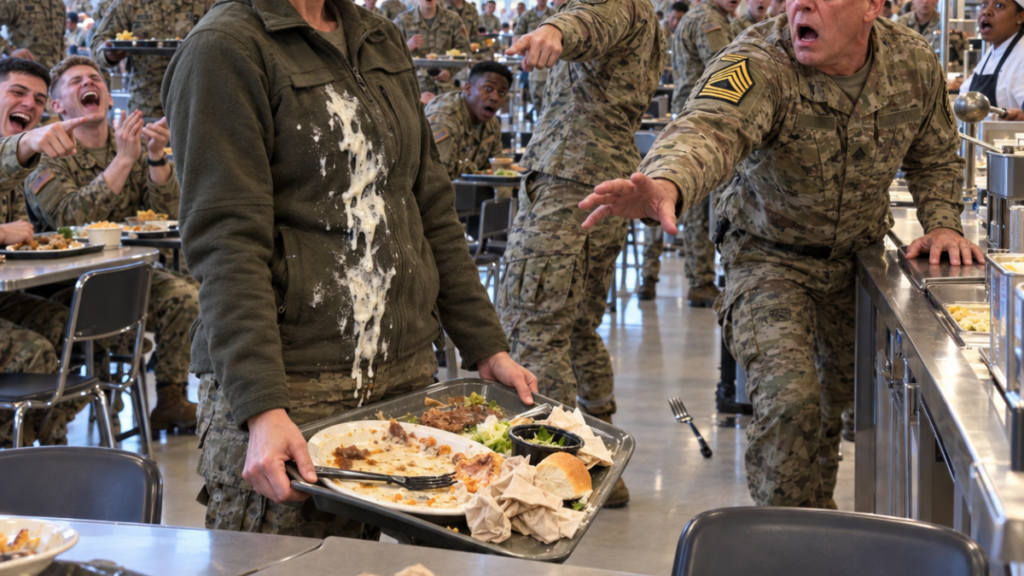
“Hurry It Up. I Got Formation At Thirteen Hundred.” The Specialist Dropped His Tray On My Table And Walked Off, Ranch On My Jacket. His Friends Clapped. I Picked Up The Tray. Didn’t Argue. His Sergeant Major Was Two Places Back In Line. He Saw Me Holding It. The Color Left His Face. The Specialist Yelled Back, “And Wipe The Table!” “Ma’am. Please. Let Me Take That.”
For twelve years, I had worked very hard to become a woman nobody recognized. Then a young Army specialist dropped his half-eaten lunch on my table, told me to clean it up, and walked away laughing with his friends. I would have thrown the tray out and gone home if his command sergeant major had not seen my damaged hand. Two days after that food-court humiliation turned my hidden past into public news, an old soldier called and asked me one question: “Mara, do you remember the route warning Victor Boone signed the night before Daniel and Megan died?”
Part 1
The tray landed on my table at 12:54 on a Thursday afternoon, hard enough to splash ranch dressing across the left sleeve of my gray jacket. Half a cheeseburger slid against a crushed paper cup, cold fries scattered beside my teriyaki bowl, and a plastic fork bounced once before settling near my elbow. I stared at the white streak on my sleeve, then looked up at the young soldier who had put it there.
He was maybe twenty-two, a specialist with a military police patch on his shoulder and the impatient confidence of someone who had spent just enough time in uniform to think he understood how the whole world ranked itself. Two soldiers stood behind him, one young man with a red sunburn creeping above his collar and a female specialist holding a phone loosely at her side. “Hurry it up,” the first specialist said. “I’ve got formation at thirteen hundred.”
He turned before I answered. The young man behind him clapped three slow times, and the woman laughed into her shoulder as if she were trying to hide it while making sure I heard. A few people at nearby tables looked over, took in my jeans, plain jacket, tied-back hair, and the fact that I was sitting beside a cleaning cart near the trash station, then went back to their food.
I understood the mistake because it was the kind of mistake people make every day. The table nobody wanted was where the food-court custodians took their breaks, and the woman who usually used it had left an iced tea and paperback novel on the cleaning cart beside me. I was fifty feet from a dozen obvious seats occupied by soldiers, retirees, spouses, and contractors, but I had chosen the hidden table because hidden had been my preferred condition for most of my adult life.
I set down my fork and stood. My right hand lifted his tray, while my left came out of my jacket pocket to steady the far edge. That hand had never closed properly after four surgeries; my thumb and first two fingers worked, while the others remained permanently curled, and a pale branching scar crossed the back of it like a river on an old road map.
That was when I noticed the man standing in the burger line. He was broad-shouldered, gray at the temples, wearing command sergeant major rank, and he had stopped with an unopened sandwich in one hand and a coffee in the other. His eyes moved from my hand to my face, back to my hand, and then to my face again.
I knew that look.
I had spent twelve years avoiding it.
His name tape read HALE. Command Sergeant Major Marcus Hale placed his coffee on the counter without paying for it, ignored the cashier calling after him, and stepped out of line. He crossed the food court without hurrying, but people moved aside anyway, the instinctive way soldiers make room for a senior enlisted leader whose attention has fixed itself on something important.
He stopped one step from me and put one hand beneath the tray. “Ma’am,” he said quietly. “Please let me take that.”
“I’ve got it.”
“Ma’am.”
“I said I’ve got it.”
His eyes were already wet. That bothered me more than anger would have. Anger I could handle, because anger demands something from you; grief simply stands there and recognizes you.
Near the glass doors, the specialist who had dumped the tray on me turned around. “And wipe the table!” he called, grinning toward his friends. The sunburned private laughed again, and someone by the pizza counter joined in because people sometimes laugh before they understand what they are laughing at.
Hale did not turn. “Specialist Reddick.”
The grin disappeared.
The young man came back across the food court fast enough that his friends had to hurry to keep up. He stopped beside us and snapped to parade rest, but his eyes moved between my stained sleeve, Hale’s hand beneath the tray, and my damaged left hand.
“Sergeant Major.”
“Stand there.”
“Yes, Sergeant Major.”
Reddick looked at me. His mouth tightened with the confusion of a man who knows he has done something wrong but is still trying to determine which rule he broke. “I thought she worked here,” he said.
Hale finally looked at him. “That explanation does not improve what you did.”
The female specialist now had her phone raised. People were beginning to notice, not because of me but because a command sergeant major was standing beside the trash station holding a stranger’s garbage tray with one hand. The usual lunch noise softened by degrees as curiosity passed from table to table.
“Sergeant Major,” I said, lowering my voice. “Let it go.”
Hale looked back at me.
“I’m asking you.”
His jaw moved before he answered. “Ma’am, if I let this go, he learns he shouldn’t dump trash on important people.”
“That’s not what I said.”
