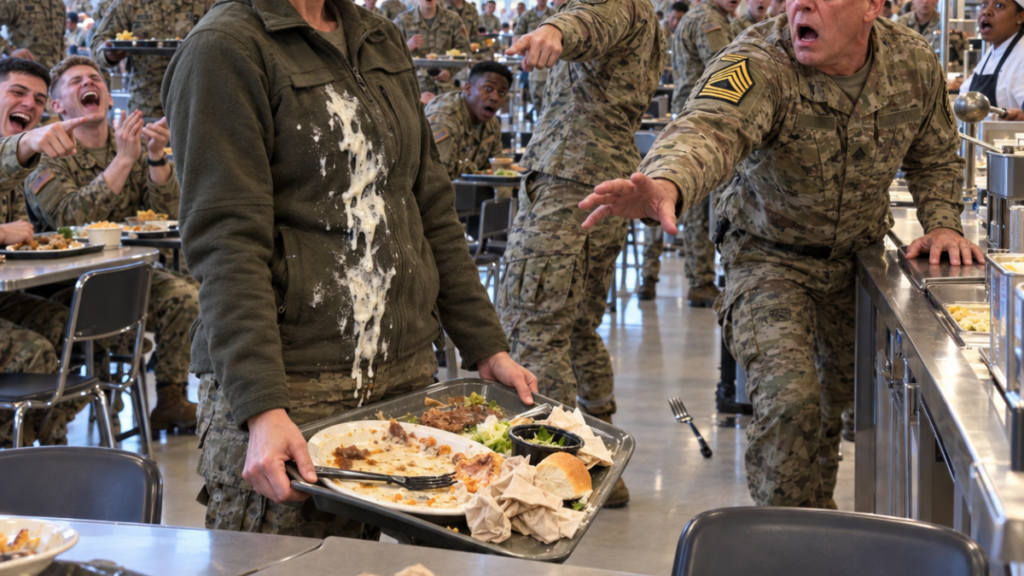
“I know.” He swallowed. “And that’s exactly why I can’t.”
I almost walked away then. My truck was in the far corner of the parking lot, my application had already been delivered to the Directorate of Emergency Services, and I could have been at the main gate in four minutes. I had spent the entire morning avoiding the east side of the installation, my former battalion, the old headquarters building, and every place where someone might recognize the face I had worked so hard to erase.
Then Hale said, “I walk past you every morning.”
My stomach tightened.
“Third frame on the left,” he continued. “Main hallway. Your portrait, then the plaque beside it with two names.”
I looked down at the tray.
“Daniel Ruiz,” Hale said softly. “Megan Cole.”
Hearing the names aloud after so many years felt like a door opening in a house I had boarded shut.
Hale glanced at his watch. “It’s twelve fifty-eight.”
Reddick shifted impatiently. “Sergeant Major, permission to go? I’m already late for formation.”
Hale looked at him for a long moment. “Do you know what formation you’re late for, Specialist?”
Reddick’s face changed.
Not guilt yet. Something closer to uncertainty.
“The memorial formation,” he said.
“For whom?”
Reddick looked toward the floor, then back at Hale. “Specialist Daniel Ruiz and Private First Class Megan Cole.”
He knew the names.
That hurt in a way I had not expected.
He had learned them, probably during his first week in the battalion, and then walked beneath their plaque every morning until they became part of the building, like paint and fluorescent lights. He had never considered that the living person in the photograph beside them might someday be sitting ten feet from a trash can eating chicken over rice.
Hale turned back to me. “Every year, we read their names.”
I did not answer.
“And your citation.”
“Don’t.”
“Ma’am—”
“No speeches. No announcement. No spectacle.”
His shoulders loosened slightly because he understood I was not refusing everything.
I lowered Reddick’s tray to the table, set it square with the edge, and wiped the worst of the ranch dressing from my sleeve. Then I stepped away from the chair and pulled my left hand completely out of my pocket.
Hale stepped back.
His heels came together.
“Sergeant Major,” I warned.
He raised his right hand.
The food court went quiet in pieces.
I had not returned a salute in twelve years, but my right hand still knew exactly where to go. Hale held his salute long enough for Reddick to look at my face, then my hand, then the frozen room around us.
His eyes widened.
“You’re…” he whispered.
I waited.
His gaze seemed to move through another room entirely, down a polished hallway he had crossed hundreds of times.
“You’re the woman on the wall.”
I lowered my hand when Hale lowered his.
“No,” I said. “I’m Mara Ellis.”
At one nearby table, a sergeant stood. Then an officer across the aisle stood, too. By the fountain, an old retiree struggled to his feet with one hand gripping the edge of his table, folded his newspaper beneath his arm, and gave me a single nod.
I nodded back.
Hale kept his promise. He did not yell at Reddick, threaten his career, or turn humiliation into entertainment. He simply asked, “Specialist, who are you supposed to honor at thirteen hundred?”
Reddick swallowed. “Specialist Daniel Ruiz and Private First Class Megan Cole, Sergeant Major.”
“Then you’re going to read their names today.”
Reddick looked at me.
I said nothing.
Hale turned toward the exit. “Move.”
I should have gone home.
Instead, twenty minutes later, I was standing at the very back of a parade field while four hundred military police soldiers faced forward beneath a brutal Texas sun. Nobody announced me, nobody turned around, and Specialist Evan Reddick walked to a microphone holding one sheet of paper with both hands.
He read Daniel’s name.
Then Megan’s.
His voice broke on hers.
That was the first moment I understood the day was no longer about a tray.
I just did not know yet what it was really about.
Part 2
Fifteen years earlier, on October 1, 2011, I had been twenty-two years old and stupid enough to believe experience was the same thing as control. I was a sergeant leading a military police team in eastern Afghanistan, and our mission that morning was one we had completed so many times the route had started to feel familiar. Familiar roads are dangerous because familiarity teaches your brain to stop asking new questions.
The night before, I had asked questions anyway. Local traffic had been strange near one stretch of road, a shopkeeper who usually waved had closed early, and one of our interpreters had mentioned that men from outside the district had been seen near a drainage culvert. I wrote a short route concern on the operations log and recommended we use an alternate road on the return trip.
My platoon sergeant, Sergeant First Class Victor Boone, read it while drinking coffee from a green plastic mug. Boone was the kind of man who could make a room feel crowded with only one person in it, broad-chested, loud, convinced every problem could be solved by looking less worried than everybody else. He read my note, wrote his initials beside it, and said, “We’ve driven that road thirty times, Ellis.”
“Thirty-one tomorrow.”
“Exactly.”
“That’s not an argument.”
He looked at me over the rim of his mug. “It is when battalion wants that mentor team at the district center by eight.”
I remember the wall clock behind him showing 2140. I remember a moth beating itself against the fluorescent light above his desk. What I do not remember is whether I pushed a second time, because memory gets slippery around the things you wish you had done differently.
At 0715 the next morning, the lead vehicle rolled over a hidden explosive device.
