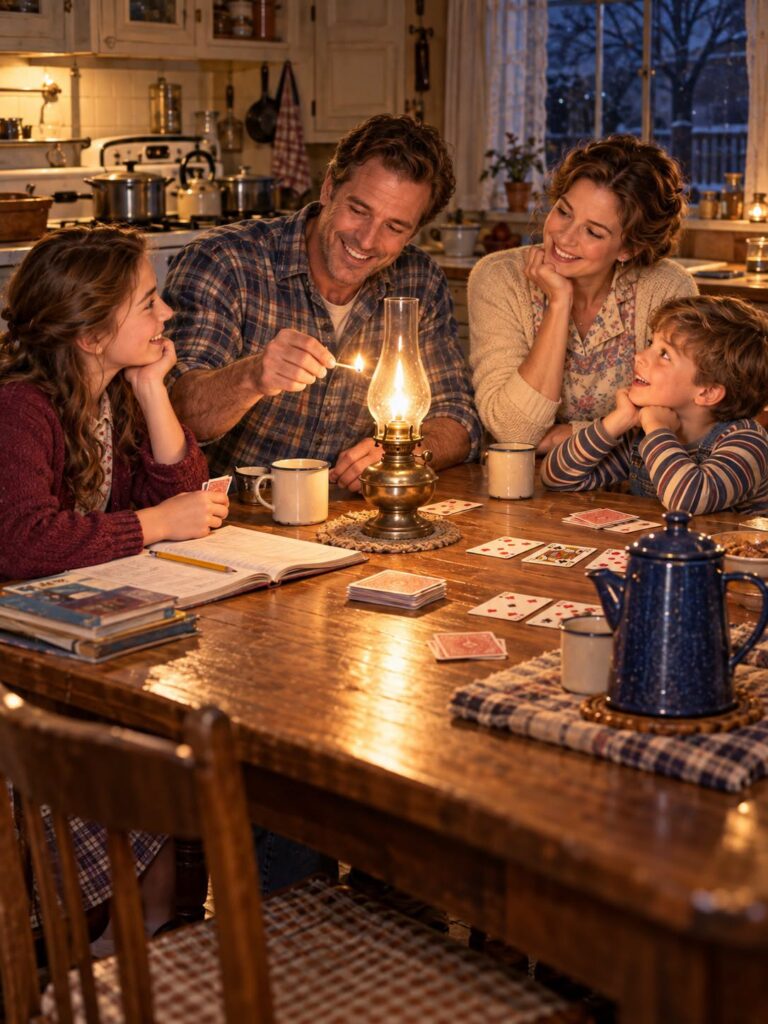
Before the screen glowed in every room, the kitchen table was where the evening happened.
Daniel was eight years old when his family moved into the little white house at the edge of town. It was not the sort of house anyone would call special from the road. It had two bedrooms, a narrow hallway, a front step that tilted slightly to the left, and a kitchen window that looked toward a row of elm trees. In summer, his mother kept that window open while she cooked, letting in the smell of cut grass, dust, and whatever flowers Mrs. Hanley next door had planted near her fence. In winter, she wiped the glass with her apron because it clouded whenever the kettle boiled.
The house had no television.
Daniel had seen one at his cousin’s place, where the family sat in a dark living room watching a man in a shiny suit sing songs into a microphone. The picture had been gray and ghostly, and sometimes the man’s face stretched oddly when the signal weakened, but Daniel had been fascinated. His cousin barely blinked the entire time. Nobody talked much while the television was on. They just watched, faces blue-white in the flickering light.
When Daniel asked if they could get one, his father said, “When we can afford it.”
His mother, who was mending one of Ruth’s socks at the time, said there were more important things first: new tires for the car, coal for the furnace, and shoes for Daniel’s older sister, Ruth, whose toes had begun pressing hard against the ends of her old pair.
Daniel thought this was unfair. Tires did not sing. Coal did not tell jokes. Shoes were useful, he supposed, but they did not fill a living room with music. Still, money in their house had a way of already belonging to something before it arrived, so he stopped asking.
Most evenings began with the same sounds. His father came through the back door after work and placed his lunch pail beside the sink. The metal handle clinked against the counter. His boots scraped once on the mat. His mother asked whether he wanted coffee, though she already knew the answer. Ruth did her homework at the kitchen table, pressing her pencil so hard that the wood beneath her paper became marked with small gray lines. Daniel finished his chores, washed his hands, and waited for the moment when his mother would bring out the cards.
They played rummy, though Daniel never understood why Ruth always seemed to have the best cards. Ruth said it was because she paid attention. Daniel suspected cheating, though he could never prove it. His father would sit with his sleeves rolled up, one large hand wrapped around a coffee cup, the other arranging cards with slow patience. His mother played as if she did not care who won, then quietly won often enough to make that impossible to believe.
Sometimes, after the cards were put away, his father told stories about the town before Daniel was born. He remembered the old bridge before it was rebuilt, when wagons and cars still had to cross one at a time if the river was high. He remembered the winter when the river froze solid and boys dared one another to walk across it while their mothers shouted from the bank. He remembered the time he walked five miles to deliver a message because the telephone line had gone down in an ice storm, and by the time he arrived, the message no longer mattered but the woman at the farmhouse gave him pie anyway.
Daniel had heard those stories many times. So had Ruth. Sometimes she rolled her eyes when their father began one again, but she never left the table. Daniel liked the way his father told them. He never hurried the ending. He let the beginning stretch out, let the middle wander, let people from years ago step back into the room as if they had only been waiting outside the kitchen door.
His mother had stories too, but hers came out differently. She told them while peeling apples or folding towels or measuring flour. They were quieter stories, hidden inside ordinary things. A recipe from her aunt. A hymn her mother used to hum. A teacher who had once told her she had nice handwriting. A neighbor who could grow roses out of soil that looked like old dust. Daniel did not always know when a story had begun until he was already inside it.
One Thursday evening in January, the electricity failed just after supper.
The kitchen went black.
Ruth groaned because her homework was unfinished, and Daniel complained immediately that there was nothing to do. His mother told him not to be dramatic. His father stood, felt his way to a drawer, and took out an old oil lamp Daniel had seen only once before during a storm. He trimmed the wick with a pocketknife, struck a match, and placed the lamp in the center of the table.
The light was small and yellow. It made the walls seem closer and turned the window into a dark mirror. In that reflection, Daniel could see all four of them gathered around the table: Ruth with her pencil still in her hand, his mother with her apron tied at the waist, his father leaning back in his chair, and himself staring at the lamp as if it were something alive.
Outside, the wind pushed against the house. Somewhere down the street, a dog barked. Inside, there was no radio, no television, no hum from the refrigerator, no bright ceiling bulb to flatten the room. Only the lamp, the sound of breathing, and the occasional creak from the old floorboards.
His mother began talking about the first dress she had sewn. She had been sixteen and had used cloth left over from her aunt’s curtains. Ruth looked up from her unfinished homework.
“Curtains?”
