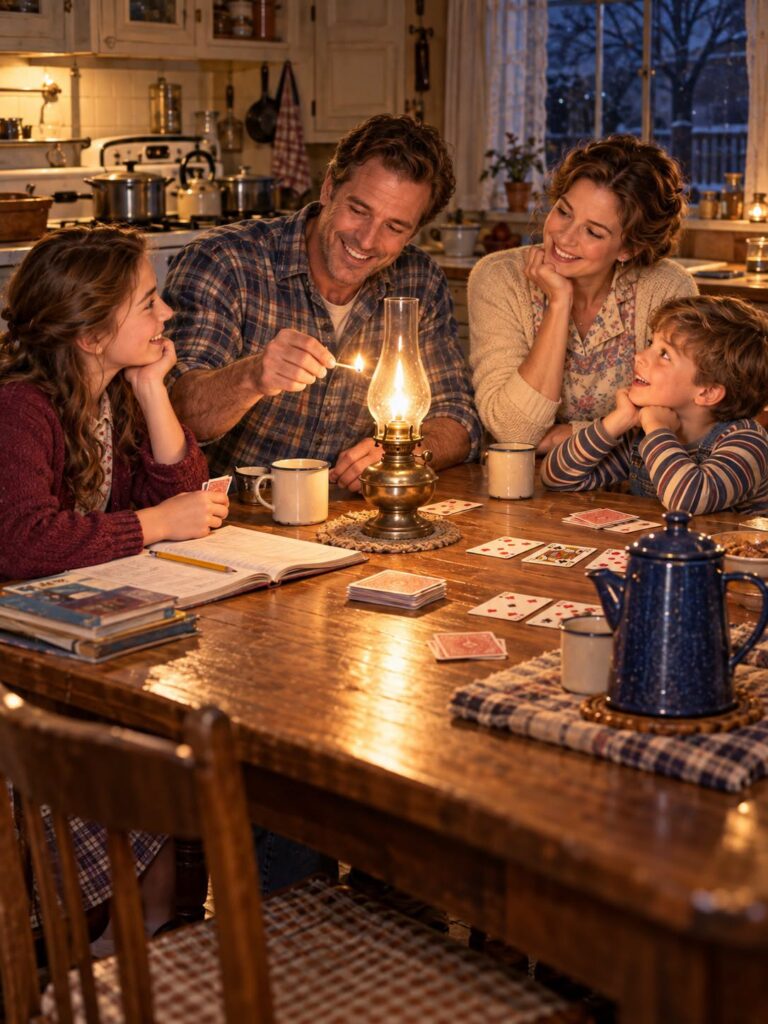
“Yes,” their mother said. “Green curtains with little yellow flowers.”
“Did it look strange?”
Their mother laughed, and the lamp flame trembled as if it had laughed too.
“It looked worse than strange. But I wore it proudly anyway.”
“Where?” Daniel asked.
“To a church picnic.”
His father smiled into his coffee. “She looked like a parlor window.”
His mother threw a folded napkin at him, and Ruth laughed so hard her pencil rolled off the table.
Then his father told Daniel about the day he met Daniel’s mother. It was the first time Daniel had heard the story from beginning to end. His father had been working part-time at a grocery store, carrying a box of oranges through the front door when the bottom gave way. Oranges rolled everywhere, bouncing down the steps and into the street. His mother, who had only come in to buy sugar, set down her basket and helped him chase them.
One orange rolled farther than the rest. Both of them went after it. Neither noticed the car coming until it stopped beside them, the driver leaning out to shout that young people ought to look where they were going.
“I thought she was going to faint,” his father said.
“I was not,” his mother said.
“You went white as flour.”
“I was angry.”
“You were holding an orange like it had insulted you.”
His mother laughed again. “And your father apologized to me even though I had nearly gotten myself run over chasing his fruit.”
“That,” his father said, “was because I was raised correctly.”
Ruth asked, “Did you know then?”
“Know what?” their mother said.
“That you liked him.”
Their mother looked at Daniel’s father across the lamp. Something passed between them that Daniel did not understand at eight years old. It was not a secret, exactly. It was more like a doorway he was too young to enter.
“I knew he was polite,” she said.
His father nodded solemnly. “That’s how all great romances begin. With manners and loose oranges.”
Daniel listened to the adults laugh about it. He watched the lamp flame bend whenever someone moved. Nobody checked the clock. Nobody asked when the electricity would return. Ruth’s homework remained unfinished. The dishes waited in the sink. The dark window held their reflection like a photograph that had not yet been taken.
For the rest of his childhood, Daniel would remember that evening more clearly than birthdays with wrapped presents or trips to the county fair. Nothing important happened by most standards. Nobody won money. Nobody announced news. Nobody traveled farther than the kitchen table. But the darkness had made a small circle of light, and inside it, his family had stayed.
The electricity came back sometime later with a sudden click and hum. The ceiling bulb flashed on, bright and ordinary. The refrigerator woke. The window became glass again instead of a mirror. Ruth complained that she still had spelling words to finish. His mother rose to wash the dishes. His father blew out the lamp, and a thin ribbon of smoke curled above the chimney.
The evening moved on.
Years moved on too.
Eventually, a television did arrive in the house. A small black-and-white set with thin legs and knobs Daniel was not supposed to turn too roughly. They watched programs together at first, all four of them arranged in the living room. Daniel loved it. Ruth pretended she was too old to care but always appeared when her favorite show started. His father criticized the commercials. His mother said people on television entered rooms too quickly and never seemed to close doors.
But even after the television arrived, Daniel sometimes missed the old kitchen evenings, though he would not have admitted it then. The table became a place for quick meals, school papers, grocery lists, and bills. The stories still came, but less often. There was always something on at eight. Something at eight-thirty. Something everyone wanted to see before bed.
By the time Daniel was grown, the little white house had changed. The elm trees were gone, lost one by one to disease and storms. The kitchen window was replaced. The narrow hallway was painted a color his mother called cheerful and Ruth called yellow. His father’s hair thinned. His mother’s hands stiffened. Ruth married and moved two towns over. Daniel built his own life in a house with more rooms, more outlets, more screens, and less silence.
After his parents were gone, Daniel found the lamp in a box in the attic. The metal was dull, and the glass chimney had a thin crack near the top. It had been wrapped in newspaper and tucked beside old Christmas ornaments, a bundle of letters, and a chipped mixing bowl his mother had refused to throw away.
He carried it to his own kitchen and set it on the table.
His children were grown by then. His house was quiet in a different way than his grandmother’s or his mother’s had once been quiet. The silence no longer felt like a pause before someone came through the back door. It felt like something settled.
He did not light the lamp often. When he did, the room seemed to fill with familiar voices: Ruth turning a card and denying she had cheated, his mother laughing about the dress made from curtains, and his father saying, “Now, let me tell you how it really happened.”
The lamp had never been expensive. It had not belonged to anyone famous. It would have meant nothing to a collector. But it had held a family together through one ordinary evening, and sometimes that was more than enough.
Before the screen glowed in every room, the kitchen table was where people lingered. Where stories repeated themselves until they became inheritance. Where children learned that their parents had once been young. Where a cracked lamp could turn a dark window into a mirror and show a family to itself.
