The exclusion
The text from my mother came in at 9:47 on a Tuesday night. I remember the exact time because I had just gotten off a call with a client in Portland, kicked off my boots, and poured myself a glass of wine I’d been looking forward to since noon.
My phone lit up on the counter.
“Honey, about Thanksgiving, Aaron and Priya want to keep it small this year. Her parents are flying in from Mumbai and we want them to feel comfortable. Just the immediia family, you understand?”
Seven sentences, and just like that, I was on the outside again. I stood there reading it twice, then a third time, as if the words might rearrange themselves into something that made more sense.
“You understand?”
That was what she expected me to type back every time. I was the one who understood, the one who adjusted, the one who made space. I was 32 years old and still shrinking myself to fit inside a gap my family barely noticed.
I set the wine down. I didn’t finish it.
Phân cảnh 2: Life in the shadow
I should explain something about my brother Aaron. Not because he’s the villain of this story. He isn’t. Not exactly. But because you can’t understand what Thanksgiving meant to me without understanding what Aaron has always meant to my parents.
Aaron is four years older than me. He’s a corporate attorney in Manhattan. He’s the son my father points to at every gathering, the name my mother mentions within the first 3 minutes of any conversation with anyone.
When Aaron passed the bar, my parents threw a dinner party for 40 people. When I launched my own landscape architecture firm at 28—8 years of school and apprenticeships and for working for other people’s visions finally behind me—my mother called to say, “That’s wonderful, honey,” and then asked if I’d seen Aaron’s new apartment on the Upper West Side.
Growing up in our house in Westchester, I learned early that my achievements came with a footnote. I made honor role every semester of high school. My father nodded, said, “Good,” and went back to reading about Aaron’s lacrosse stats.
I won a full scholarship to Cornell’s architecture program. One of 12 students accepted that year out of several thousand applicants. My mother’s response was, “That’s so far. Aaron went to form. We can drive to see him.”
I remember standing in the kitchen holding that acceptance letter, the official Cornell seal still crisp under my fingers, and thinking I could cure a disease, and they would ask if I’d considered staying closer to home.
I stopped expecting anything. I got quiet about my wins and learned to find my worth somewhere else. In the blueprints spread across my studio floor at midnight. In the satisfaction of watching a neglected property come back to life under my hands.
The holidays were always the hardest. There’s something about Thanksgiving, specifically the whole mythology of it. The table set for everyone. The idea that no one gets left behind.
I sat through years of those dinners where the conversation revolved around Aaron’s cases, Aaron’s clients, Aaron’s latest case that made partner raise his glass. I’d try to mention a project I was proud of and my father would say, “Tell us more, Celeste.”
And then Aaron would say one sentence, and the attention swung away like a compass finding north.
Last year was the clearest. I had just finalized a partnership that brought my firm under the umbrella of one of the largest landscape design groups on the East Coast. A deal that valued my work at nearly $4 million.
I came to Thanksgiving with a bottle of champagne. I tried once, quietly, to mention it. My mother interrupted to announce that Aaron and Priya were engaged. The champagne sat unopened on the counter for the rest of the night.
Nobody asked about the deal again.
Have you ever had that moment where someone treats your whole life like background noise? If you have, leave a comment and tell me where you’re listening from. I want to know I’m not alone in this.
Phân cảnh 3: A secret sanctuary
So, when that text arrived on a Tuesday in October—”just the immediate family”—something in me went very still. Not the shaky, close-to-tears still of when I was younger. Something colder, clearer.
I typed back, “Of course. I hope it’s wonderful.”
And then I sat down and thought about what I actually owned.
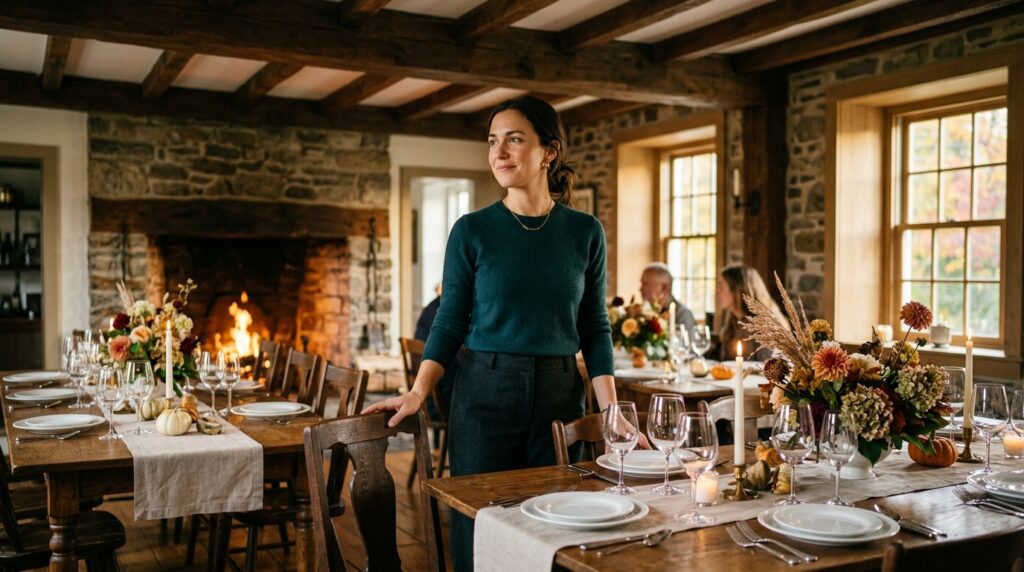
There’s a property in the Hudson Valley I had never told my family about. 28 acres in Colombia County, about 2 hours north of the city. An old stone farmhouse built in the 1880s, thick walls and wide plank oak floors, and a wraparound porch that faces a meadow sloping down to a treeine.
I found it four years earlier, right after I sold my first firm, and I bought it quietly with a contractor I trusted and a vision I’d been sketching in notebooks for years.
The restoration took 18 months. I was there nearly every weekend, learning to distinguish between mortar that needed replacing and stone that just needed cleaning, arguing with the electrician about conduit placement, choosing every window latch and door hinge myself.
My family knew I had a place upstate. That was all they knew.
The farmhouse sits at $2.4 million now between the land and what the restoration cost. But the number was never the point. The point was that it was mine.
Every beam I’d chosen, every garden I’d laid out, every room designed for exactly the kind of gathering I’d never been part of. A long dining table in the main room that seats 20. A kitchen with a six burner range and a walk-in pantry. Three guest rooms upstairs, two more in the converted barn out back, a fireplace wide enough to heat the whole first floor.
I had built myself a table. I just hadn’t invited anyone yet.
I called my cousin Jules the next morning. Jules lives in Albany, works in hospital administration, and—
Phân cảnh 4: Planning an alternative
